

Maya Civilization
Images
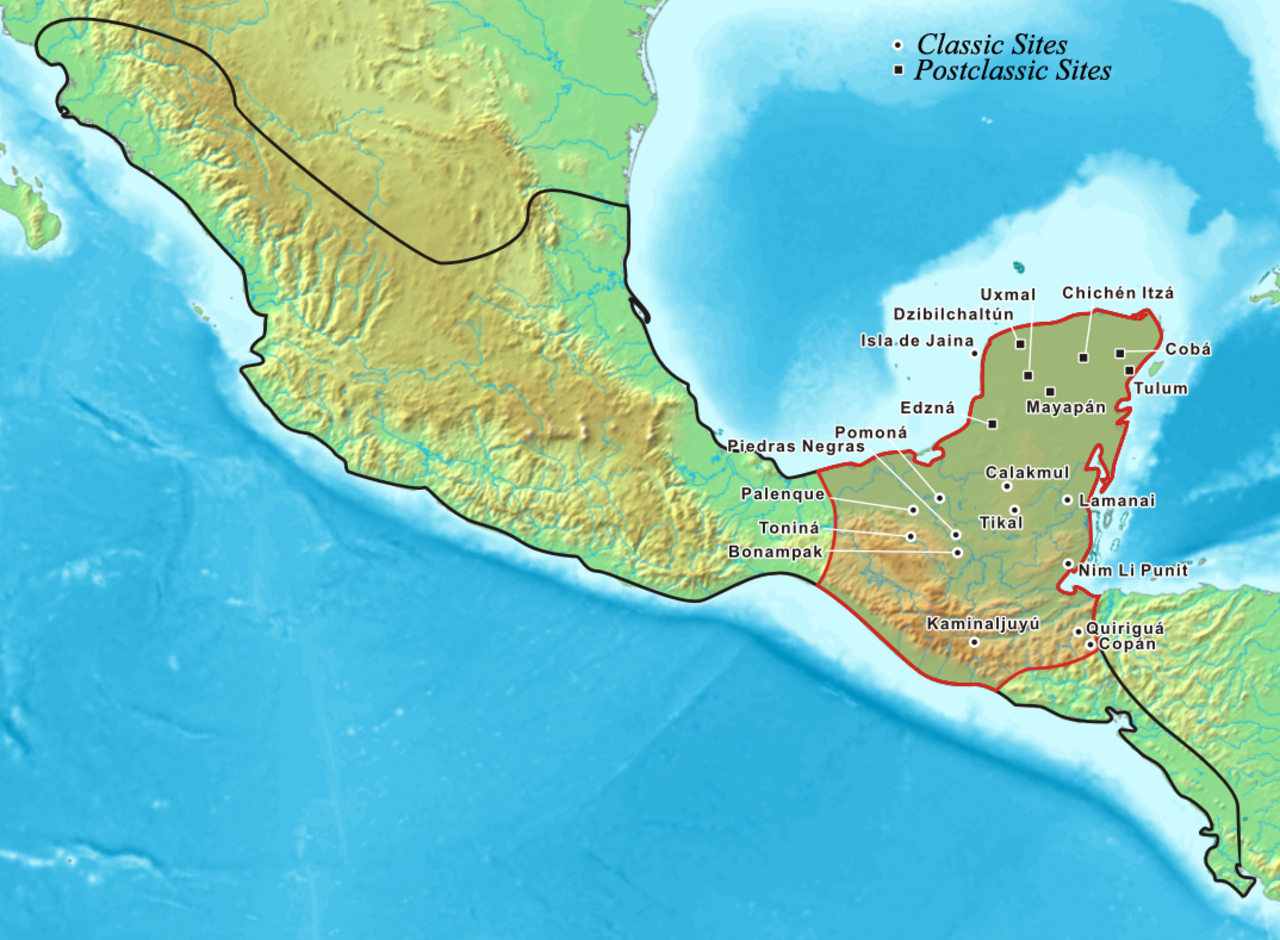
Maya civilization
The Maya Polities
The Maya civilization, flourishing in Mesoamerica from roughly 2000 BCE to 1500 CE, was characterized by a complex network of independent city-states rather than a unified empire. These polities, such as Tikal, Calakmul, Palenque, and Copán, developed sophisticated political, social, and economic structures. The Classic Period (c. 250–900 CE) witnessed the zenith of Maya urbanism, with monumental architecture including towering pyramids, elaborate palaces, ballcourts, and observatories.
These cities served as centers of religious ritual, political administration, and trade, often engaged in complex relationships of alliance and warfare. The decentralized nature of Maya governance allowed for regional diversity in culture and political organization, yet shared fundamental aspects of ideology, religion, and artistic style across the Maya lowlands and highlands.
Intellectual Achievements
The Maya made profound intellectual contributions, particularly in mathematics and astronomy. They independently developed a sophisticated vigesimal (base-20) number system, which notably included the concept of zero, a crucial innovation that facilitated complex calculations. This mathematical prowess was integral to their highly accurate calendrical systems.
The Maya employed multiple interlocking calendars, including the Tzolk'in (260-day ritual calendar), the Haab' (365-day solar calendar), and the Long Count, which provided a linear chronological framework for recording history over vast periods. Their meticulous astronomical observations allowed them to predict celestial events like solar and lunar eclipses, the synodic periods of Venus, and solstices with remarkable precision, reflecting a worldview deeply intertwined with cosmic cycles and divine order.
The Maya Script
The Maya developed the most sophisticated and fully developed writing system in the pre-Columbian Americas. Their hieroglyphic script, a logosyllabic system, was capable of representing spoken language and recording a wide range of information. Inscriptions on stelae, lintels, altars, pottery, and murals, along with the few surviving bark-paper codices (Dresden, Madrid, Paris, and Grolier), provide invaluable primary source material.
These texts document dynastic histories, royal genealogies, warfare, religious rituals, astronomical observations, and prophecies. The decipherment of Maya glyphs, a process that gained significant momentum in the mid-20th century, has revolutionized our understanding of Maya history, politics, and ideology, moving beyond earlier interpretations that often viewed them as a peaceful, purely scientific culture.
Decline, Resilience, and Modern Maya
The collapse of the Classic Maya lowlands, beginning around the 9th century CE, remains a subject of intense scholarly debate, with theories ranging from environmental degradation and drought to endemic warfare and political instability. However, this decline did not signify the end of Maya civilization. Maya populations continued to thrive in the northern Yucatán and the highlands, and new centers like Chichen Itza rose to prominence.
Crucially, the Maya people themselves persisted. Today, millions of Maya descendants live across their ancestral homelands, speaking numerous distinct Maya languages and actively preserving and adapting their cultural heritage. Their resilience and the ongoing study of their rich history continue to illuminate the enduring legacy of this remarkable civilization.
Go deeper
Frequently Asked Questions
What were the Maya city-states like?+
How did the Maya use numbers and calendars?+
What kind of buildings did the Maya build?+
How did the Maya study the stars?+
What happened to the Maya after the Classic period?+
Based on content from Wikipedia · Licensed under CC BY-SA 4.0