

Mastaba
Images

Mastaba of Ptahshepses (IV)


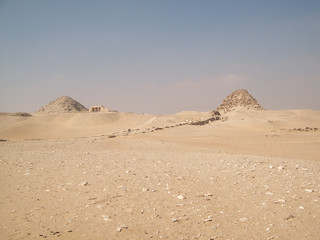
The Genesis of Monumental Burial
The mastaba represents a pivotal development in ancient Egyptian funerary architecture, serving as the predominant tomb type for royalty and the elite during the Early Dynastic Period and the Old Kingdom. Its characteristic form-a rectangular, flat-roofed structure with inward-sloping sides-is derived from early mudbrick constructions, evolving into more robust limestone edifices. The name 'mastaba' itself is a later Arabic appellation, translating to 'stone bench,' a descriptive moniker for its visual appearance.
However, its ancient Egyptian designation, 'per-djed,' meaning 'house of stability' or 'eternal house,' more accurately reflects its profound religious and cosmological significance. These structures were not merely burial markers but elaborate complexes designed to ensure the deceased's successful transition and eternal existence in the afterlife. The scale and complexity of mastabas, often featuring subterranean chambers and above-ground chapels, underscore the societal stratification and the immense resources dedicated to elite burials, setting a precedent for monumental construction that would culminate in the pyramids.
Evolutionary Trajectory
The mastaba's architectural lineage can be traced back to the predynastic period, with simpler pit graves gradually evolving into more sophisticated superstructures. During the Early Dynastic Period, mastabas began to take on their distinctive rectangular form, often constructed from unfired mudbricks. This era saw the consolidation of royal power and the development of a complex bureaucracy, necessitating more elaborate burial provisions for the ruling class.
The Old Kingdom, particularly the 3rd and 4th Dynasties, witnessed the zenith of mastaba construction, with many royal and high-ranking officials buried in vast necropolises, such as Saqqara and Giza. These mastabas became increasingly elaborate, incorporating multiple chambers, offering chapels, and sometimes even false doors and serdabs to facilitate the deceased's spiritual needs. The transition from mastaba to the step pyramid, exemplified by Djoser's complex at Saqqara, demonstrates a direct architectural lineage, where stacked mastabas formed the foundational stages of this revolutionary design.
The continued use of mastabas for non-royal elites even after the advent of pyramids highlights their persistent cultural relevance and adaptability.
Architectural and Ritual Complexity
The internal layout of a mastaba was meticulously planned to serve both practical and spiritual functions related to the afterlife. The primary burial occurred in a subterranean chamber, accessed via a deep shaft that was often sealed after interment. This chamber housed the sarcophagus, containing the mummy and grave goods intended for use in the next world.
Above ground, the mastaba's superstructure contained a chapel or chapels where rituals and offerings could be performed. These spaces were adorned with reliefs and inscriptions depicting the deceased, their family, and scenes of daily life or religious ceremonies, intended to magically provide sustenance and continuity for the deceased. A significant feature in many mastabas was the 'serdab,' a small, sealed room housing one or more statues of the deceased.
These statues served as a physical vessel for the 'ka' (life force) should the mummy be destroyed. The careful integration of these elements-burial chamber, offering chapel, and serdab-reflects a sophisticated understanding of Egyptian cosmology and the requirements for eternal life.
Enduring Legacy
The significance of the mastaba extends far beyond its function as a tomb; it is a crucial artifact for understanding the evolution of Egyptian society, religion, and monumental architecture. As the direct architectural ancestor of the pyramid, the mastaba provides invaluable context for the development of large-scale stone construction and the engineering prowess of the ancient Egyptians. The study of mastaba necropolises offers profound insights into social stratification, economic organization, and the pervasive belief system centered on the afterlife.
The sheer number and scale of these structures attest to the power of the pharaoh and the elite, and the collective effort required for their construction. Furthermore, the longevity of the mastaba form, persisting for over a millennium, underscores its deep cultural resonance and its role in shaping Egyptian identity. They are tangible links to a civilization that profoundly influenced subsequent cultures and continues to captivate the modern world with its enduring mysteries and achievements.
See also
Frequently Asked Questions
What is a mastaba?+
Why did people build mastabas?+
How did a mastaba look and what was inside?+
Where can we find mastabas?+
When were mastabas built?+
Based on content from Wikipedia · Licensed under CC BY-SA 4.0