

Marjorie Taylor Greene
Images

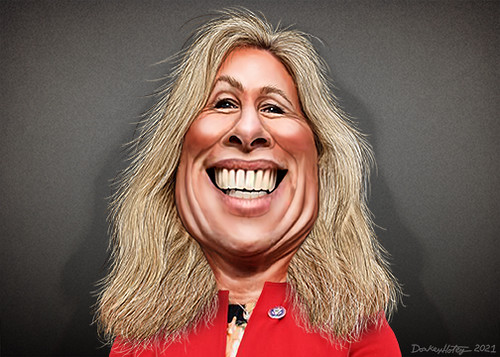
Marjorie Taylor Greene - Caricature




From Business Acumen to Political Arena
Marjorie Taylor Greene, born May 27, 1974, transitioned from a career in business, notably within her family's construction firm, to become a significant figure in American politics. Elected as the U.S. Representative for Georgia's 14th congressional district in 2020, she joined the Republican Party, quickly establishing herself as a vocal and often polarizing member.
Her entry into Congress coincided with a period of intense political division, and her approach to public discourse has been characterized by a willingness to engage with and promote ideas that challenge mainstream narratives. Her background as a businesswoman provided a different perspective entering the legislative branch, one that she has often highlighted.
Amplifying Unconventional Narratives and Ideologies
A defining aspect of Marjorie Taylor Greene's political career has been her embrace and amplification of various conspiracy theories, including QAnon and claims of government involvement in mass shootings. She has also promoted antisemitic and white supremacist viewpoints, and has been criticized for equating Democratic policies with Nazism and for comparing COVID-19 safety measures to the Holocaust, for which she later apologized. Her rhetoric has frequently involved strong endorsements of former President Donald Trump and his challenges to the 2020 election results.
This has led to significant debate regarding the boundaries of acceptable speech and the spread of misinformation within political discourse.
Navigating Congressional Power and Accountability
Marjorie Taylor Greene's tenure in the House of Representatives has been marked by significant disciplinary actions and internal party conflicts. In February 2021, the House voted to remove her from all committee assignments, a rare move taken in response to her past endorsements of political violence. This action underscored the gravity with which her rhetoric was perceived by a bipartisan majority.
Despite this setback, she was later appointed to new committees. Her expulsion from the conservative House Freedom Caucus in June 2023, following a dispute with a fellow member, further illustrates the turbulent dynamics within her party. Her attempts to oust Speaker Mike Johnson in May 2024 also highlight her assertive approach to leadership challenges.
The Broader Implications of Her Political Stance
Marjorie Taylor Greene's political trajectory raises important questions about the evolution of political communication, the role of social media in shaping public opinion, and the challenges of maintaining civil discourse in a polarized environment. Her ability to garner significant attention and maintain a strong base of support, despite facing widespread criticism and disciplinary actions, speaks to the complex nature of contemporary political movements. Her career serves as a case study in how unconventional candidates can gain traction and influence, and the ongoing debates surrounding accountability, truth, and representation in the digital age.
Her actions and statements continue to be a focal point in discussions about the future direction of American politics.
Key Moments and Political Maneuvers
Beyond her public statements, Marjorie Taylor Greene has actively engaged in political maneuvering within Congress. She was a vocal proponent of efforts to overturn the 2020 election results, filing articles of impeachment against President Biden shortly after his inauguration. Her participation in challenging electoral votes during the 2021 count, despite findings of no widespread fraud by federal agencies and courts, demonstrates her commitment to contesting election outcomes.
During the Russian invasion of Ukraine, she promoted Russian propaganda and expressed admiration for President Putin, a stance that drew considerable international attention and criticism. Her identification as a Christian nationalist further informs her policy positions and public persona.
See also
Frequently Asked Questions
Who is Marjorie Taylor Greene?+
How did she become a politician?+
Why has she been in the news a lot?+
What happened to her in Congress because of her words?+
Has she ever apologized for something she said?+
Based on content from Wikipedia · Licensed under CC BY-SA 4.0