

Mao Anying
Images
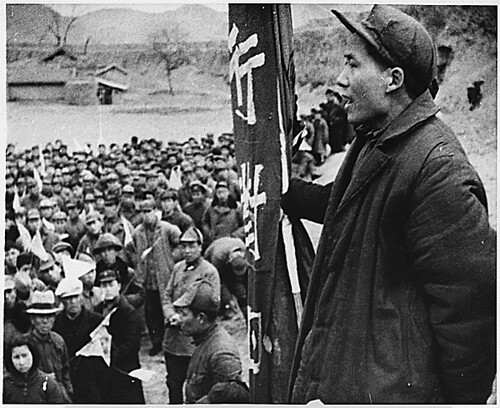
Public Domain: Mao Tse-Tung, 1944 (NARA)




Formative Years and International Education
Mao Anying, born in 1922, was the eldest son of Mao Zedong and Yang Kaihui, figures central to the Chinese Revolution. His early life was profoundly shaped by the political turmoil and revolutionary activities of his parents. Following his mother's arrest and execution, and amidst the ongoing civil war, Mao Anying, along with his younger brother, was sent to the Soviet Union in 1937.
He spent over a decade in Moscow, attending prestigious institutions like the Sun Yat-sen University and the Kremlin School. This period of education in the heart of the Soviet Union provided him with a Westernized, Marxist-Leninist ideological grounding and exposure to international affairs, distinguishing his intellectual development from many of his Chinese contemporaries. He learned Russian and engaged with Soviet culture and political thought, preparing him for future roles.
Return to China and Military Engagement
Upon his return to China in 1946, Mao Anying immediately immersed himself in the revolutionary cause. He joined the Communist Party and began his military career, serving in various capacities. He participated in the land reform movement in the Northeast, gaining practical experience in implementing party policies.
His background, including his Soviet education and his status as Mao Zedong's son, positioned him for leadership roles. He demonstrated a commitment to the party's objectives and showed a willingness to engage in the practical, often harsh, realities of post-war reconstruction and political consolidation. His military service was not merely symbolic; he was actively involved in the organizational and strategic aspects of the campaigns he joined.
The Korean War
The pivotal and tragic chapter of Mao Anying's life unfolded during the Korean War. In October 1950, he volunteered to join the Chinese People's Volunteer Army (CPV) as a translator and political worker, despite his father's initial reservations. He was assigned to the 64th Army.
His presence on the front lines, as the eldest son of the Chinese leader, carried immense symbolic weight. Tragically, on November 25, 1950, the CPV headquarters where Mao Anying was located was bombed by American aircraft. He was killed in the attack, along with other CPV officials.
His death was a significant personal loss for Mao Zedong and a moment of national mourning, highlighting the human cost of the conflict.
Enduring Legacy and Historical Significance
Mao Anying's life, though cut short at 28, holds considerable historical and symbolic significance. His education in Moscow represented a direct link between the Chinese Communist Party and the Soviet Union, underscoring the ideological and practical support exchanged between the two nations. His participation in the Korean War, and his subsequent death, transformed him into a martyr figure, embodying the sacrifices made by Chinese soldiers in the conflict.
His story has been widely propagated in China as an example of revolutionary dedication and patriotism, illustrating that even the children of top leaders were willing to face the dangers of war for their country. His life serves as a case study in the intersection of personal destiny, family legacy, and geopolitical events in 20th-century China.
See also
Frequently Asked Questions
Who was Mao Anying?+
Where did Mao Anying study?+
What did Mao Anying do in the military?+
How did Mao Anying die?+
Why is Mao Anying remembered?+
Based on content from Wikipedia · Licensed under CC BY-SA 4.0