

Luzhniki Stadium
Images

University Square, Luzhniki Stadium from Moscow State University, Moscow, Russia


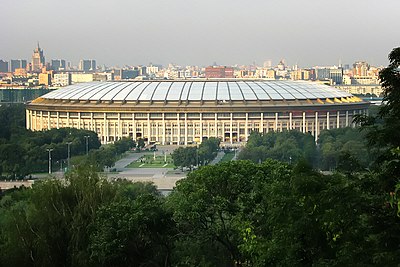

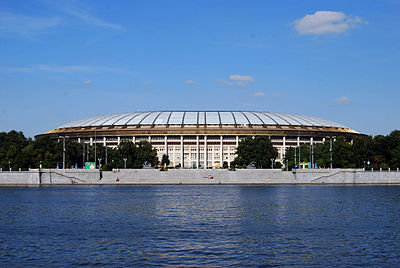


Luzhniki Stadium
The Grand Sports Arena of the Luzhniki Olympic Complex, commonly known as Luzhniki Stadium, stands as a monumental edifice in Moscow, representing the pinnacle of Russian sporting infrastructure. With a formidable seating capacity of 81,000, it ranks as Russia's largest football stadium and holds a significant position among Europe's elite arenas. Its location, nestled in the bend of the Moskva River, is historically significant, deriving its name 'Luzhniki' from the ancient 'flood meadows' that once characterized the area.
This transformation from natural landscape to a state-of-the-art sporting complex underscores decades of urban development and national ambition. As a UEFA Category 4 stadium, it signifies adherence to the highest international standards for hosting premier football competitions, a testament to its enduring quality and importance in the European sporting landscape.
A Tapestry of Triumphs
Luzhniki Stadium's history is interwoven with some of the most significant moments in sporting history. Its zenith arrived with the 1980 Moscow Summer Olympics, where it served as the primary venue, hosting the opening and closing ceremonies and pivotal athletic and football competitions. This cemented its global recognition.
However, its role as a host for elite events continued unabated. It has graced the finals of major club competitions, including the UEFA Cup in 1999 and the UEFA Champions League in 2008, showcasing the highest level of club football. The stadium's prestige was further amplified by its central role in the 2018 FIFA World Cup, where it hosted seven matches, including the highly anticipated opening fixture and the climactic final, reaffirming its status as a world-class venue capable of managing the logistical and ceremonial demands of global tournaments.
The Enduring Significance of Luzhniki
Luzhniki Stadium's significance transcends its physical dimensions; it is a potent symbol of Russian national identity and a cornerstone of its sporting heritage. As the national stadium, it is the spiritual home of the Russian national football team, a place where national pride is on full display. Historically, it was the battleground for legendary football rivalries, notably between Spartak Moscow and CSKA Moscow, whose matches drew immense crowds and national attention.
Even as its primary tenants may shift, its role in hosting national team fixtures and other major sporting events, alongside its capacity for large-scale concerts, ensures its continued relevance. It remains a vital hub for cultural and athletic expression, connecting generations of Russians through shared experiences and sporting passion.
Architectural Evolution and Functional Versatility
The evolution of Luzhniki Stadium reflects advancements in stadium design and functionality. While originally built in 1956, it has undergone significant renovations, most notably for the 2018 FIFA World Cup, to meet contemporary standards for safety, comfort, and technology. The stadium's design emphasizes a multi-purpose approach, accommodating not only football but also track and field events, which require specific field configurations.
Its capacity to transform into a premier concert venue, capable of hosting international artists and large audiences, highlights its adaptability. This versatility ensures that Luzhniki remains a dynamic and economically viable asset, capable of generating revenue and hosting diverse events that cater to a broad spectrum of public interest, from elite sports to major cultural spectacles.
Luzhniki's Role in the Modern Sporting Ecosystem
In the contemporary sporting world, Luzhniki Stadium continues to play a crucial role. Beyond its function as the home ground for the Russian national football team and occasional club matches, it serves as a benchmark for stadium development. Its hosting of major international tournaments, such as the 2018 FIFA World Cup, demonstrates its capability to meet the stringent requirements of global sporting federations.
Furthermore, its integration into the broader Luzhniki Olympic Complex provides a comprehensive sports and recreation environment. The stadium's ongoing use for various sporting disciplines and large-scale cultural events underscores its importance not just as a venue, but as a vital component of Moscow's and Russia's cultural and athletic infrastructure, contributing to national prestige and international engagement.
See also
Based on content from Wikipedia · Licensed under CC BY-SA 4.0