

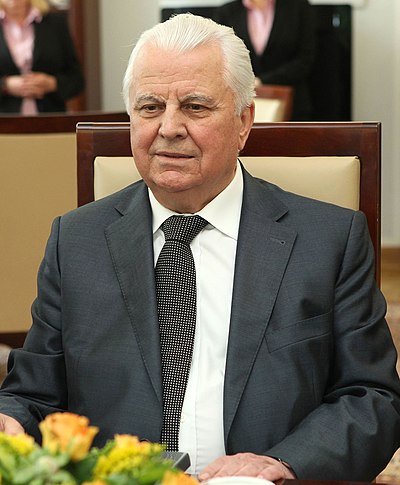
Leonid Kravchuk
Images

RIAN archive 52076 Leonid Kravchuk, Stanislav Shushkevich and Boris Yeltsin




From Soviet Bureaucrat to National Icon
Leonid Makarovych Kravchuk's ascent to the presidency of independent Ukraine is a narrative deeply intertwined with the final years of the Soviet Union. Born in 1934 into a peasant family in Volhynia, his formative years were profoundly marked by the cataclysms of World War II and the subsequent nationalist insurgency. His political career began within the Communist Party of Ukraine, where he honed his skills as a propagandist, a role that required adeptness in shaping public opinion and disseminating ideological messages.
He steadily climbed the party hierarchy, eventually becoming Chairman of the Verkhovna Rada (Supreme Soviet) of the Ukrainian SSR in 1990. This pivotal position placed him at the forefront of Ukraine's burgeoning independence movement during the tumultuous period of the late 1980s and early 1990s. Kravchuk's stance against the 1991 Soviet coup attempt was a defining moment, signaling his commitment to Ukraine's self-determination and positioning him as a key figure in its separation from Moscow.
His leadership during this critical juncture was instrumental in formalizing Ukraine's independence, transitioning from a Soviet republic to a sovereign nation.
Forging a New State
Kravchuk's presidency, spanning from December 1991 to July 1994, was characterized by monumental decisions and severe economic tribulations. A cornerstone of his foreign policy was the relinquishment of Ukraine's substantial post-Soviet nuclear arsenal. This act, undertaken in exchange for security assurances from major powers, was a significant step towards global nuclear non-proliferation and marked Ukraine's commitment to a peaceful international role.
Domestically, he focused on consolidating a centralized state, opposing federalist tendencies, and establishing the foundations of an independent Ukrainian Armed Forces. He also signaled openness to potential future membership in NATO. However, his tenure was overshadowed by a severe economic crisis.
The transition from a centrally planned economy to a market-based system proved exceptionally difficult, leading to a staggering 40% contraction in Ukraine's GDP. This economic downturn, coupled with the enrichment of the former nomenklatura (Communist Party elite), fueled public discontent and widespread strikes, most notably among coal miners. The ensuing political instability ultimately led to snap elections.
The Ideological Landscape and Political Maneuvering
As Ukraine embarked on its journey as an independent nation, Kravchuk sought to navigate a complex ideological landscape. He forged an informal alliance between his 'national communists'-those who retained communist ideals but supported Ukrainian independence-and national democrats, who represented a more liberal and Western-oriented political spectrum. This coalition was crucial for maintaining stability and advancing the agenda of state-building.
Kravchuk's vision for Ukraine was that of a strong, centralized state, and he actively opposed proposals for federalism, which he believed could undermine national unity. His administration also engaged with international bodies and sought to establish Ukraine's place on the global stage, including exploring avenues for integration into European security structures. His political maneuvering aimed to consolidate power and ensure the survival of the nascent Ukrainian state in a volatile geopolitical environment.
The End of an Era and Lasting Influence
The economic hardships and social unrest during Kravchuk's presidency culminated in the 1994 elections, where he was defeated by Leonid Kuchma. This marked the end of his first term as president, but not his engagement with Ukrainian politics. Following his presidency, Kravchuk remained a prominent figure, serving as a People's Deputy of Ukraine from 2002 to 2006 and leading the parliamentary group of the Social Democratic Party of Ukraine (united).
His post-presidency career demonstrated his continued commitment to public service and his adaptation to Ukraine's evolving political landscape. Kravchuk's legacy is that of a transitional figure, the first leader of a newly independent Ukraine who presided over its initial steps towards sovereignty, nuclear disarmament, and nationhood, while simultaneously grappling with the immense economic and social challenges inherent in such a monumental transformation. His presidency laid the groundwork for future Ukrainian leaders to build upon.
Key Decisions and Their Global Resonance
Leonid Kravchuk's decision to divest Ukraine of its nuclear arsenal was a globally significant event. At the time of the Soviet Union's collapse, Ukraine inherited the world's third-largest nuclear arsenal. The Budapest Memorandum on Security Assurances, signed in 1994, provided Ukraine with security assurances against the threat or use of force by Russia and the United States in return for its accession to the Treaty on the Non-Proliferation of Nuclear Weapons as a non-nuclear-weapon state.
This move was lauded internationally as a major victory for arms control and a crucial step in preventing nuclear proliferation. It demonstrated a pragmatic approach to security in the post-Cold War era, prioritizing national stability and international cooperation over military might. While the long-term implications of these security assurances have been debated, Kravchuk's role in facilitating this disarmament remains a defining aspect of his presidency and Ukraine's early foreign policy.
See also
Frequently Asked Questions
Who was Leonid Kravchuk?+
Why did he give up Ukraine's nuclear weapons?+
What happened to Ukraine's economy while he was president?+
How did he help Ukraine become independent?+
What was his view on federalism?+
Based on content from Wikipedia · Licensed under CC BY-SA 4.0