

Kowloon Walled City
Images

Kowloon Walled City 九龍城寨 - Photos - 80年代-清拆前之黃昏景色.jpg


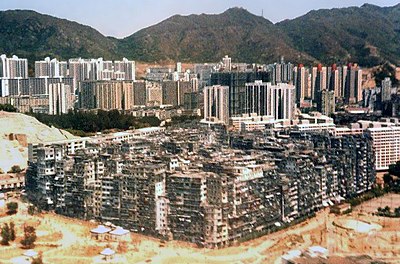


Spatial Anarchy and Extreme Density
Kowloon Walled City was a physical manifestation of unchecked urban growth, an anomaly in the planned development of Hong Kong. Spanning a mere 2.6 hectares, it housed an estimated 35,000 residents, achieving a population density of over 1.2 million people per square kilometer. This extreme concentration was a result of buildings being constructed without any zoning laws or building codes.
Structures rose haphazardly, often without proper foundations or sunlight access, creating a dense, multi-layered urban fabric. The lack of official oversight meant that infrastructure like sanitation and electricity was often jury-rigged, leading to precarious living conditions. Yet, within this chaos, a vibrant, self-sufficient community emerged, demonstrating remarkable resilience and ingenuity in adapting to an environment that pushed the limits of human habitation.
The city's layout was a labyrinth of narrow alleys, elevated walkways, and interconnected buildings, fostering a unique sense of shared space and community.
Historical Trajectory
The origins of Kowloon Walled City trace back to the Qing Dynasty, established as a military fort and administrative center. Its status as a de jure Chinese enclave was solidified in 1898 when the New Territories were leased to Britain, but the Walled City itself remained under Chinese jurisdiction. This unique political status created a vacuum of authority, particularly after World War II.
The influx of refugees fleeing the Chinese Civil War dramatically increased its population, transforming it from a small settlement into a sprawling, densely packed urban area. The absence of any recognized municipal government meant that law enforcement was virtually non-existent. This environment fostered the rise of powerful triad gangs who controlled various illegal activities, including drug trafficking, gambling, and prostitution, shaping the city's notorious reputation.
The Walled City became a symbol of the ungoverned urban frontier.
Socio-Economic Dynamics and Unofficial Governance
The absence of formal governance in Kowloon Walled City created a unique socio-economic landscape. While the triad gangs exerted considerable influence, day-to-day life was also managed through informal community networks and the sheer force of collective living. Businesses thrived in the unregulated environment, ranging from small food stalls and tailor shops to more illicit enterprises.
Residents developed their own systems for waste disposal, water supply, and even rudimentary healthcare, often through community cooperation or private initiatives. The economic activity, though often operating outside legal frameworks, provided livelihoods for thousands. This period highlights a fascinating case study in how societies can function and adapt in the absence of state control, demonstrating both the potential for exploitation and the capacity for self-organization and mutual support among inhabitants.
A Contested Legacy
By the 1980s, the untenable conditions and negative externalities of Kowloon Walled City prompted the Hong Kong government to initiate its clearance. The process, beginning in 1987 and culminating in demolition between 1993 and 1994, was a complex undertaking involving the relocation of approximately 35,000 residents. The government provided compensation and rehousing assistance, but the eviction process was arduous and emotionally charged for many who had lived their entire lives within its walls.
The site was subsequently transformed into Kowloon Walled City Park, a deliberate effort to reclaim the land for public use and create a green lung in a densely urbanized area. The park incorporates preserved historical elements, such as the yamen building and remnants of the southern gate, serving as a memorial to the city's past. The legacy of Kowloon Walled City continues to be debated, representing a complex interplay of urban planning failures, human resilience, and the enduring impact of unregulated urban development.
Educational Landscape and Cultural Significance
Formal education within Kowloon Walled City was scarce and largely informal. Due to the lack of official oversight and the challenging living conditions, established schools were not a prominent feature. Children often received rudimentary education through informal means, or their families prioritized immediate survival and work over schooling.
However, the Walled City itself served as a unique, albeit harsh, educational environment. Residents learned practical skills for survival, community organization, and navigating a complex, unregulated social structure. The cultural significance of Kowloon Walled City lies in its representation of extreme urban density, its unique governance model, and its role as a refuge for many.
It has inspired numerous books, films, and artistic works, serving as a potent symbol of a forgotten urban frontier and the adaptability of human life under challenging circumstances. The park today stands as a place of remembrance, offering a space for reflection on this extraordinary chapter of Hong Kong's history.
See also
Frequently Asked Questions
What was Kowloon Walled City and why was it so crowded?+
How did people live without official rules or government help?+
Why were there triad gangs in Kowloon Walled City?+
When and why was Kowloon Walled City demolished?+
How many people lived there and how big was the area?+
Based on content from Wikipedia · Licensed under CC BY-SA 4.0