

New Territories
Images
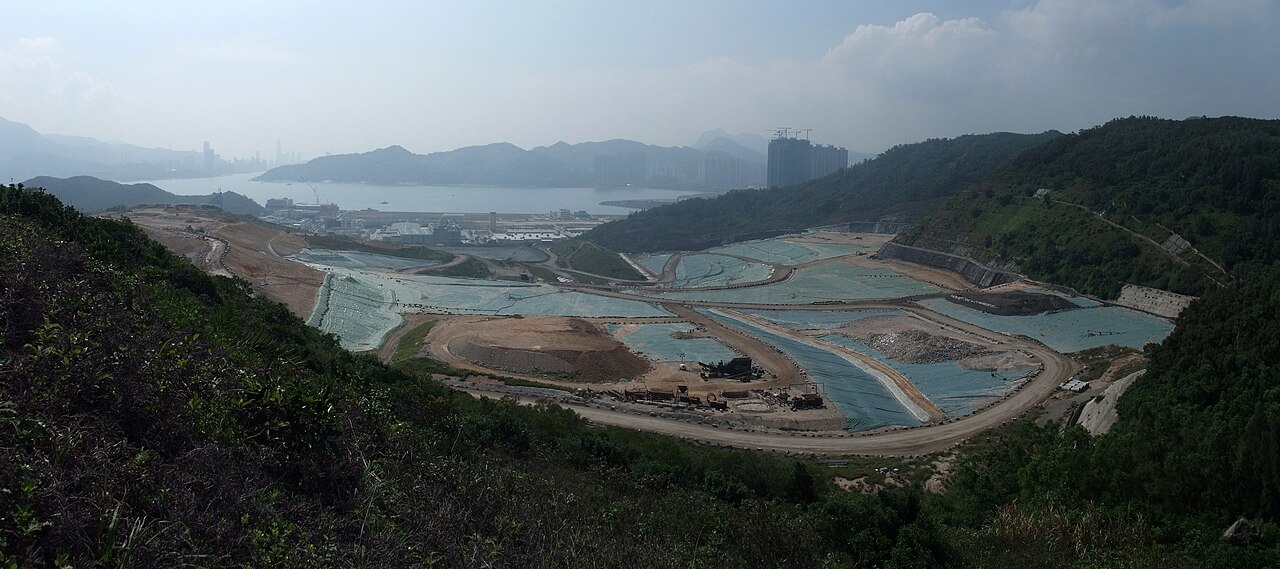
South East New Territories Landfill 2


Geographical Scope and Ecological Significance
The New Territories represents the overwhelming majority of Hong Kong's landmass, encompassing 952 square kilometers, which constitutes 86.2% of the total territory. This vast area extends from the northern boundary of Kowloon to the Sham Chun River, which forms the international border with mainland China. Geographically, it is characterized by a dramatic topography, featuring the prominent Kowloon Ranges that traverse the region, separating the more urbanized south from the less developed north.
Beyond the mainland, the New Territories includes an archipelago of over 200 islands, such as Lantau Island, Lamma Island, and Cheung Chau, each possessing distinct ecological features and settlement patterns. This diverse geography supports a range of ecosystems, from coastal wetlands and mangrove forests to hilly woodlands and country parks, contributing significantly to Hong Kong's biodiversity and offering crucial recreational spaces for its dense population.
Historical Trajectory
The historical narrative of the New Territories is intrinsically linked to the expansion of British colonial rule in Hong Kong. Originally part of Qing Dynasty China, the region was leased to the United Kingdom in 1898 for a term of 99 years under the Second Convention of Peking. This lease, along with the cession of Hong Kong Island and the Kowloon Peninsula, formed the basis of modern Hong Kong.
The subsequent definition of 'New Kowloon' saw parts of the area between Boundary Street and the Kowloon Ranges gradually urbanized and absorbed into the Kowloon conurbation. However, statutorily, the New Territories continues to encompass the mainland area north of the Kowloon Ranges and the outlying islands. The expiry of the lease in 1997 marked a pivotal moment, with sovereignty over the New Territories, like the rest of Hong Kong, being transferred to the People's Republic of China under the 'One Country, Two Systems' framework.
Demographic Landscape and Urbanization Patterns
The New Territories is a demographic powerhouse, home to approximately half of Hong Kong's total population, with a recorded figure of 3,984,077 in 2021. This results in a significant population density of 4,140 people per square kilometer, reflecting a complex pattern of urbanization. While historically more rural, the region has experienced substantial development, particularly in areas like Sha Tin, Tsuen Wan, and Tuen Mun, which have transformed into major urban centers.
This growth has led to a dynamic interplay between high-density residential developments, commercial hubs, and pockets of preserved rural villages and agricultural land. The linguistic landscape is dominated by Cantonese, though English remains an important language for business, education, and government.
Economic Drivers and Development Strategies
The economic profile of the New Territories is multifaceted, reflecting its role as a major residential base and a hub for various industries. While the service sector, particularly finance and retail, is dominant across Hong Kong, the New Territories hosts significant industrial estates and logistics centers, leveraging its proximity to mainland China and its extensive transportation networks. The region also plays a role in Hong Kong's food security through its remaining agricultural activities.
Furthermore, its natural landscapes and historical sites contribute to the tourism sector. Development strategies often focus on balancing urban expansion with the preservation of green spaces and the enhancement of public transportation infrastructure to support its large and growing population.
Governance, Education, and Future Prospects
As an integral part of the Hong Kong Special Administrative Region, the New Territories is governed under the Basic Law, which enshrines the 'One Country, Two Systems' principle. The region is administered through a system of district councils that oversee local services, planning, and community engagement. Educationally, the New Territories is well-served with a comprehensive network of primary, secondary, and tertiary institutions, including major universities and vocational training centers.
These educational facilities are crucial for developing the skilled workforce needed to sustain Hong Kong's economy. Looking forward, the New Territories faces ongoing challenges and opportunities related to housing, infrastructure development, and environmental sustainability, all within the unique political and economic context of Hong Kong.
Go deeper
Frequently Asked Questions
What is the New Territories in Hong Kong?+
How many islands are in the New Territories?+
When did the New Territories become part of Hong Kong?+
Why is the New Territories important for nature?+
What languages are spoken in the New Territories?+
Based on content from Wikipedia · Licensed under CC BY-SA 4.0