

Jean-François Champollion
Images

Jean François Champollion Grave


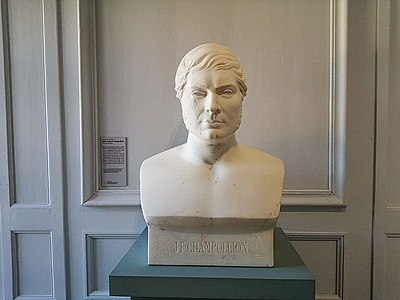


A Linguistic Prodigy in an Age of Discovery
Jean-François Champollion, born in 1790, was a true polymath from his earliest years, demonstrating an extraordinary aptitude for languages. By his late teens, he possessed a formidable command of classical and Oriental languages, including Coptic, Ancient Greek, Latin, Hebrew, and Arabic. This linguistic foundation was crucial for his later groundbreaking work.
His intellectual development occurred during a period of intense European interest in ancient Egypt, often termed 'Egyptomania,' significantly spurred by Napoleon Bonaparte's Egyptian campaign (1798–1801) and the subsequent discovery of artifacts like the Rosetta Stone. This era was marked by scholarly debate regarding the nature of Egyptian hieroglyphs: were they purely symbolic, phonetic, or ideographic?
Many scholars harbored skepticism about their decipherability, viewing them as tied to esoteric philosophical concepts rather than historical records. Champollion, however, was driven by a conviction that these ancient writings held tangible historical and cultural information waiting to be revealed.
The Rosetta Stone
The discovery of the Rosetta Stone proved to be the linchpin in Champollion's quest. This trilingual inscription, featuring the same decree in hieroglyphic, Demotic, and ancient Greek, provided a critical comparative tool. While British polymath Thomas Young had made initial strides, Champollion’s deep understanding of Coptic, which he believed was a direct descendant of the ancient Egyptian language, gave him a unique advantage.
He meticulously analyzed the cartouches (oval frames containing royal names) on the stone and other inscriptions, hypothesizing that they contained phonetic elements. His insight that the hieroglyphic system was not solely ideographic but a complex hybrid of phonetic, ideographic, and determinative signs was revolutionary. This understanding allowed him to systematically assign phonetic values to many hieroglyphs, a critical step that moved beyond mere guesswork and established a verifiable method for decipherment.
The Breakthrough and its Immediate Impact
In 1822, Champollion published his seminal work, the 'Lettre à M. Dacier,' which announced his decipherment of the hieroglyphic script. This publication detailed his findings, demonstrating the phonetic and ideographic nature of the writing system.
His subsequent work, the 'Précis du système hiéroglyphique' (1824), further elaborated on his methodology and provided a comprehensive grammar of the ancient Egyptian language. This was not merely an academic exercise; it was the key that unlocked millennia of Egyptian history, literature, religion, and daily life. Suddenly, inscriptions on monuments, papyri, and artifacts could be read and understood, transforming the study of ancient Egypt from a field of conjecture into a rigorous historical discipline.
Champollion's decipherment directly challenged the prevailing notion that hieroglyphs were solely mystical or ritualistic, proving their capacity for recording factual information.
Founding Egyptology and Enduring Legacy
Champollion's decipherment laid the indispensable foundation for the field of Egyptology. His 1829 expedition to Egypt allowed him to verify his readings against numerous inscriptions in situ and collect extensive new material. Upon his return, he was appointed to a professorship in Egyptology, though his health, weakened by the expedition's hardships, limited his teaching career.
Despite facing academic disputes and accusations of plagiarism regarding his work relative to Thomas Young's earlier contributions, Champollion's decipherment has been universally accepted and forms the bedrock of modern Egyptological studies. His posthumously published grammar of Ancient Egyptian, supervised by his brother, further cemented his contributions. Jean-François Champollion is rightly revered as the 'Founder and Father of Egyptology,' whose intellectual brilliance opened a direct window into one of the world's most enduring and fascinating ancient civilizations.
See also
Frequently Asked Questions
Who was Jean-François Champollion?+
How did Champollion figure out the meaning of hieroglyphs?+
What is the Rosetta Stone and why was it important?+
What did Champollion publish that showed he could read hieroglyphs?+
Why is Champollion's work important for learning about ancient Egypt?+
Based on content from Wikipedia · Licensed under CC BY-SA 4.0