

Italy National Football Team
Images

Chiesa - Italy national football team - 2021 (51099525577) (cropped)




The Genesis of Gli Azzurri
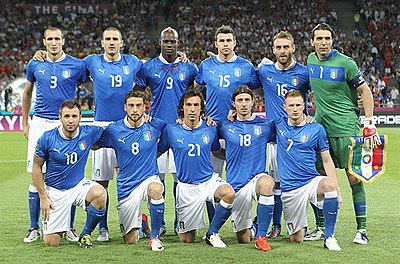
The Italian national football team, affectionately known as 'gli Azzurri,' draws its identity from the royal blue color of the House of Savoy, a historical symbol of Italian royalty. This tradition, established in the early 20th century, imbues the team with a sense of national heritage. Officially formed and playing its first match in 1910, the team is governed by the Federazione Italiana Giuoco Calcio (FIGC), a co-founder of UEFA.
The Azzurri's home matches are a spectacle, played across various iconic stadiums throughout Italy, fostering a nationwide connection to the sport. Their technical headquarters in Coverciano, Florence, serves as the nerve center for tactical development and player preparation, underscoring the professional infrastructure supporting this storied program. The team's existence is not merely athletic; it's a cultural cornerstone, deeply interwoven with Italian national pride and identity.
Dominance on the Grandest Stages
Italy's pedigree in international football is undeniable, marked by an exceptional record in the sport's most prestigious tournaments. They stand as one of the most successful national teams globally, boasting four FIFA World Cup titles (1934, 1938, 1982, 2006). Their back-to-back World Cup victories in the 1930s were a historic feat, making them the first nation to defend the title, a testament to their early dominance.
Furthermore, they have reached two other World Cup finals, showcasing consistent competitiveness. On the continental stage, Italy has claimed the UEFA European Championship twice (1968, 2020), appearing in two additional finals. Their success extends to other intercontinental competitions, including runner-up finishes in the CONMEBOL–UEFA Cup of Champions and podium placements in the FIFA Confederations Cup and UEFA Nations League, solidifying their status as perennial contenders.
Navigating Adversity
The Azzurri's narrative is one of remarkable resilience, punctuated by both profound tragedy and extraordinary achievements. Following their early World Cup triumphs and an Olympic gold medal in 1936, the team suffered a catastrophic loss in the 1949 Superga air disaster, which decimated the legendary Grande Torino squad, many of whom were key national team players. This event cast a long shadow, leading to a challenging decade and a failure to qualify for the 1958 World Cup.
However, Italian football has consistently demonstrated an indomitable spirit. Despite recent setbacks, including consecutive World Cup qualification failures in 2018 and 2022, the team achieved an unprecedented world record: an unbeaten streak of 37 consecutive matches from October 2018 to October 2021. This remarkable run exemplifies their capacity for renewal and sustained excellence.
The Strategic Landscape
Italy's footballing journey is defined by intense rivalries and a consistent presence at the pinnacle of global rankings. Their matches against traditional powerhouses like Brazil, France, Germany, and Spain are often highly anticipated clashes, characterized by tactical battles and national pride. These rivalries are not just historical footnotes; they represent the ongoing competition for supremacy in the international football arena.
Since the inception of the FIFA World Rankings in August 1993, Italy has frequently occupied the top position, notably in November 1993 and across several months in 2007. While their lowest ranking was 21st in August 2018, their historical performance and consistent ability to compete at the highest level underscore their enduring significance as a footballing superpower, constantly influencing and shaping the global game.
See also
Frequently Asked Questions
What does the nickname "Azzurri" mean and why do they wear blue?+
How many times has Italy won the World Cup?+
Where does Italy play its home games?+
What happened to the Italian team in 1949?+
Did Italy ever have an unbeaten streak?+
Based on content from Wikipedia · Licensed under CC BY-SA 4.0