

Smarty Pants Machines!
Images
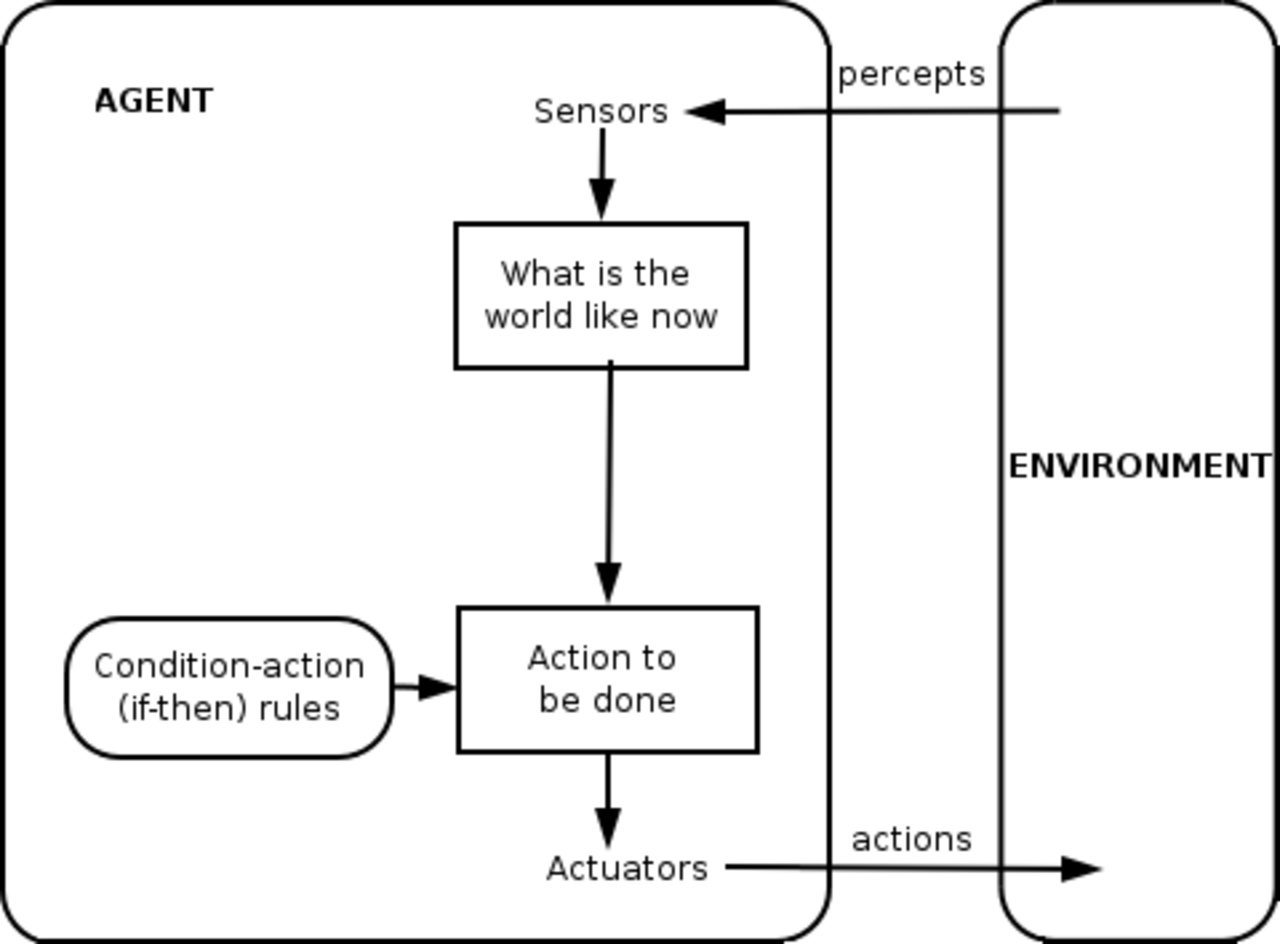
Intelligent agent





Defining the Agent
At the heart of artificial intelligence lies the concept of the intelligent agent. Defined as an entity that perceives its environment through sensors and acts upon that environment through actuators, an intelligent agent is characterized by its autonomy and goal-directed behavior. The field of AI is often formally defined as the 'study and design of intelligent agents,' emphasizing that the ability to pursue goals is fundamental to intelligence itself.
These agents are not merely reactive systems; they are designed to make decisions and take actions that are expected to lead to the maximization of some objective function. This objective function encapsulates the agent's goals, whether it's a reward function in reinforcement learning, a fitness function in evolutionary computation, or a utility function in economic models. The spectrum of intelligent agents is vast, ranging from simple control systems like thermostats and embedded controllers to highly complex systems like human beings, organizations, or even entire ecosystems, all of which can be modeled as agents perceiving and acting within their respective environments.
The Architecture of Intelligence
The internal workings of an intelligent agent can be conceptualized through various architectural models, though the most fundamental is the agent program. This program maps percept sequences (what the agent has sensed over time) to actions. A simple agent might operate on a 'PEAS' (Performance measure, Environment, Actuators, Sensors) description.
More sophisticated agents employ complex internal states, memory, and reasoning capabilities. For instance, a 'model-based agent' maintains an internal model of the world, allowing it to reason about unseen aspects of the environment. A 'goal-based agent' explicitly considers its goals and plans sequences of actions to achieve them. 'Utility-based agents' go a step further by considering not just whether a goal is achieved, but how well it is achieved, using a utility function to quantify desirability.
The concept of 'rationality' is key: an agent is rational if it acts to maximize its expected performance measure, given the percept sequence and any built-in knowledge. This pursuit of maximizing expected value is a core principle guiding agent design.
Evolution of Intelligence
The theoretical foundations for intelligent agents have roots stretching back to early cybernetics and the philosophy of mind, but the formalization within AI gained momentum in the latter half of the 20th century. Early AI research often focused on symbolic reasoning and problem-solving, but the agent paradigm offered a more unified and pragmatic framework. The introduction of concepts like 'rationality' and 'objective functions' drew heavily from economics and decision theory.
Fields such as cognitive science and philosophy of practical reason have also contributed to understanding how agents make decisions and interact with their world. The development of machine learning, particularly reinforcement learning, has been pivotal, enabling agents to learn optimal behaviors through interaction rather than explicit programming. This interdisciplinary approach underscores that intelligence, whether artificial or natural, is deeply intertwined with perception, decision-making, and action within an environment.
Ubiquitous Agents
Intelligent agents are no longer confined to research labs; they are pervasive in modern technology and society. In computing, software agents are autonomous programs that perform tasks on behalf of users, such as web crawlers indexing the internet or personal assistants managing schedules. In e-commerce, recommendation engines are intelligent agents that analyze user behavior to suggest products, significantly influencing consumer choices. Robotics heavily relies on intelligent agents for navigation, manipulation, and interaction, from industrial automation to autonomous vehicles and exploration robots.
In healthcare, agents are being developed for diagnostic assistance, personalized treatment plans, and drug discovery. The concept also extends to socio-cognitive modeling and computer simulations, where agents represent individuals or groups to study complex social dynamics. As AI continues to advance, the capabilities and applications of intelligent agents will undoubtedly expand, raising important ethical and societal questions about their role and impact.
See also
Frequently Asked Questions
What is a Smarty Pants Machine?+
How does a Smarty Pants Machine learn to do better?+
What makes a Smarty Pants Machine smart?+
Can a Smarty Pants Machine be like a thermostat or a robot?+
Why do Smarty Pants Machines need a plan?+
Based on content from Wikipedia · Licensed under CC BY-SA 4.0