

Hypergiant: The Biggest Stars Ever!
Images
Hypergiant


Defining the Hypergiant
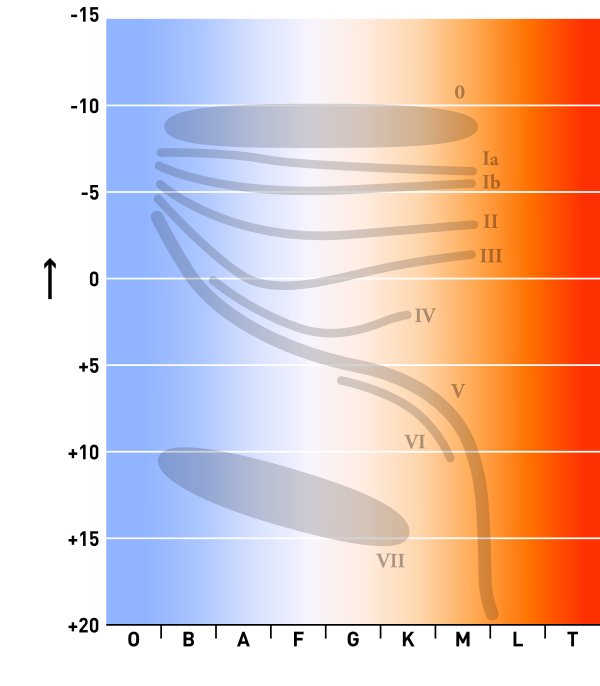
Hypergiants are a classification of stars that transcend even the definition of supergiants, representing the most massive and luminous stars known to exist. Their sheer scale is almost incomprehensible; a hypergiant could engulf the entire solar system out to Jupiter's orbit, and some may even extend beyond Saturn. Spectroscopically, they are often characterized by broad emission lines, indicating extremely rapid mass loss through powerful stellar winds that can reach velocities of thousands of kilometers per second.
These winds are so intense that they can create extensive circumstellar envelopes and nebulae, making the star appear even larger and more complex. The classification is not strictly defined by luminosity alone but also by the presence of these extreme mass-loss phenomena, often placing them in spectral types O, B, or luminous red supergiants with unusual spectral features.
Formation Pathways and Evolutionary Stages
The genesis of a hypergiant is tied to the most massive progenitor stars, those with initial masses exceeding 25-30 solar masses. These stars evolve rapidly, often passing through phases as blue supergiants or Wolf-Rayet stars before potentially becoming luminous blue variables (LBVs) or red hypergiants. LBVs are particularly unstable, undergoing dramatic outbursts where they shed enormous quantities of mass, temporarily increasing their luminosity and size.
Red hypergiants, like UY Scuti, represent a later, cooler phase where the star has expanded to its maximum radius. The evolutionary path is complex and not fully understood, with some stars potentially cycling between blue and red phases. Their extremely short lifespans, on the order of a few million years, mean they are rare and represent a fleeting but spectacular stage in stellar evolution.
The Spectacle of Stellar Death
The ultimate fate of a hypergiant is a core-collapse supernova, one of the most energetic events in the cosmos. When the star's iron core can no longer support itself against gravity, it collapses, triggering a shockwave that blasts the outer layers into space. These supernovae are not only spectacular displays of energy but are also critical for cosmic chemical enrichment.
They are the primary sites for the creation of many heavy elements, from iron to uranium, through rapid neutron capture processes (r-process). The material ejected by these explosions seeds the interstellar medium with these heavy elements, providing the raw materials for future generations of stars, planets, and potentially life. Understanding hypergiant supernovae helps us trace the history of elements in the universe.
Observational Challenges and Scientific Significance
Observing and studying hypergiants presents unique challenges due to their extreme luminosity, rapid variability, and immense distances. Their powerful stellar winds can obscure their photospheres, making accurate measurements of their size and temperature difficult. However, their study is of paramount importance for several reasons.
They serve as laboratories for testing theories of stellar structure and evolution under the most extreme conditions. Their mass loss influences the evolution of galaxies, and their supernovae are key events in cosmic nucleosynthesis. Furthermore, understanding these behemoths helps us comprehend the upper limits of stellar mass and the processes that govern the most energetic phenomena in the universe, providing context for the formation and evolution of all stars, including our own Sun.
See also
Frequently Asked Questions
What is a hypergiant?+
How do hypergiants lose so much mass?+
Why do hypergiants explode as supernovae?+
What do hypergiant supernovae give to the universe?+
Why do scientists study hypergiants?+
Based on content from Wikipedia · Licensed under CC BY-SA 4.0