

The Hess Triangle: A Tiny Piece of Land with a Big Story!
Images

File:Hess Triangle, February 28, 2015.JPG


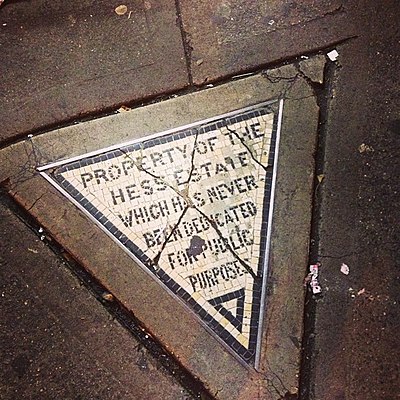


The Genesis of a Sidewalk Anomaly
The Hess Triangle, a 500-square-inch isosceles triangular plot of private land situated at the intersection of Seventh Avenue and Christopher Street in Manhattan's West Village, is a unique artifact of urban planning and property law. Its existence is rooted in the early 1910s, a period of significant urban expansion in New York City. The city initiated a large-scale eminent domain acquisition to widen Seventh Avenue and accommodate the burgeoning IRT subway system, a process that necessitated the demolition of 253 buildings.
David Hess, a landlord from Philadelphia, owned the Voorhis, a five-story apartment building, within this development zone. Despite the Hess family exhausting all legal challenges to prevent the seizure of their property, a critical oversight occurred. A small corner of Plot 55, the parcel on which The Voorhis stood, was inadvertently excluded from the city's eminent domain proceedings.
This minuscule omission, discovered by Hess's heirs, became the foundation for the Hess Triangle's continued private ownership, a testament to the meticulous nature of legal documentation and the potential for even the smallest discrepancies to have profound and lasting effects on urban landscapes.
A Defiant Declaration
Following the discovery of the excluded parcel, the Hess heirs were presented with a choice: relinquish the land to the public domain or assert their ownership. In a move that has cemented the Hess Triangle's place in urban lore, they chose the latter. On July 27, 1922, they installed a defiant mosaic plaque that reads: PROPERTY OF THE HESS ESTATE WHICH HAS NEVER BEEN DEDICATED FOR PUBLIC PURPOSES.
This inscription is more than just a declaration of ownership; it is a historical marker, a piece of public art, and a symbol of individual assertion against municipal power. The plaque's enduring presence signifies a refusal to yield, transforming a legal technicality into a permanent fixture of the streetscape. This act of defiance has ensured that the Hess Triangle remains a distinct entity, a private island within the public thoroughfare, prompting curiosity and discussion about property rights and the complex interplay between private interests and public development.
The Triangle's Enduring Significance
The Hess Triangle transcends its physical dimensions to represent several significant concepts. Legally, it serves as a compelling case study in property law, illustrating the principle that even the smallest parcel of land, if legally held, can be defended. It highlights the importance of precise legal descriptions and the potential for historical oversights to create enduring anomalies.
Historically, the triangle is a tangible link to a transformative era of New York City's development, a quiet reminder of the vast urban renewal projects that shaped the modern metropolis. Culturally, it has evolved into a minor icon, a point of interest for tourists and locals alike, sparking conversations about urban quirks and the unexpected stories embedded within city streets. Its continued existence, despite multiple changes in ownership of the adjacent commercial property, underscores a respect for its unique historical context and the persistent legacy of the Hess family's assertion of their rights.
The triangle’s story is a micro-narrative within the macro-history of New York City's growth.
A Shifting Landscape
The Hess Triangle's narrative is one of continuous, albeit quiet, evolution. In 1938, the property, then recognized as the smallest plot in New York City, was sold to the adjacent Village Cigars store for $100, a sum that, while modest, represented a tangible transaction for this unique piece of real estate. This sale effectively integrated the triangle into the commercial footprint of the business, though its distinct legal status and the inscribed plaque remained.
Ownership later transferred to Yeshiva University, further demonstrating the varied entities that have held title to this peculiar plot. In October 1995, it was sold to 70 Christopher Realty Corporation, continuing a pattern of commercial ownership. Crucially, each subsequent owner has maintained the integrity of the original mosaic plaque, respecting its historical significance.
In 2021, the Hess Triangle, along with the Village Cigars shop, was placed on the market, signaling another potential chapter in the ongoing story of this enduring urban anomaly. The future of the triangle remains a subject of interest, as it continues to occupy its unique space, a testament to a historical legal battle.
See also
Based on content from Wikipedia · Licensed under CC BY-SA 4.0