

Heraldry: Your Family's Secret Symbols!
Images
Heraldry
The Genesis of Heraldry
The origins of heraldry are deeply rooted in the practical necessities of medieval warfare, specifically the Crusades and the development of tournament combat in the 12th century. As knights donned increasingly elaborate and concealing armor, the need for a reliable method of personal identification became paramount. Surcoats, emblazoned with distinctive colors and symbols, were worn over armor, allowing for immediate recognition.
Shields, too, became canvases for these evolving emblems. This visual language facilitated command and control on the battlefield, enabling commanders to identify their own forces and distinguish allies from enemies. Beyond military utility, heraldry quickly became intertwined with social status and lineage.
The symbols adopted were often hereditary, passed down through generations, and became markers of noble birth and established families. This formalized system, governed by emerging rules and traditions, provided a visual hierarchy that reflected the feudal society of the time, distinguishing royalty, nobility, and landed gentry.
The Grammar of the Shield
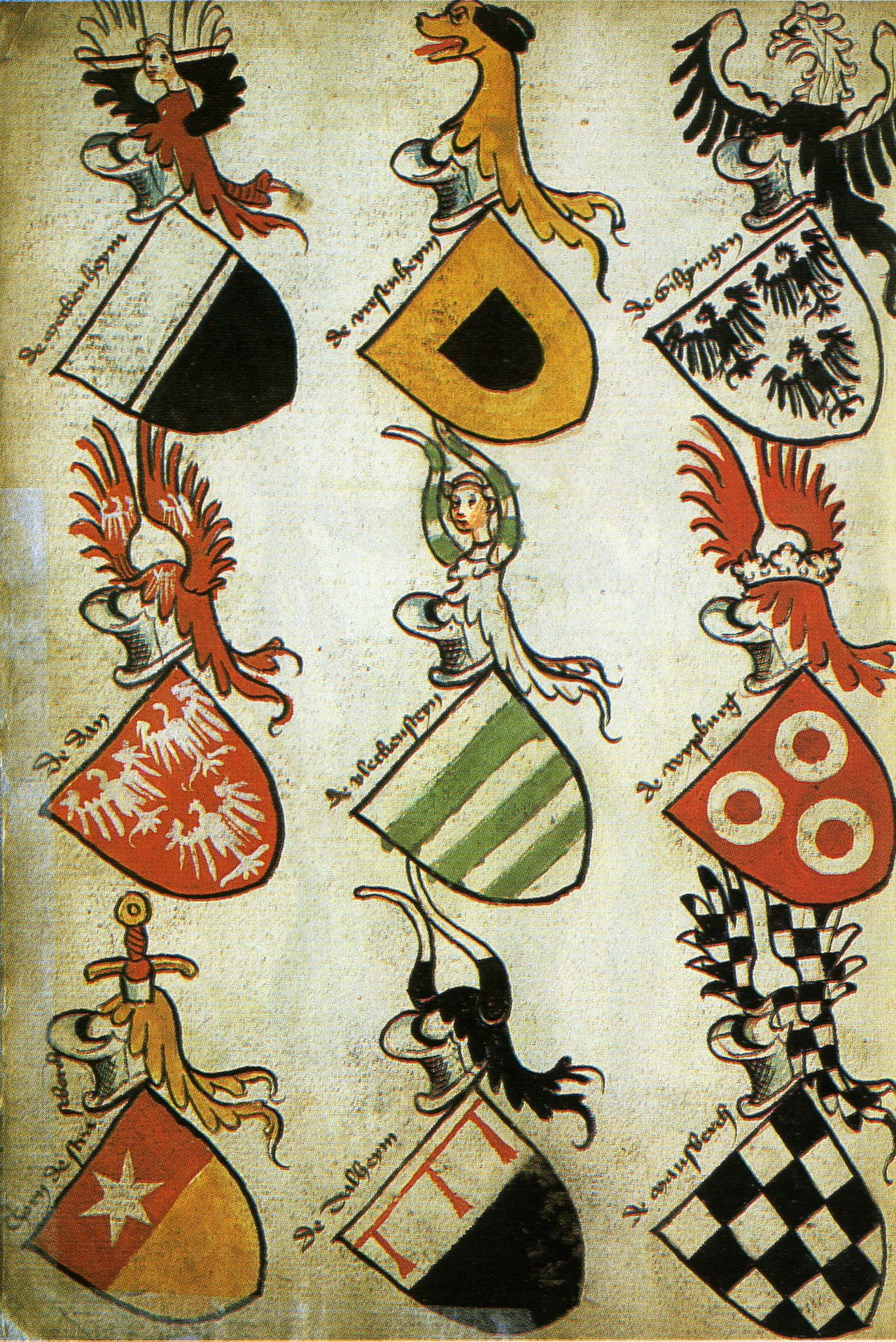
Heraldry is a codified system with a precise grammar that dictates the design and display of coats of arms. The fundamental element is the shield, or escutcheon, which bears the primary charges. Surrounding the shield, one might find a helmet, mantling (a decorative cloth), a crest (a three-dimensional figure atop the helmet), and sometimes supporters (figures flanking the shield).
The 'tinctures' are the colors and patterns used: metals (Or - gold, Argent - silver), colors (Gules - red, Azure - blue, Sable - black, Vert - green, Purpure - purple), and furs (Ermine, Vair, etc.). A key rule, the 'Rule of Tincture,' generally prohibits placing metal on metal or color on color, ensuring clarity and contrast. 'Charges' are the symbols depicted on the shield, ranging from animals (lion, eagle, bear) and mythical beasts (griffin, dragon) to geometric shapes (crosses, chevrons) and everyday objects.
Each charge carries traditional symbolic weight, contributing to the overall narrative of the coat of arms. The specific arrangement and combination of these elements create a unique and legally recognized heraldic achievement.
The Enduring Significance
Although its military origins have faded, heraldry's significance persists across various domains. Historically, coats of arms served as personal seals, used to authenticate legal documents and signify ownership, a practice that laid the groundwork for modern branding and trademarks. Today, heraldic symbols continue to be employed by sovereign states, national governments, and sub-national entities (like provinces and cities) as official insignia, embodying national identity and historical continuity.
For many families, particularly those with a documented heraldic lineage, their coat of arms is a vital link to their heritage, a tangible representation of ancestral achievements and a source of familial pride. Furthermore, heraldry is a recognized field of study within history and art, involving complex rules of blazon (the written description of a coat of arms) and design. Official heraldic authorities in many countries, such as the College of Arms in England or the Lord Lyon King of Arms in Scotland, continue to grant and regulate new arms, ensuring the system's continued relevance and integrity.
Heraldry in the Modern World
The influence of heraldry extends far beyond medieval reenactments. Its principles of symbolic representation and visual identity are deeply embedded in contemporary culture. Many academic institutions, from ancient universities like Oxford and Cambridge to newer colleges, proudly display coats of arms that reflect their founding principles, historical figures, or academic disciplines.
Professional bodies and corporations also utilize heraldic-inspired designs for their logos and emblems, leveraging the gravitas and historical resonance associated with heraldic tradition. The concept of a unique, recognizable symbol representing an entity or individual is a direct descendant of heraldry. Moreover, the study of heraldry, known as armory, remains a vibrant academic pursuit, attracting historians, genealogists, and art enthusiasts.
The meticulous rules of blazon and the artistic interpretation of charges continue to inspire new designs, demonstrating that heraldry is not merely a relic of the past but a dynamic visual language that adapts to modern contexts.
Go deeper
Frequently Asked Questions
What is heraldry?+
Why did knights use heraldry on their armor?+
What are the main parts of a coat of arms?+
What are tinctures and why can’t you put metal on metal?+
How can a family use heraldry today?+
Based on content from Wikipedia · Licensed under CC BY-SA 4.0