

Heat Engine
Images
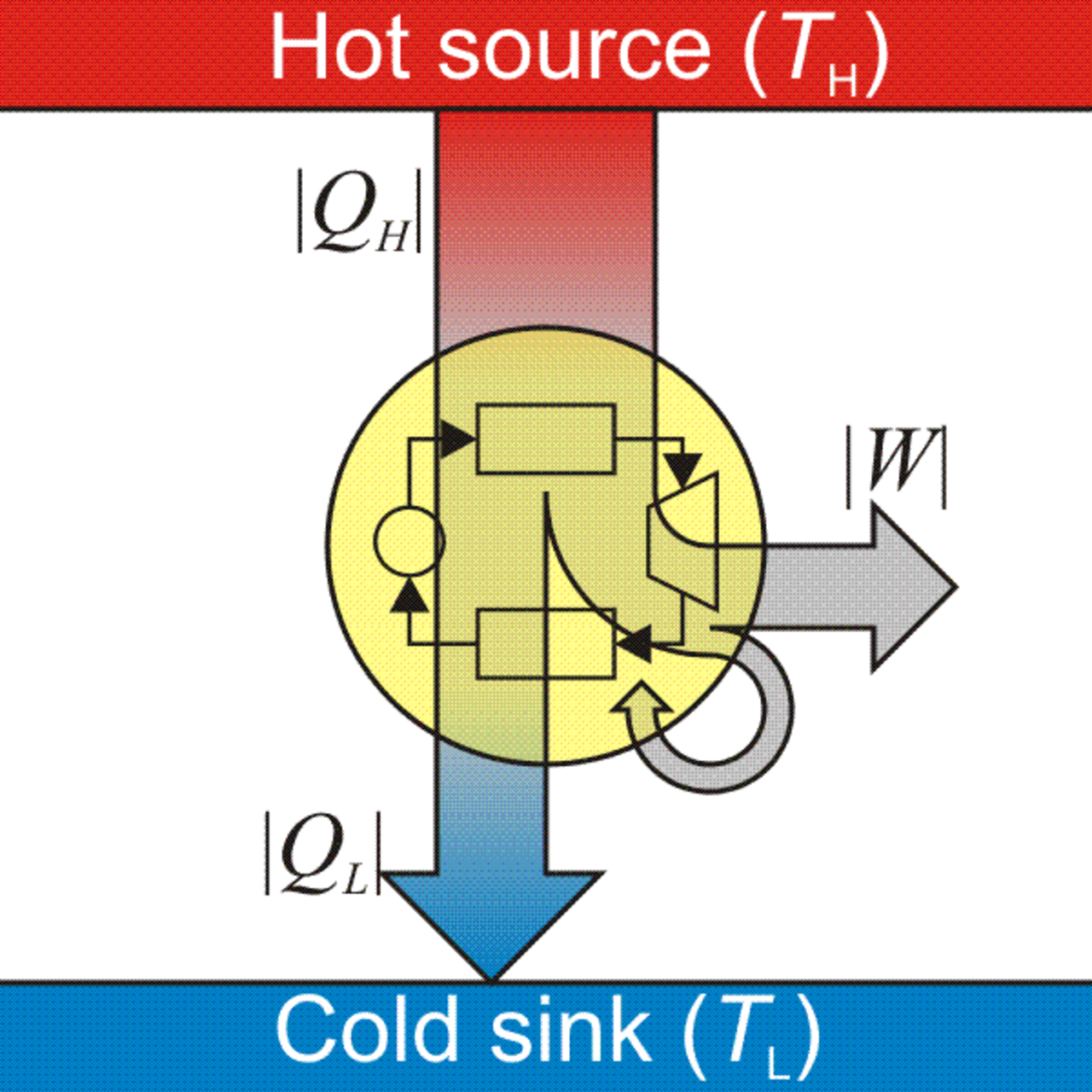
Heat engine
The Thermodynamic Imperative
A heat engine is a thermodynamic system designed to convert thermal energy into mechanical work. This conversion is fundamentally governed by the laws of thermodynamics, particularly the second law, which dictates that heat naturally flows from hotter to colder regions. A heat engine exploits this natural flow by operating in a cycle.
It absorbs heat from a high-temperature reservoir (the heat source), converts a portion of this heat into work, and rejects the remaining heat to a low-temperature reservoir (the heat sink). The 'working substance,' typically a gas or liquid, undergoes changes in pressure, volume, and temperature throughout this cycle. While the concept is simple, the efficiency of any heat engine is inherently limited by the temperatures of its reservoirs, as described by Carnot's theorem, setting a theoretical maximum that real-world engines strive to approach.
From Alchemy to Industry
The quest to harness heat for mechanical advantage has a long history, with early concepts emerging from attempts to understand steam power. The development of practical steam engines in the 17th and 18th centuries, notably by inventors like Thomas Newcomen and later significantly improved by James Watt, marked a pivotal moment. These engines, initially designed for mine drainage, became the driving force behind the Industrial Revolution.
They powered factories, enabled mass production, and revolutionized transportation with steam locomotives and ships. Subsequent innovations led to the development of internal combustion engines, which ignited fuel within the engine itself, offering greater portability and efficiency for vehicles, and gas turbines, crucial for aviation and power generation.
The Indispensable Role of Heat Engines in Civilization
Heat engines are arguably the most critical technological invention in shaping modern civilization. They are the primary means by which electrical power is generated globally; fossil fuel, nuclear, and even concentrated solar power plants all rely on heat engines to drive turbines. In transportation, they remain dominant, powering the vast majority of automobiles, trucks, trains, and aircraft.
Their ability to convert energy from diverse and abundant sources-combustion of hydrocarbons, nuclear fission, solar radiation, geothermal heat-into usable mechanical or electrical energy makes them exceptionally versatile. Despite ongoing research into alternative energy systems, heat engines continue to be the workhorses of our energy infrastructure.
The Mechanics of Motion
The operation of a heat engine is defined by its thermodynamic cycle. Common cycles include the Otto cycle (for gasoline engines), the Diesel cycle (for diesel engines), the Rankine cycle (for steam engines), and the Brayton cycle (for gas turbines). Each cycle involves a series of thermodynamic processes: heat addition, expansion (work output), heat rejection, and compression.
For instance, in an internal combustion engine, fuel is mixed with air and ignited, causing rapid expansion that pushes a piston. This linear motion is then converted into rotational motion by a crankshaft. In a steam power plant, heat from burning fuel or nuclear reactions boils water into steam, which expands through a turbine, causing it to spin and generate electricity.
Inefficiencies arise from friction, incomplete combustion, and heat loss to the surroundings.
Ubiquitous Applications and Future Frontiers
The applications of heat engines are incredibly diverse. Beyond transportation and electricity generation, they are found in industrial machinery, pumps, and even some portable generators. The ongoing challenge is to improve their efficiency and reduce their environmental impact.
Research focuses on advanced materials for higher operating temperatures, more sophisticated combustion strategies, waste heat recovery systems, and hybrid designs. Furthermore, the principles of heat engines are being explored in novel ways, such as thermoelectric generators that convert heat directly into electricity, and advanced Stirling engines that can operate on very low-grade heat sources. The fundamental concept of converting thermal energy into work remains a cornerstone of engineering.
See also
Frequently Asked Questions
What is a heat engine?+
How does a heat engine work?+
Why are heat engines important?+
What are some types of heat engines?+
How do heat engines power cars?+
Based on content from Wikipedia · Licensed under CC BY-SA 4.0