

Haboob: The Giant Dust Storms!
Images

Suburban Haboob 7/23/2012


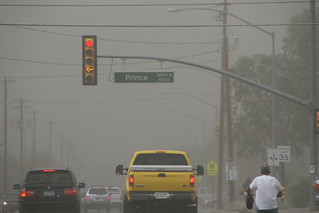
The Meteorology of Haboob Formation
Haboobs are a dramatic manifestation of atmospheric instability, primarily triggered by the outflow boundaries of thunderstorms. The intense convective activity within a thunderstorm generates significant evaporative cooling and precipitation loading, leading to a powerful downdraft. As this cold, dense air mass descends and impacts the surface, it spreads outwards horizontally, creating a surge of high-velocity winds.
In arid and semi-arid environments, characterized by loose, unconsolidated surface materials like sand and dust, these strong winds act as an efficient lifting mechanism. The sheer kinetic energy of the outflow is sufficient to entrain vast quantities of fine particulate matter into the atmosphere, forming a dense, often towering, dust front. The characteristic wall-like appearance arises from the organized nature of this outflow boundary, which acts as a leading edge for the dust plume.
The interaction between the thunderstorm outflow and the dry, erodible surface is the critical factor in haboob genesis.
Global Distribution and Extraterrestrial Analogues
The geographical prevalence of haboobs is intrinsically linked to climate and topography. They are most frequently observed in regions with a combination of hot, dry climates and abundant sources of fine sediment, such as the Sahara Desert, the Arabian Peninsula, the Sahel, and parts of the southwestern United States and Australia. These areas experience prolonged periods of drought and high temperatures, which dry out the soil and make it susceptible to wind erosion.
The term 'haboob' itself originates from Arabic, reflecting its common occurrence in the Middle East. Intriguingly, the phenomenon is not confined to Earth. Observations from space missions have provided evidence of similar dust storms on Mars.
These Martian haboobs, driven by atmospheric pressure differences and seasonal changes, can be even larger in scale than their terrestrial counterparts, sometimes encircling the entire planet. The presence of haboob-like events on Titan, Saturn's largest moon, further suggests that the fundamental processes of wind erosion and dust transport are not unique to our planet.
Environmental and Societal Ramifications
The impact of haboobs extends beyond immediate visibility reduction. They play a significant role in atmospheric dust loading, influencing regional and global climate patterns by scattering and absorbing solar radiation. This dust can also act as a nutrient source for distant ecosystems, with mineral-rich dust transported across oceans and continents, fertilizing marine and terrestrial environments.
For human populations, haboobs pose considerable challenges. Reduced visibility severely impacts transportation networks, leading to flight cancellations, road closures, and increased accident risks. Air quality deteriorates dramatically, exacerbating respiratory conditions like asthma and bronchitis.
Furthermore, the abrasive nature of the dust can damage infrastructure and agricultural crops. Understanding haboob dynamics is crucial for developing effective early warning systems, implementing dust mitigation strategies, and managing the health and safety of communities in affected areas. The study of haboobs also contributes to our broader understanding of atmospheric science and geomorphology.
Scale, Velocity, and Temporal Persistence
The sheer scale of haboobs is one of their most defining characteristics. These storms can reach vertical heights of up to 2,000 meters (approximately 7,000 feet), a dimension comparable to the cruising altitude of many commercial aircraft. Their horizontal extent is equally impressive, with some haboobs spanning distances of up to 1,000 kilometers (around 600 miles), effectively covering vast geographical areas.
The speed at which these dust fronts advance is also considerable, often reaching velocities of 70 kilometers per hour (about 45 miles per hour). This rapid movement allows them to traverse landscapes quickly, transforming the environment in a matter of minutes. The temporal persistence of a haboob can vary, but they are known to last for up to 6 hours, during which time they can significantly alter local weather conditions and atmospheric composition.
The combination of their immense size, significant speed, and prolonged duration makes haboobs formidable natural events.
See also
Frequently Asked Questions
What is a haboob?+
Why do haboobs happen?+
Where do haboobs usually happen?+
How do haboobs affect people and the environment?+
Can haboobs happen on other planets?+
Based on content from Wikipedia · Licensed under CC BY-SA 4.0