

The Gutenberg Bible: A Super Special Book!
Images
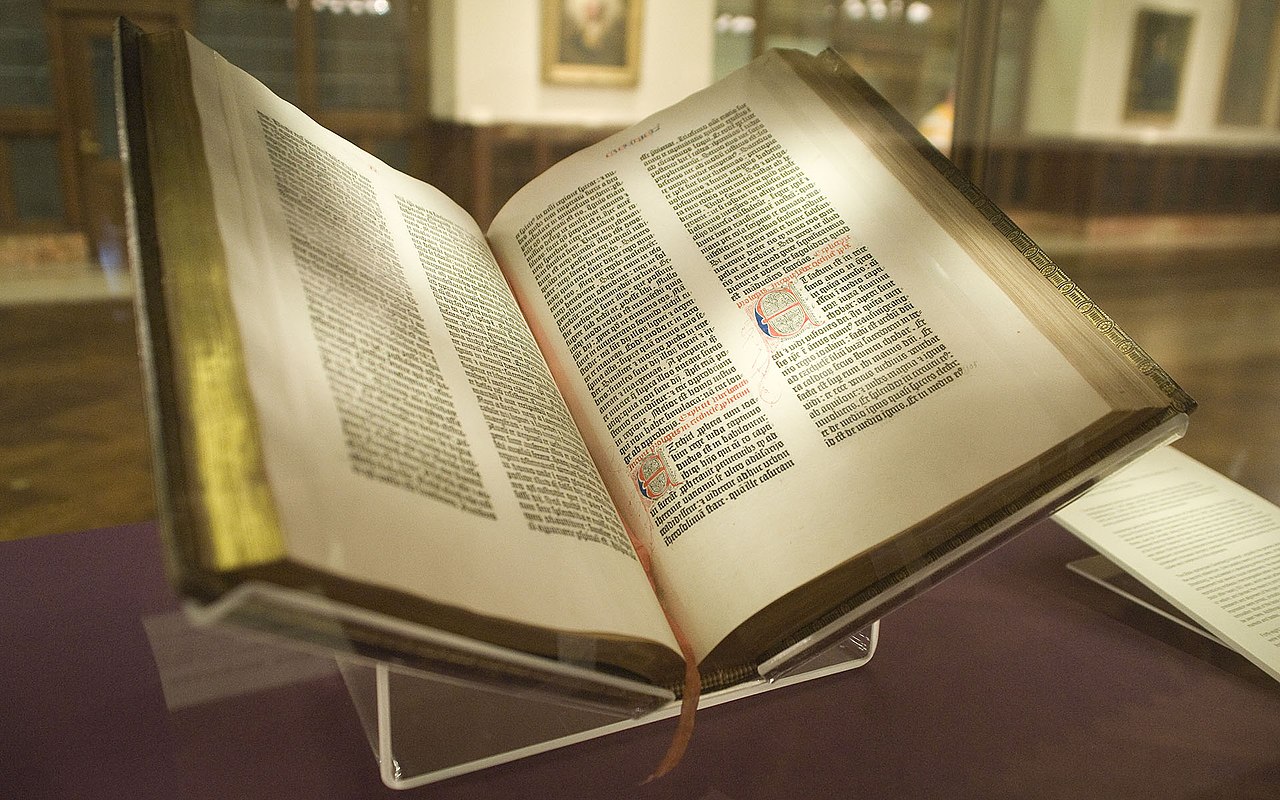
Gutenberg Bible
From Scriptorium to Printing House
The creation of the Gutenberg Bible in the mid-15th century was not an isolated event but the culmination of centuries of technological and intellectual development. Prior to Johannes Gutenberg's innovation, book production in Europe was dominated by manual transcription in monastic scriptoria, a laborious and error-prone process that severely limited the availability and affordability of texts. Gutenberg, a skilled metallurgist and craftsman, ingeniously combined several existing technologies-metallurgy for casting durable type, oil-based inks suitable for metal, and the screw press (used in winemaking and papermaking)-to develop a revolutionary printing system.
His movable metal type, cast in precise matrices, allowed for unprecedented uniformity and speed. The Bible, a monumental undertaking, was chosen as the first major project, likely due to its religious significance and the demand for accurate, standardized copies of scripture. The printing process itself, completed around 1455 in Mainz, Germany, was a testament to Gutenberg's meticulous engineering and vision, setting the stage for a paradigm shift in information dissemination.
The Mechanics of Revolution
Gutenberg's system of printing with movable type was a sophisticated technological leap. The core innovation lay in the mass production of uniform, durable metal type characters. Gutenberg developed a hand mould and a punch system to create matrices, into which a molten alloy of lead, tin, and antimony was poured to cast individual letters.
This ensured that each 'a' or 'b' was identical, a stark contrast to the variations found in handwritten scripts. The type was then arranged in a composing stick and locked into a forme, creating a full page of text. A viscous, oil-based ink, superior to the water-based inks used for woodblock printing, was applied to the type using leather balls.
The paper or vellum was then carefully placed over the inked type and pressed firmly using a modified screw press. This mechanical process allowed for the rapid production of pages, with Gutenberg's team reportedly printing thousands of sheets per day, a rate unimaginable for scribes. The aesthetic quality of the printed pages, often featuring two columns of 42 lines, was deliberately designed to emulate the finest manuscripts, including space for rubrication and illumination to be added by hand.
The Enduring Significance
The Gutenberg Bible's significance extends far beyond its status as a historical artifact; it represents a pivotal moment in the democratization of knowledge. By drastically reducing the cost and increasing the speed of book production, Gutenberg's invention made texts accessible to a much broader segment of society. This surge in available information fueled rising literacy rates and fostered critical thinking.
The rapid dissemination of ideas facilitated by printing played an indispensable role in major historical movements. The Renaissance saw a renewed interest in classical texts, which printing helped to spread widely. The Protestant Reformation was profoundly accelerated by the ability to print and distribute theological arguments and vernacular translations of the Bible, challenging the Church's monopoly on religious interpretation.
Furthermore, the standardization of texts through printing reduced errors and fostered a more unified intellectual discourse across Europe, laying the groundwork for the scientific revolution and the Enlightenment. The Gutenberg Bible, therefore, is not merely a book but a symbol of the transition from an oral and manuscript culture to a print culture, fundamentally altering the landscape of human communication, education, and power structures.
A Legacy Preserved
The profound historical and cultural value of the Gutenberg Bible is reflected in its extreme rarity and immense monetary worth. It is estimated that Gutenberg printed between 180 and 200 copies of the Bible, with roughly 135 printed on paper and the remainder on more expensive vellum. Today, only 49 of these copies are known to have survived, and many are incomplete.
These surviving examples are considered among the most precious treasures in the world's libraries and private collections. Their value is derived not only from their age and the revolutionary technology they represent but also from their direct connection to a transformative period in Western civilization. Each surviving copy is a tangible link to the dawn of mass communication, a testament to human ingenuity, and a reminder of the enduring power of the printed word to shape thought, culture, and history.
The few complete copies, such as those held by the Library of Congress and the British Library, are priceless artifacts, meticulously preserved for their historical significance.
Go deeper
Frequently Asked Questions
What is the Gutenberg Bible?+
Why was the Gutenberg Bible so important?+
How did Gutenberg print the Bible?+
Where was the Gutenberg Bible printed?+
What impact did the Gutenberg Bible have on society?+
Based on content from Wikipedia · Licensed under CC BY-SA 4.0