

Great Ellipse
Images
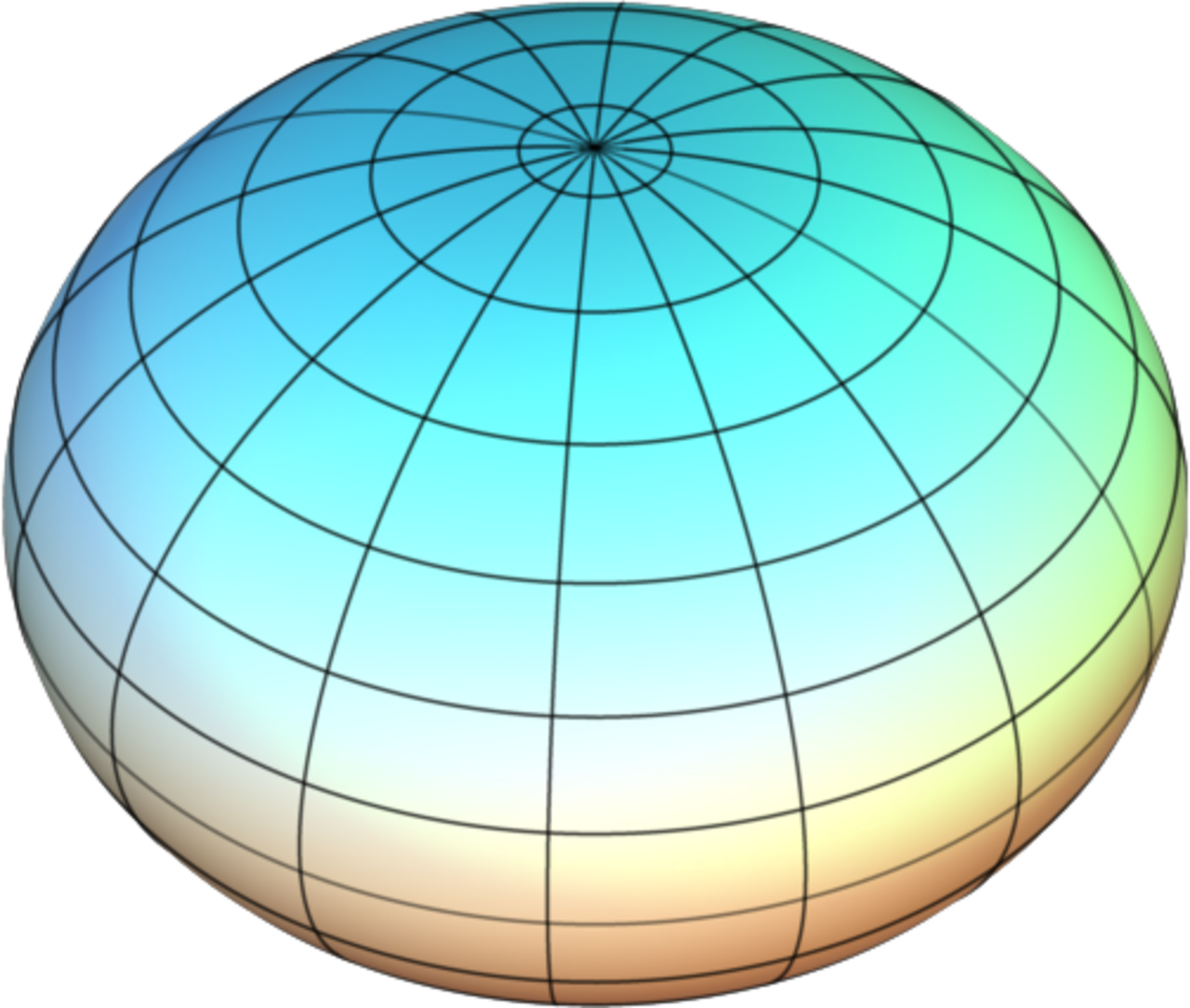
Great ellipse
Defining the Great Ellipse
The great ellipse is a sophisticated geometric construct that arises from the intersection of a plane with a spheroid, specifically when that plane passes through the spheroid's center. On a perfect sphere, such an intersection yields a circle, which is a special case of an ellipse. However, for a general spheroid, the resulting curve is an ellipse.
This ellipse is characterized by its passage through two points on the spheroid's surface and its co-centricity with the spheroid. It represents a fundamental way to divide or traverse a spherical body. The concept is crucial in understanding geodesics, which are the shortest paths between two points on a curved surface.
For distances that are relatively small compared to the overall circumference of the spheroid, the great ellipse provides an exceptionally accurate approximation of these geodesic paths, making it a cornerstone in fields requiring precise spatial calculations.
Historical Context and Navigational Evolution
The practical application of great ellipses is deeply intertwined with the history of navigation. For millennia, mariners and explorers have sought the most efficient routes across vast oceans. While early navigators may not have used the formal mathematical term 'great ellipse,' their empirical knowledge led them to follow curved paths on their charts that, when accurately projected onto a spherical model of the Earth, corresponded closely to great ellipses.
This understanding was vital for long-distance voyages, enabling them to conserve resources and reach distant lands. The development of spherical trigonometry and later, more advanced mathematical tools, allowed for the precise calculation of these routes, transforming navigation from an art based on experience to a science grounded in geometry and physics. The great ellipse remains a foundational concept in this evolution.
Significance and Applications in Modern Science
The primary significance of the great ellipse lies in its close approximation to geodesic distances on a spheroid. For points separated by distances up to approximately 10,000 kilometers (about a quarter of the Earth's circumference), the length of the great ellipse connecting them is remarkably close to the true geodesic distance, with an error of less than one part in 500,000. This precision makes it invaluable for marine navigation, where optimizing travel time and fuel consumption is paramount.
Beyond maritime applications, the concept extends to other areas of geodesy and cartography, influencing how we map and measure our planet. It serves as a building block for understanding more complex spatial relationships and calculating optimal paths for various forms of transportation and communication networks.
Mathematical Underpinnings and Real-World Modeling
The mathematical basis of the great ellipse is rooted in the intersection of a plane with a spheroid. If we consider a spheroid defined by an equation, and a plane passing through its origin (center), the intersection curve is the great ellipse. This geometric relationship is key to its properties.
For instance, the great ellipse is the longest possible 'great circle' path that can be drawn on a spheroid between two points, assuming the spheroid is not a perfect sphere. In practical terms, while the Earth is an oblate spheroid, the great ellipse concept provides a robust model for calculating the shortest routes. This is particularly relevant for long-distance flights and shipping lanes, where deviations from these optimal paths can lead to significant increases in travel time and operational costs.
It's a testament to how abstract mathematical ideas have tangible, impactful applications.
The Great Ellipse as a Special Case of Earth Section Paths
The great ellipse is not an isolated concept but rather fits within a broader category of geometric paths on a spheroid known as 'earth section paths.' These paths are formed by the intersection of a plane with the Earth's surface. The 'great ellipse' is a specific and particularly important type of these paths because it is centered on the Earth's core and, for many practical purposes, represents the shortest distance between two points. Understanding this classification helps to contextualize the great ellipse within the larger framework of spherical and spheroidal geometry.
It highlights how different types of planar intersections with our planet's shape lead to various curves, with the great ellipse holding a special place due to its direct relationship with geodesic distances and its utility in navigation and spatial analysis.
See also
Frequently Asked Questions
What is a great ellipse?+
How does a great ellipse look on Earth?+
Why do sailors use great ellipses?+
How close is a great ellipse to the shortest path?+
Where can we see great ellipses in maps or charts?+
Based on content from Wikipedia · Licensed under CC BY-SA 4.0