

German battleship Bismarck
Images

The Polish Institute and Sikorski Museum (24136934585)



The Pinnacle of German Naval Engineering
The Bismarck, commissioned in August 1940, represented the zenith of German battleship design and construction during the World War II era. As the lead ship of its class, alongside the Tirpitz, it was engineered to be a formidable predator on the high seas. Measuring over 800 feet long and displacing approximately 50,000 tons, it was one of the largest battleships ever built by any European power.
Its construction at Blohm & Voss in Hamburg was a testament to Germany's industrial capacity, but also a significant investment in a capital ship that would ultimately have a limited operational impact. The Bismarck was equipped with eight 15-inch guns, extensive armor plating designed to withstand heavy shellfire, and advanced fire control systems. Its design prioritized speed and firepower, intended to outmatch and overwhelm Allied naval assets, particularly those of Great Britain, which relied heavily on sea lanes for survival.
The ship was a powerful statement of intent by the Kriegsmarine, aiming to project German naval power globally.
Operation Rheinübung
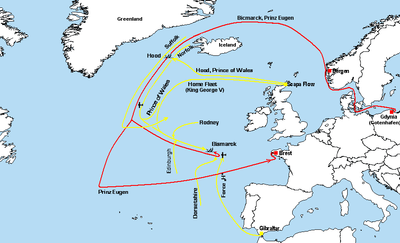
The Bismarck's brief but impactful career was defined by its sole major offensive operation: Operation Rheinübung, which commenced in May 1941. This mission was a strategic gamble, aiming to disrupt the vital Atlantic supply convoys that sustained Great Britain. Accompanied by the heavy cruiser Prinz Eugen, the Bismarck was tasked with breaking into the Atlantic and wreaking havoc on Allied shipping.
The operation, however, was fraught with challenges from its inception. The ships were detected early by British reconnaissance, immediately triggering a massive naval response. The initial engagement at the Denmark Strait, where the Bismarck and Prinz Eugen famously sank the pride of the Royal Navy, HMS Hood, while taking damage from HMS Prince of Wales, highlighted the ship's combat prowess but also its vulnerability.
The damage sustained forced Admiral Lütjens to abandon the primary raiding mission, shifting the focus to reaching occupied France for repairs, a decision that sealed the Bismarck's fate.
The Hunted Becomes the Hunter
The sinking of HMS Hood galvanized the Royal Navy, initiating one of the most intensive naval pursuits in history. Dozens of British warships were deployed, creating a relentless pressure on the damaged Bismarck. While attempting to evade its pursuers and make for Brest, France, the battleship suffered a critical blow from a torpedo attack by Fairey Swordfish aircraft launched from HMS Ark Royal.
This single hit jammed the Bismarck's rudder mechanism, rendering it virtually immobile and unable to effectively steer. This disabling damage turned the mighty battleship into a sitting duck. The following morning, May 27, 1941, the crippled Bismarck engaged the pursuing British fleet, including battleships HMS King George V and HMS Rodney, and heavy cruisers HMS Norfolk and HMS Dorsetshire.
Despite a valiant defense, the Bismarck was subjected to overwhelming firepower, sustaining catastrophic damage that led to immense loss of life.
Scuttling and Discovery
Faced with overwhelming odds and catastrophic damage, the surviving officers and crew of the Bismarck made the difficult decision to scuttle their ship. This act was intended to prevent the vessel from falling into enemy hands and to minimize further casualties, as the ship was clearly doomed. Most naval historians agree that the battle damage alone would have eventually caused the Bismarck to sink.
Its loss was a significant propaganda victory for the Allies and a stark reminder of the perils of naval warfare. The exact location of the Bismarck's wreck remained a mystery for nearly five decades. In June 1989, Dr.
Robert Ballard's expedition successfully located the sunken battleship, lying in two main pieces on the seabed. Subsequent surveys have provided detailed insights into the ship's final moments and the forces that tore it apart. The Bismarck's story continues to resonate, representing a complex interplay of advanced engineering, strategic miscalculation, and the brutal realities of total war.
See also
Frequently Asked Questions
What was the Bismarck?+
How did the Bismarck sink the HMS Hood?+
Why was the Bismarck unable to steer?+
What happened to the Bismarck after it was damaged?+
Why was the Bismarck important to Germany?+
Based on content from Wikipedia · Licensed under CC BY-SA 4.0