

Gallium: The Metal That Melts in Your Hand!
Images
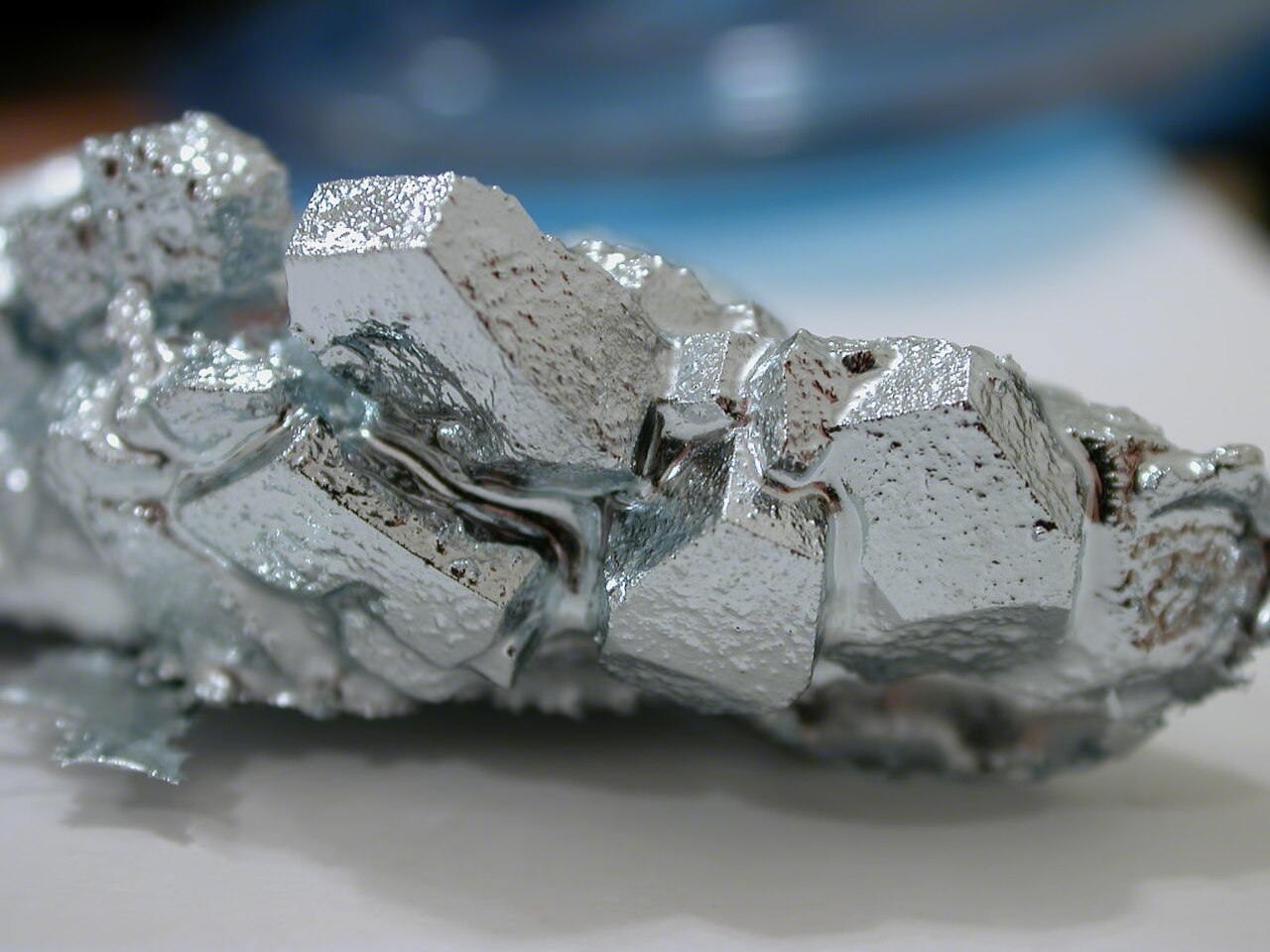
Gallium
Gallium's Genesis
Gallium's story begins not with its discovery, but with its prediction. In 1869, Dmitri Mendeleev, the architect of the periodic table, boldly left gaps for undiscovered elements, forecasting their properties with remarkable accuracy. One such element, which he named 'eka-aluminum' due to its position below aluminum, was predicted to have an atomic weight of around 68, a low melting point, and a high density.
It wasn't until 1875 that French chemist Paul-Émile Lecoq de Boisbaudran, using spectroscopic analysis of a zinc ore sample, identified the spectral lines of a new element. He successfully isolated a small quantity of this silvery-white metal, confirming Mendeleev's predictions and naming it 'gallium' after his homeland, Gallia (ancient name for France). This discovery was a monumental validation of Mendeleev's periodic law, demonstrating its predictive power and revolutionizing the understanding of chemical relationships.
Gallium's Unique Thermal Properties
The most striking characteristic of elemental gallium is its exceptionally low melting point of 29.7646 °C (85.5763 °F). This is significantly below the average human body temperature of 37 °C (98.6 °F), leading to its famous 'melting in your hand' demonstration. This property is not merely a scientific curiosity but has practical implications.
Gallium's melting point is so precise and reproducible that it's used as a standard temperature reference point in scientific calibration. Furthermore, gallium forms alloys with other metals, such as indium and tin, creating materials like galinstan. Galinstan has an even lower melting point, remaining liquid well below freezing temperatures, making it an ideal, non-toxic replacement for mercury in thermometers.
Unlike mercury, which poses significant health and environmental risks, gallium-based thermometers are safer and can operate across a wider temperature range.
Extraction and Abundance
Gallium is not found in its elemental form in nature; it is always bound within compounds. Its abundance in the Earth's crust is relatively low, estimated at about 15-20 parts per million, making it rarer than elements like zinc or copper. The primary commercial sources of gallium are as a byproduct of processing zinc ores, particularly sphalerite, and from bauxite, the principal ore for aluminum production.
The extraction process is complex and energy-intensive, typically involving Bayer process liquors from alumina refining or hydrometallurgical treatment of zinc concentrates. Because it is a byproduct, the availability and price of gallium are often linked to the production levels of aluminum and zinc, making its supply chain somewhat volatile.
Gallium's Technological Revolution
Gallium's true significance lies in its indispensable role in modern high-technology industries, particularly in the field of electronics. Its unique electronic properties make it a cornerstone for advanced semiconductor materials. Gallium arsenide (GaAs) is a direct-bandgap semiconductor renowned for its high electron mobility, making it ideal for high-frequency applications such as microwave integrated circuits (MMICs) used in telecommunications, radar systems, and satellite communications.
Gallium nitride (GaN) is another critical compound, forming the basis for high-efficiency blue and violet light-emitting diodes (LEDs) and laser diodes. These LEDs have revolutionized lighting and display technology, enabling energy-efficient illumination and vibrant color reproduction. GaN-based transistors are also gaining prominence in power electronics for their ability to handle high voltages and frequencies, contributing to more efficient power conversion in devices like chargers and electric vehicles.
Beyond Electronics
While electronics dominate gallium's applications, its utility extends to other fields. In medicine, gallium compounds, particularly gallium citrate and gallium nitrate, have been used for their ability to interfere with bacterial growth and for their anti-cancer properties. They are also employed in radiopharmaceuticals for diagnostic imaging, such as PET scans, where radioactive isotopes of gallium can help detect bone metastases or inflammation.
In materials science, gallium is used to create synthetic crystals like gadolinium gallium garnet (GGG), which serves as a substrate for growing magnetic bubble memory films and is also used in jewelry as a diamond simulant. Its ability to form low-melting-point alloys also finds niche applications in specialized solders and safety devices designed to melt at specific temperatures.
Go deeper
Based on content from Wikipedia · Licensed under CC BY-SA 4.0