

Syria's Awesome Eagle Emblem!
Images

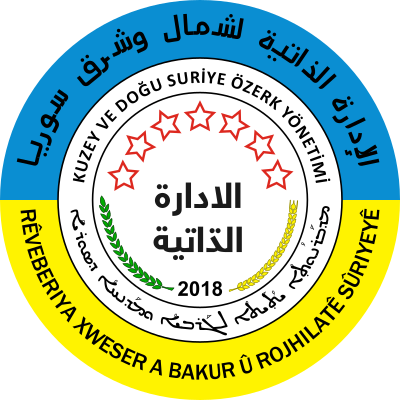
Emblem of the Democratic Administration of North and East Syria




Heraldic Analysis of the Syrian National Emblem
The national emblem of Syria is a complex heraldic device designed to encapsulate the essence of the nation. At its core is a tan-colored eagle, a creature frequently employed in vexillology and heraldry to denote power, strength, and far-sightedness. The eagle's orientation, facing dexter (to its right), is a standard heraldic convention, often signifying a forward-looking stance or readiness.
Above the eagle's head, three five-pointed stars are arranged in an arc. These stars are a recurring motif in Syrian national symbols and can be interpreted in various ways, potentially representing unity, historical epochs, or core national principles. The most intricate aspect of the emblem lies in its feather count.
The eagle's tail comprises five feathers, a deliberate choice to symbolize the five principal geographical regions of Syria: north, east, west, south, and the central territories. This serves as a cartographic representation within the emblem itself. Complementing this, the eagle's wings are depicted with fourteen feathers, directly corresponding to the fourteen governorates, the primary administrative divisions of Syria.
This meticulous detail transforms the emblem from a mere symbol into a visual charter of the nation's internal structure and territorial integrity.
Evolution of Syrian National Symbols
The current emblem of Syria, officially adopted on July 3, 2025, represents the latest iteration in a lineage of national symbols. Since the proclamation of the Syrian Republic on May 14, 1930, the country has utilized various coats of arms. Historically, these emblems often featured a prominent supporter, most notably the Hawk of Quraish, a symbol with deep historical and cultural resonance in the Arab world, often associated with tribal leadership and authority.
These earlier designs typically incorporated a shield emblazoned with the official Arabic name of Syria, often displayed on a scroll beneath the supporter. The transition to the current eagle emblem signifies a deliberate shift in national iconography. While the Hawk of Quraish represented a specific historical and cultural heritage, the eagle, with its more universal connotations of strength and sovereignty, and its specific symbolic feather count, offers a more direct and comprehensive representation of the modern Syrian state, its administrative framework, and its geographical expanse.
This evolution reflects a conscious effort to craft a national symbol that is both historically informed and contemporarily relevant.
The Semiotics of Sovereignty
National emblems function as potent semiotic devices, communicating complex layers of meaning about a state's identity, values, and structure to both domestic and international audiences. The Syrian emblem, through its carefully chosen imagery and numerical symbolism, plays a crucial role in fostering national cohesion and projecting an image of sovereignty. The eagle, as a symbol of power and vigilance, reinforces the state's authority and its commitment to protecting its territory and people.
The stars, while their specific meaning may vary, often serve as aspirational markers or historical signposts, connecting the present to the past and future. The precise representation of Syria's five regions and fourteen governorates through the eagle's feathers is particularly significant. It visually asserts the territorial integrity of the nation and acknowledges the diversity within its administrative framework, promoting a sense of inclusive national identity.
The emblem's consistent display on official documents, government buildings, and national currency serves as a constant, tangible reminder of the unified Syrian state, reinforcing collective identity and national pride.
Interpreting the Nuances
Beyond the primary elements, the subtle details of the Syrian emblem contribute to its overall meaning and impact. The tan color of the eagle can be interpreted as earthy, connecting the symbol to the land and soil of Syria, grounding its identity in its territory. This color choice might also evoke the arid landscapes prevalent in parts of the country.
The eagle's dextral orientation, facing right, is a convention in heraldry that often implies progress, looking towards the future, or vigilance. In the context of a national emblem, this suggests a nation that is forward-thinking and watchful. The arc formation of the stars can imply a celestial connection or a unified front.
Understanding these elements requires an appreciation for heraldic traditions and the symbolic language of national representation. The emblem is not merely an arbitrary design; it is a deliberate construction intended to convey specific messages about Syria's geography, its administrative organization, and its perceived national character, all within a visually coherent and impactful format.
Broader Implications
In an increasingly interconnected world, national emblems continue to hold significant importance, serving as critical identifiers in international relations and cultural exchange. The Syrian emblem, with its distinct imagery, functions as a visual ambassador for the nation. It provides a recognizable point of reference in global discourse, whether on international treaties, sporting events, or cultural exhibitions.
The specific design choices, such as the representation of administrative divisions through feathers, offer insights into how Syria perceives its own internal structure and unity. For citizens, the emblem remains a powerful symbol of belonging and shared heritage, a constant reminder of their national identity amidst diverse global influences. The evolution of such symbols also highlights how nations adapt their visual language to reflect changing historical contexts and national aspirations, ensuring their emblems remain relevant and resonant across generations.
See also
Frequently Asked Questions
What does the eagle on Syria's emblem look like?+
Why are there three stars on the emblem?+
How many feathers are on the eagle's wings and tail, and what do they mean?+
When did Syria adopt its current eagle emblem?+
What was used before the eagle in Syria’s symbols?+
Based on content from Wikipedia · Licensed under CC BY-SA 4.0