

Your Earth Size!
Images

National Ecological Footprint of Consumption Compared to Total Biocapacity




The Ecological Footprint
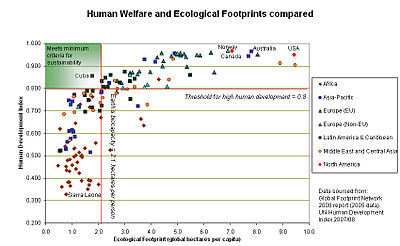
The ecological footprint is a powerful analytical tool that quantifies the demand placed on Earth's regenerative capacities by human activities. It operates as an ecological accounting system, measuring the biologically productive area required to support a population's consumption of resources and absorption of its waste. This includes land for food, fiber, timber, and energy, as well as the area needed to sequester carbon emissions.
By contrasting this demand with the planet's biocapacity – the biologically productive area available to regenerate resources – the footprint highlights humanity's impact on natural capital. It’s a crucial metric for understanding whether our collective activities are sustainable within the Earth's finite limits, providing a quantitative basis for discussions on resource management and environmental policy.
Genesis and Evolution of the Footprint Methodology
The concept of the ecological footprint emerged in the early 1990s, driven by a need to translate the abstract notion of sustainability into tangible, measurable terms. Developed by Mathis Wackernagel and William Rees at the University of British Columbia, the methodology sought to provide a scientifically robust framework for assessing human carrying capacity. Over time, the methodology has been refined and standardized, notably by the Global Footprint Network, which now provides national-level assessments.
This evolution has enabled broader application, from individual lifestyle analysis to national policy-making, allowing for consistent comparisons across diverse regions and economies. The ongoing development ensures its relevance in addressing complex environmental challenges.
The Critical Significance of Ecological Overshoot
The ecological footprint's most profound implication lies in its ability to reveal ecological overshoot. When humanity's aggregate footprint exceeds global biocapacity, we are consuming resources at a rate faster than the planet can regenerate them. As of recent estimates, humanity requires the equivalent of 1.71 Earths to sustain its current consumption patterns.
This deficit represents a depletion of natural capital, akin to a company spending more than its assets can support, leading to long-term economic and ecological instability. Overshoot manifests in various environmental crises, including biodiversity loss, resource scarcity, and accelerated climate change, underscoring the urgent need for systemic shifts towards sustainability.
Mechanisms of Footprint Calculation and Biocapacity Assessment
The calculation of an ecological footprint involves a complex, multi-step process that translates diverse consumption data into a standardized unit: global hectares (gha). This involves converting statistics on food consumption, housing, transportation, goods, and services into the land and sea area required to produce them and absorb their waste. For instance, the energy footprint component quantifies the land area needed to sequester the CO2 emissions from fossil fuel consumption.
Biocapacity is assessed by measuring the productivity of different land types (cropland, grazing land, forest land, fishing grounds) and then converting these into global hectares, accounting for their relative productivity. This rigorous methodology allows for a comprehensive, albeit complex, assessment of resource demand versus supply.
Applications and Future Directions for Footprint Analysis
The ecological footprint has found widespread application across various sectors, serving as a vital tool for sustainability assessments at individual, organizational, and national levels. It informs urban planning, corporate sustainability reporting, and national environmental policies. For individuals, understanding their footprint can guide lifestyle choices towards greater efficiency and reduced impact.
For businesses, it can highlight resource dependencies and opportunities for innovation. Looking forward, the methodology continues to evolve, aiming to incorporate more nuanced aspects of environmental impact and to be integrated more seamlessly into economic and policy frameworks. Its potential to drive behavioral change and inform effective environmental governance remains significant.
See also
Frequently Asked Questions
What is an ecological footprint?+
Why do we need to know our ecological footprint?+
How many Earths do we need right now?+
Who created the ecological footprint idea?+
What happens when our footprint is bigger than Earth's capacity?+
Based on content from Wikipedia · Licensed under CC BY-SA 4.0