

Duty Cycle: The On-and-Off Secret!
Images

Duty cycle


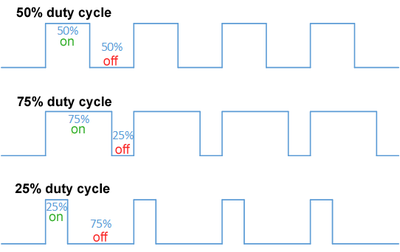


The Mathematical Framework of Duty Cycle
Duty cycle is a fundamental metric in signal processing and electrical engineering, quantifying the proportion of time a signal or system is in an active state within a given period. Mathematically, it is defined as the ratio of the pulse width (PW), the duration of the 'on' state, to the total period (T) of the signal, which encompasses both the 'on' and 'off' durations. This ratio, D = PW/T, is often expressed as a percentage by multiplying by 100%.
A 100% duty cycle signifies a continuous 'on' state, while a 0% duty cycle represents a continuous 'off' state. For example, a square wave oscillating between 0 and 5 volts with an 'on' time of 1 millisecond and a period of 2 milliseconds has a duty cycle of 50%. This simple yet powerful concept allows engineers to precisely describe and control the behavior of pulsed signals, which are ubiquitous in modern electronics.
Evolution of Duty Cycle
The conceptual roots of duty cycle can be traced back to early communication systems like the telegraph, where the timing of pulses was critical for transmitting information. However, the term and its formal application gained prominence with the advent of electronics and the development of technologies like pulse-width modulation (PWM). Early radio transmitters and control systems relied on understanding and manipulating the on-off timing of signals.
As electronic components became smaller and faster, particularly with the rise of transistors and integrated circuits, the ability to generate and control signals with precise duty cycles became essential. Microprocessors, for instance, operate by executing instructions in discrete time steps, and the timing of these operations, akin to a duty cycle, dictates their performance. The evolution of duty cycle measurement mirrors the progression of electronic complexity and efficiency.
The Indispensable Role of Duty Cycle in Engineering
The significance of duty cycle extends across numerous engineering disciplines, impacting efficiency, control, and functionality. In power electronics, PWM with variable duty cycles is the cornerstone of modern switching power supplies, enabling efficient voltage regulation and reducing energy loss as heat. This is crucial for everything from mobile device chargers to industrial power systems.
In motor control, adjusting the duty cycle of a voltage pulse directly controls the average voltage applied to the motor, thereby regulating its speed and torque without the need for complex mechanical gearboxes. Furthermore, duty cycle is fundamental in digital communication, signal processing, and even in biological systems like neural signaling, where the frequency and duration of action potentials (a form of biological duty cycle) encode information. Understanding and manipulating duty cycle allows for optimization of performance, miniaturization of components, and conservation of energy.
Ubiquitous Applications
Duty cycle is an invisible yet pervasive force in the technology that surrounds us. In consumer electronics, the blinking LEDs on routers, smartwatches, and game consoles all operate with specific duty cycles to convey status information. The dimming of LED lights, often controlled by PWM, relies on rapidly changing the duty cycle to adjust brightness.
In automotive systems, electronic fuel injection and ignition timing are precisely managed using duty cycle principles. Advanced applications include medical devices like pacemakers, which deliver electrical pulses with carefully calibrated duty cycles, and scientific instruments such as oscilloscopes, which are designed to visualize and measure signals with varying duty cycles. Even in the realm of renewable energy, the efficiency of solar inverters and wind turbine control systems is heavily influenced by duty cycle management.
Advanced Concepts and Related Fields
Beyond its basic definition, duty cycle is intertwined with several advanced engineering concepts. Pulse Width Modulation (PWM) is perhaps the most direct application, where the duty cycle is intentionally varied to control the average power delivered to a load, enabling precise regulation of voltage, current, or motor speed. Related terms include 'duty factor,' which is synonymous with duty cycle, and 'pulse repetition frequency' (PRF), which is the inverse of the period (1/T) and indicates how often pulses occur.
In some contexts, particularly in analog signal processing, the concept of 'signal-to-noise ratio' (SNR) can be indirectly affected by the duty cycle, as continuous or high-duty-cycle signals might behave differently in noisy environments. Understanding duty cycle is also foundational for grasping more complex modulation techniques used in telecommunications and data transmission.
See also
Frequently Asked Questions
What is a duty cycle?+
How do you calculate a duty cycle?+
Why do engineers use duty cycles?+
Where can I see duty cycles in everyday gadgets?+
What happens if the duty cycle is 100% or 0%?+
Based on content from Wikipedia · Licensed under CC BY-SA 4.0