

De Havilland Comet
Images
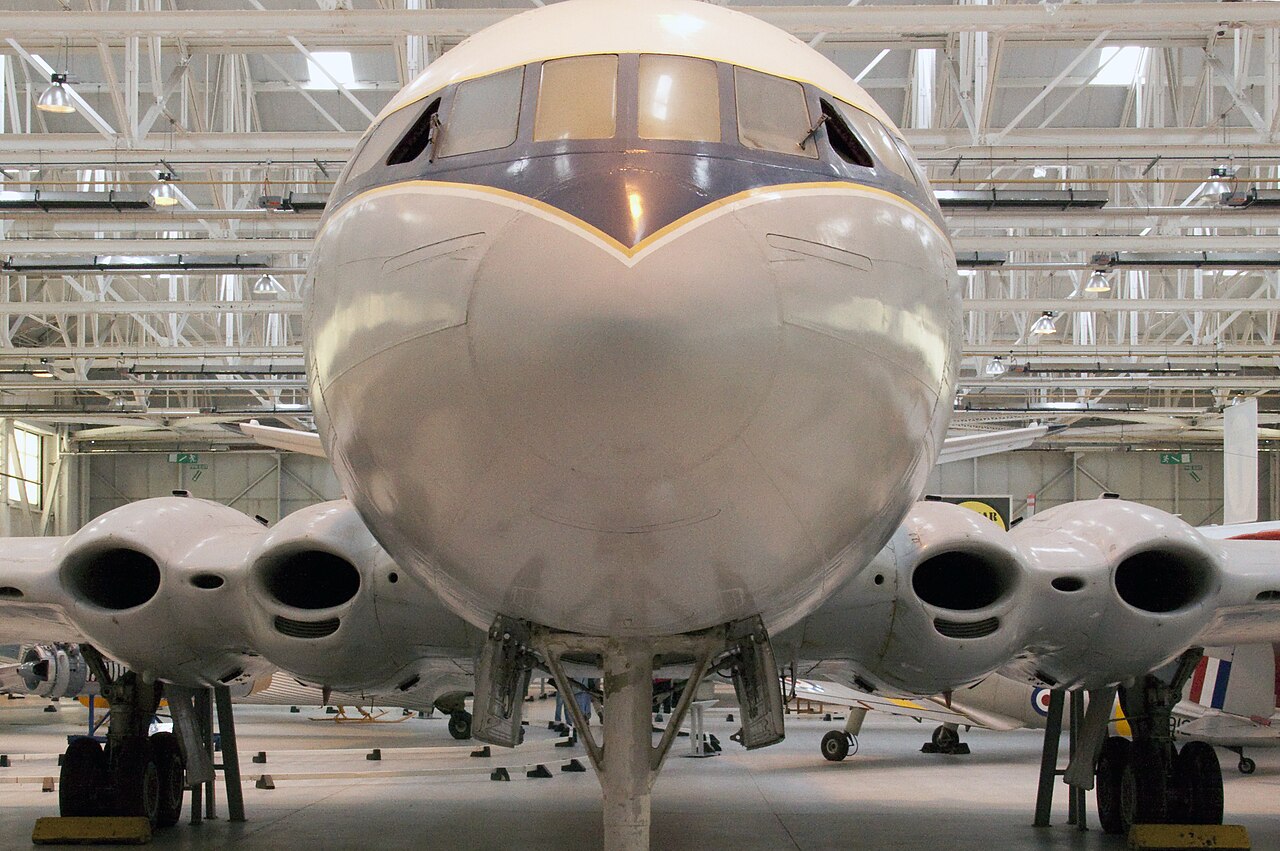
De Havilland Comet RAF Museum Cosford (1)
![Nose of de Havilland Comet 4C [G-BEEX]](https://live.staticflickr.com/4665/24806496097_e52fb06f58_n.jpg)


De Havilland's Ambitious Vision
The De Havilland Comet represents a pivotal moment in aviation history, marking the transition from propeller-driven aircraft to the jet age. Developed by the British firm de Havilland, the Comet DH.106 was conceived with a vision for faster, more comfortable air travel. Its design was remarkably advanced for its time, featuring four de Havilland Ghost turbojet engines integrated into the wing roots, a sleek aerodynamic profile, and crucially, a pressurized cabin.
This pressurization allowed the Comet to fly at higher altitudes, above much of the turbulent weather, offering a smoother and quieter passenger experience. The prototype first flew in 1949, and its commercial debut in 1952 with BOAC was met with immense excitement, promising to shrink the world and revolutionize long-distance travel. It was a bold leap forward, showcasing British engineering prowess and setting a new benchmark for passenger aviation.
Tragedy Strikes
The Comet's initial success was tragically short-lived. Within its first year of operation, three Comet 1 aircraft were lost in mid-air disasters, events that were highly publicized and deeply concerning. These accidents were not attributed to pilot error or simple mechanical failure but to a more insidious problem: catastrophic structural failure.
Investigations, utilizing advanced techniques for the era, revealed the culprit to be metal fatigue. The repeated cycles of pressurization and depressurization inherent in high-altitude jet flight caused microscopic cracks to propagate, particularly around stress concentration points like the square-shaped cut-outs for the automatic direction finder (ADF) antennas and the corners of the large, square windows. This phenomenon, not fully understood at the time, led to explosive decompression and the disintegration of the aircraft's fuselage.
The Comet's failures served as a stark, real-world laboratory for understanding the complex stresses placed upon aircraft structures.
Engineering Resilience
The grounding of the Comet fleet initiated an intensive period of engineering analysis and redesign. De Havilland, alongside independent researchers, conducted exhaustive testing, including the construction of a full-scale fuselage section that was subjected to repeated pressurization cycles until failure. This meticulous process confirmed the role of stress concentrations around openings.
The subsequent redesign was comprehensive. The Comet 2 and prototype Comet 3 incorporated significant structural reinforcements. Most notably, the windows were made smaller and more rounded, and the overall airframe was strengthened to better withstand the rigors of high-altitude jet flight.
This redesign effort was not just about salvaging the Comet program; it was about establishing new standards for aircraft design and safety. The lessons learned were invaluable, directly informing the development of subsequent jetliners by rival manufacturers who carefully studied the Comet's setbacks.
The Comet's Enduring Legacy
Although the Comet's initial market advantage was lost due to the grounding and redesign, the improved Comet 4 series, introduced in 1958, achieved considerable commercial success and remained in passenger service until 1981. The aircraft's versatility extended far beyond civilian transport. It was adapted for numerous military roles, including VIP transport, medical evacuation, and reconnaissance.
The most significant adaptation was the development of the Hawker Siddeley Nimrod, a maritime patrol and reconnaissance aircraft. Based on the Comet's airframe, the Nimrod entered service in the late 1960s and proved exceptionally long-lived, with the last variant flying until 2011. This remarkable service life, spanning over six decades from the Comet's first flight, underscores the fundamental soundness of the original design and its adaptability.
The De Havilland Comet, despite its challenging beginnings, ultimately left an indelible mark on aviation, pioneering jet travel and fundamentally advancing the science of aerospace engineering and safety.
See also
Frequently Asked Questions
What was the De Havilland Comet?+
Why did the early Comet planes crash?+
How did engineers fix the Comet after the crashes?+
When did the Comet first fly and when did it start commercial service?+
Did the Comet ever fly again after the crashes?+
Based on content from Wikipedia · Licensed under CC BY-SA 4.0