

Central African Republic
Images
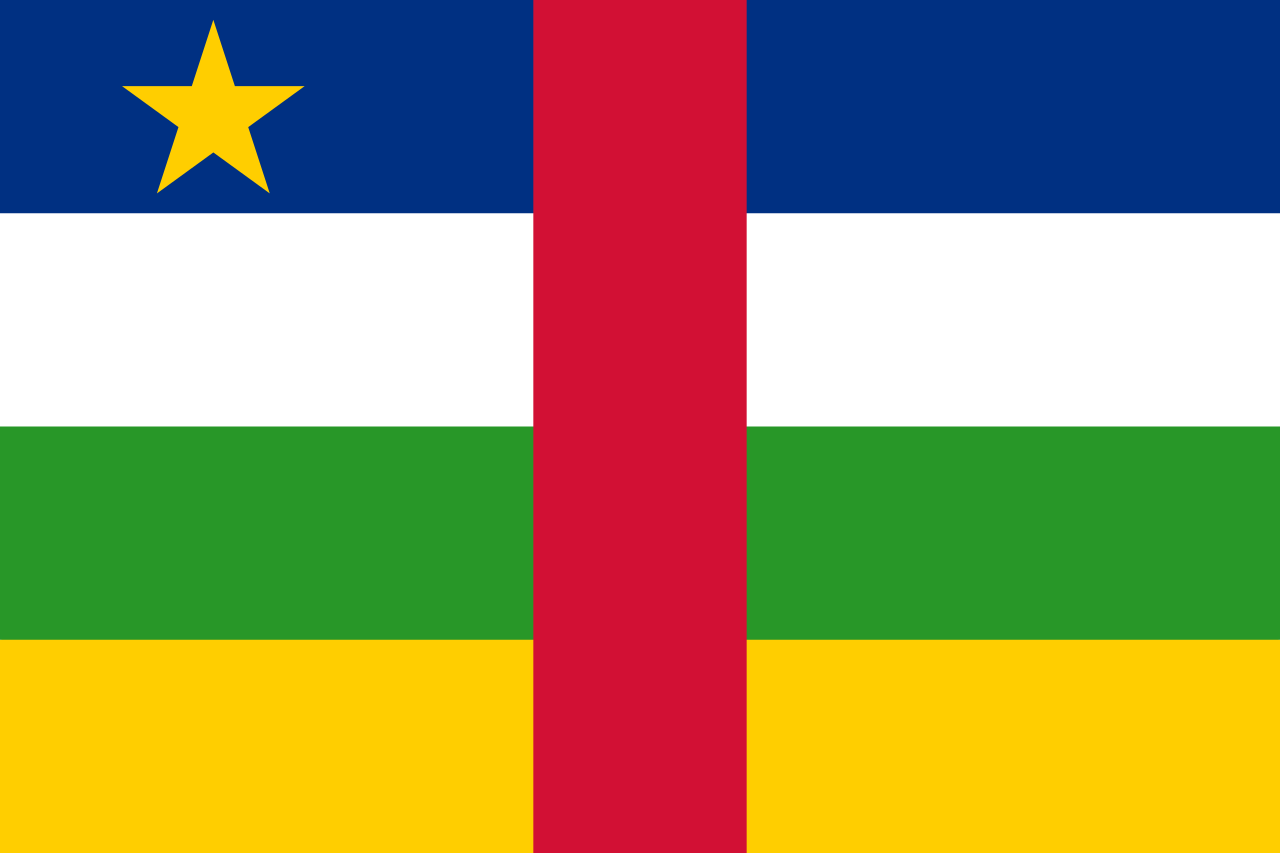
Central African Republic
Opens Google Maps in new tab
Geopolitical Crossroads and Environmental Tapestry
The Central African Republic (CAR) occupies a strategic, yet challenging, position in the heart of the African continent. As a landlocked nation, it shares borders with six countries: Chad, Sudan, South Sudan, the Democratic Republic of the Congo, the Republic of the Congo, and Cameroon. This central location influences its trade routes and regional dynamics.
Geographically, the CAR is a mosaic of ecosystems. The dominant Sudano-Guinean savanna stretches across much of its territory, supporting diverse flora and fauna. To the north, a drier Sahelo-Sudanian zone transitions towards the Sahel, while the southern reaches are characterized by dense equatorial rainforests.
Hydrologically, the country is divided: two-thirds lie within the Ubangi River basin, a major tributary of the Congo River, while the remaining third is part of the Chari River basin, which flows into Lake Chad. This varied geography presents both opportunities and challenges for resource management and development.
A Chronicle of Colonialism, Independence, and Imperial Ambitions
The human history of the CAR stretches back millennia, with evidence of settlement dating to at least 8000 BCE. The modern borders, however, were largely defined by French colonial expansion in the late 19th and early 20th centuries. The territory was organized as Ubangi-Shari, a constituent part of French Equatorial Africa.
Following decolonization, the CAR gained independence in 1960. The post-independence era has been marked by political turbulence, characterized by a succession of autocratic leaders. Perhaps the most notorious was Jean-Bedel Bokassa, who seized power and, in 1976, declared the Central African Empire, crowning himself emperor in a lavish ceremony.
This period of imperial rule lasted until 1979, leaving a significant, albeit controversial, mark on the nation's history and its international perception.
The Scars of Conflict
The Central African Republic has been embroiled in a devastating civil war, with major phases beginning in 2004 and escalating significantly in 2012. Despite peace agreements signed in 2007 and 2011, conflict has persisted, fueled by complex political, ethnic, and economic grievances. The war has resulted in widespread displacement, humanitarian crises, and a severe deterioration of human rights.
Various armed groups have been implicated in grave abuses, including killings, sexual violence, and recruitment of child soldiers. This ongoing instability severely hampers the country's ability to govern effectively, provide basic services, and foster economic recovery, creating a cycle of violence and poverty.
Paradox of Plenty
The CAR possesses substantial natural resources, including significant reserves of uranium, crude oil, gold, diamonds, and cobalt, alongside valuable timber and considerable hydropower potential. The country also boasts large tracts of arable land suitable for agriculture. Paradoxically, despite this wealth, the Central African Republic consistently ranks among the world's poorest nations.
As of recent estimates, it has one of the lowest GDP per capita figures globally and ranks extremely low on the Human Development Index (HDI), often placing among the bottom three countries out of nearly 200. The inequality-adjusted HDI (IHDI) also reveals deep disparities. This stark contrast highlights systemic issues in governance, resource management, and the devastating impact of conflict on development, making the CAR a critical case study in resource curse theory and the challenges of state-building in fragile environments.
Go deeper
Frequently Asked Questions
What is the Central African Republic and where is it located?+
Why does the Central African Republic have many rivers and forests?+
Who was Jean‑Bedel Bokassa and what did he do?+
Why is the Central African Republic facing a civil war?+
What natural resources does the Central African Republic have?+
Based on content from Wikipedia · Licensed under CC BY-SA 4.0