

Catalytic Triad: Tiny Helpers in Your Body!
Images

Catalytic triad


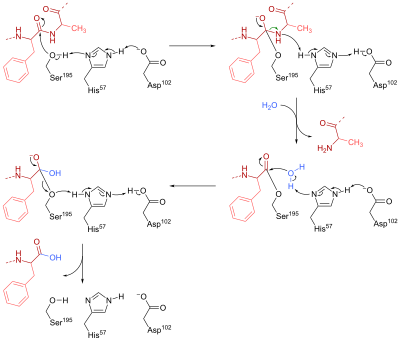


The Architectural Brilliance of the Catalytic Triad
A catalytic triad represents a sophisticated molecular design principle found in the active sites of numerous enzymes, particularly within the hydrolase and transferase superfamilies. This triad comprises three specific amino acid residues-typically an acidic residue, a basic residue, and a nucleophilic residue-that are precisely oriented in three-dimensional space to facilitate catalysis. Despite often being distant from each other in the linear amino acid sequence (primary structure), the enzyme's intricate folding brings them into close proximity, forming a functional unit.
This spatial arrangement is critical, enabling the formation of a 'charge-relay network.' This network polarizes and activates the nucleophilic residue, making it highly reactive. The nucleophile, commonly serine or cysteine (though occasionally threonine or even selenocysteine), then initiates catalysis by attacking the substrate, forming a transient covalent intermediate. This intermediate is subsequently hydrolyzed, releasing the product and regenerating the enzyme, poised for another catalytic cycle.
The precision of this arrangement underscores the remarkable specificity and efficiency of enzymatic action.
The Evolutionary Symphony
The widespread occurrence of catalytic triads across diverse enzyme families is a compelling testament to convergent evolution. This phenomenon, where unrelated organisms independently evolve similar traits or solutions to similar problems, is strikingly evident here. Chemical constraints and the fundamental requirements for efficient catalysis have guided evolutionary pressures towards this specific three-residue motif.
Scientists have identified this catalytic strategy in at least 23 distinct enzyme superfamilies, indicating its profound evolutionary advantage. This independent evolution suggests that the catalytic triad represents an optimal, perhaps even near-perfect, solution for facilitating certain types of chemical transformations, particularly ester and amide bond hydrolysis. The recurrence of this motif across vast evolutionary distances highlights fundamental principles of molecular design and the power of natural selection to discover highly effective functional mechanisms.
Biochemical Significance
The importance of catalytic triads cannot be overstated; they are central to countless biochemical processes essential for life. Enzymes employing catalytic triads are responsible for breaking down macromolecules like proteins and fats, a process vital for digestion and nutrient absorption. They play critical roles in cellular signaling pathways, DNA replication and repair, and the synthesis of various biomolecules.
For example, serine proteases, which utilize a catalytic triad, are involved in blood clotting, immune responses, and muscle contraction. The remarkable catalytic efficiency-often increasing reaction rates by factors of 10^6 to 10^12-enabled by these triads allows biological systems to operate at physiological temperatures and pressures. Without this enzymatic acceleration, many essential reactions would proceed too slowly to sustain life, rendering complex biological functions impossible.
Their study provides profound insights into the fundamental mechanisms of enzyme action and molecular recognition.
Mechanism Deep Dive
The heart of the catalytic triad's function lies in its charge-relay mechanism. Let's consider a typical serine protease triad (Ser-His-Asp). The aspartate residue, being acidic, stabilizes the positively charged imidazole ring of the histidine residue.
This stabilization lowers the pKa of the histidine, making it a better proton acceptor. In its activated state, the histidine acts as a general base, abstracting a proton from the hydroxyl group of the serine residue. This deprotonation transforms the serine's hydroxyl group into a highly potent alkoxide nucleophile.
This nucleophile then attacks the electrophilic carbonyl carbon of the substrate, forming a tetrahedral intermediate. This intermediate is stabilized by hydrogen bonds, often involving the backbone amide of the serine residue. Subsequently, the histidine, now acting as a general acid, donates a proton to facilitate the departure of the leaving group from the substrate, breaking the substrate's bond.
The enzyme is then regenerated, ready for another cycle. This intricate dance of proton transfer and nucleophilic attack exemplifies sophisticated molecular engineering.
Modern Relevance and Therapeutic Potential
The deep understanding of catalytic triads has significant implications in modern biotechnology and medicine. Many pharmaceutical drugs are designed to inhibit enzymes that contain catalytic triads, targeting diseases ranging from viral infections to cancer. For instance, inhibitors of viral proteases, which often feature catalytic triads, are crucial components of antiviral therapies, such as those used to treat HIV.
Similarly, understanding the mechanisms of serine proteases involved in inflammation and blood coagulation has led to the development of anticoagulant drugs. Furthermore, the ability to engineer enzymes with modified catalytic triads or to design novel enzymes for specific industrial applications, such as in biofuel production or bioremediation, is an active area of research. The catalytic triad serves as a foundational model for enzyme design and drug discovery, showcasing the power of understanding molecular mechanisms for practical applications.
See also
Frequently Asked Questions
What is a catalytic triad in enzymes?+
How do the three amino acids in a catalytic triad work together?+
Why are catalytic triads so important for our bodies?+
Where do catalytic triads appear in our body?+
How did catalytic triads evolve?+
Based on content from Wikipedia · Licensed under CC BY-SA 4.0