

Calvin cycle
Images

File:Calvin cycle diagram miguelferig.png

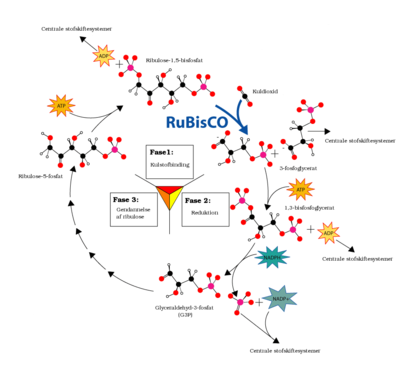


The Calvin Cycle
The Calvin cycle, also known as the light-independent reactions or the photosynthetic carbon reduction (PCR) cycle, represents a sophisticated biochemical pathway that underpins autotrophic life. It is the primary mechanism by which atmospheric carbon dioxide is converted into organic molecules, specifically sugars, which serve as the energy currency for virtually all ecosystems. This cycle is not a singular event but a complex, multi-step process occurring in the stroma of chloroplasts in plants, algae, and cyanobacteria, as well as in some photosynthetic bacteria.
Its presence across such a diverse range of organisms highlights its evolutionary significance and fundamental role in the biosphere's energy flow. The cycle's efficiency lies in its ability to regenerate its starting molecule, allowing for continuous carbon fixation as long as the necessary energy inputs are available.
The Genesis of a Discovery
The elucidation of the Calvin cycle was a monumental achievement in understanding plant physiology and biochemistry. While photosynthesis was known to involve light and carbon dioxide, the specific steps of how CO2 was converted into sugars remained a mystery for decades. Key breakthroughs came in the mid-20th century through the pioneering work of Melvin Calvin and his colleagues at the University of California, Berkeley.
Using radioactive carbon-14 as a tracer, they meticulously mapped the intermediate compounds formed during photosynthesis. Their research, which earned Calvin the Nobel Prize in Chemistry in 1961, revealed the cyclical nature of these reactions and identified the key molecules involved, including ribulose-1,5-bisphosphate (RuBP) and various phosphorylated sugars. This discovery fundamentally changed our understanding of how plants create organic matter from inorganic sources.
Ecological and Climatic Imperatives of Carbon Fixation
The Calvin cycle's importance extends far beyond the individual plant; it is a critical regulator of global biogeochemical cycles and climate. By fixing atmospheric CO2, it acts as a massive carbon sink, mitigating the greenhouse effect and influencing atmospheric composition. The organic carbon produced forms the base of terrestrial and aquatic food webs, meaning that the energy sustaining almost all life on Earth originates from this cycle.
Furthermore, the efficiency and regulation of the Calvin cycle directly impact agricultural productivity and the capacity of ecosystems to sequester carbon. Understanding its nuances is vital for addressing challenges like climate change, food security, and sustainable resource management, as it dictates how effectively we can harness biological processes for carbon capture and biomass production.
The Three Acts of Carbon Reduction
The Calvin cycle is elegantly divided into three interconnected phases, each crucial for its overall function. Phase 1, carbon fixation, involves the enzyme RuBisCO catalyzing the carboxylation of ribulose-1,5-bisphosphate (RuBP) with CO2, forming an unstable six-carbon intermediate that quickly splits into two molecules of 3-phosphoglycerate. Phase 2, reduction, utilizes the ATP and NADPH generated during the light-dependent reactions.
ATP phosphorylates 3-phosphoglycerate to 1,3-bisphosphoglycerate, which is then reduced by NADPH to glyceraldehyde-3-phosphate (G3P), a three-carbon sugar. For every six molecules of G3P produced, one molecule exits the cycle to be used for synthesizing glucose and other organic compounds. Phase 3, regeneration, is vital for maintaining the cycle's continuity.
The remaining five molecules of G3P undergo a complex series of reactions, requiring ATP, to regenerate three molecules of RuBP, thus completing the cycle and preparing it for further CO2 fixation. This intricate molecular choreography ensures a continuous supply of sugars and regenerates the CO2 acceptor.
Adaptations and Modern Relevance
While the fundamental Calvin cycle is conserved, plants have evolved sophisticated adaptations to optimize carbon fixation in diverse environments. C3 plants, the most common type, perform the Calvin cycle directly in mesophyll cells. However, RuBisCO can also bind oxygen instead of CO2, a process called photorespiration, which reduces photosynthetic efficiency, especially in hot, dry conditions.
To counter this, C4 plants (like corn and sugarcane) and CAM plants (like cacti and succulents) have developed specialized mechanisms. C4 plants spatially separate CO2 fixation and the Calvin cycle, concentrating CO2 around RuBisCO. CAM plants temporally separate these processes, fixing CO2 at night and running the Calvin cycle during the day.
These adaptations underscore the evolutionary pressures on the Calvin cycle and highlight its central role in plant survival and productivity, with ongoing research exploring how to engineer these efficiencies into crops for improved yields and resilience in a changing climate.
See also
Based on content from Wikipedia · Licensed under CC BY-SA 4.0