

Calipers: Super Measuring Tools!
Images

Calipers




The Evolution of Precision
Calipers represent a fundamental advancement in humanity's ability to quantify the physical world. Their origins can be traced back to antiquity, with evidence suggesting their use in ancient Greece and Rome for tasks demanding exactitude, such as sculpting and metalworking. These early instruments, likely simple hinged devices, laid the groundwork for more sophisticated designs.
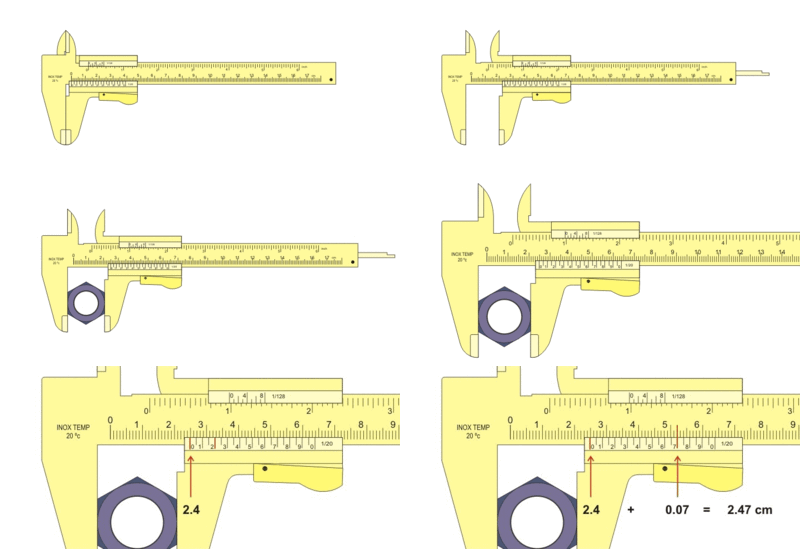
The development of the vernier caliper in the 17th century by Pierre Vernier was a monumental leap, introducing a secondary scale that dramatically increased measurement precision, allowing for readings to fractions of a millimeter. This innovation paved the way for dial calipers, which use a mechanical dial to display measurements, and later, digital calipers, employing electronic sensors for highly accurate and easily readable results. This progression highlights a continuous drive for greater accuracy and user-friendliness in measurement technology.
The Indispensable Role of Calipers in Modern Endeavors
The significance of calipers extends far beyond simple measurement; they are critical enablers of modern technology and scientific discovery. In manufacturing, they are the linchpin of quality control, ensuring that components meet stringent specifications. Without calipers, the interchangeability of parts, a cornerstone of mass production, would be impossible.
In engineering and design, precise measurements are vital for creating everything from aircraft wings to microchips. Scientific research relies heavily on calipers for accurate data collection, whether measuring biological specimens, geological samples, or experimental apparatus. Furthermore, in fields like metrology (the science of measurement), calipers are foundational tools for calibration and verification, underpinning the reliability of countless measurements across industries.
Anatomy of Accuracy
Calipers employ distinct mechanisms to achieve their precision. Vernier calipers utilize a sliding jaw and a vernier scale, which allows for interpolation between the main scale's divisions, typically achieving resolutions of 0.02 mm or 0.05 mm. Dial calipers replace the vernier scale with a geared dial indicator, offering a more intuitive visual representation of fine measurements, often with similar resolutions.
Digital calipers, the most modern iteration, incorporate electronic sensors (like capacitive or optical encoders) to detect jaw movement. This data is processed and displayed on an LCD screen, often with resolutions as fine as 0.01 mm, and frequently includes features like data output for digital recording and zero-setting capabilities for relative measurements. Each type offers a balance of precision, ease of use, and cost.
Beyond the Basics
While standard calipers measure external and internal dimensions and depth, specialized variants cater to niche applications. Micrometer calipers, for instance, combine the principles of a micrometer with caliper jaws for extremely high precision. Screw thread calipers are designed to measure the pitch and diameter of screw threads accurately. In medical fields, specialized calipers might be used in orthopedics for measuring bone lengths or in dentistry for assessing tooth dimensions.
The ongoing development in materials science and manufacturing techniques continues to drive innovation in caliper design, leading to lighter, more durable, and even more accurate instruments, some incorporating non-contact measurement technologies for delicate or sensitive materials.
The Future of Measurement
The integration of digital technology has profoundly impacted caliper design and application. Modern digital calipers often feature Bluetooth or USB connectivity, allowing for seamless data transfer to computers or tablets for analysis and record-keeping. This capability is invaluable in automated quality control systems and research environments where large datasets are generated.
Furthermore, advancements in sensor technology are pushing the boundaries of accuracy and reliability. As industries demand ever-tighter tolerances and greater efficiency, calipers will continue to evolve, potentially incorporating AI for automated inspection or integrating with 3D scanning technologies to provide comprehensive dimensional analysis. They remain a cornerstone of precision, adapting to meet the challenges of future technological frontiers.
See also
Frequently Asked Questions
What are calipers and why are they called super measuring tools?+
How did calipers become more accurate over time?+
Why do factories need calipers?+
What are digital calipers and how do they work?+
Can calipers be used in medicine?+
Based on content from Wikipedia · Licensed under CC BY-SA 4.0