

Brandenburg Gate
Images
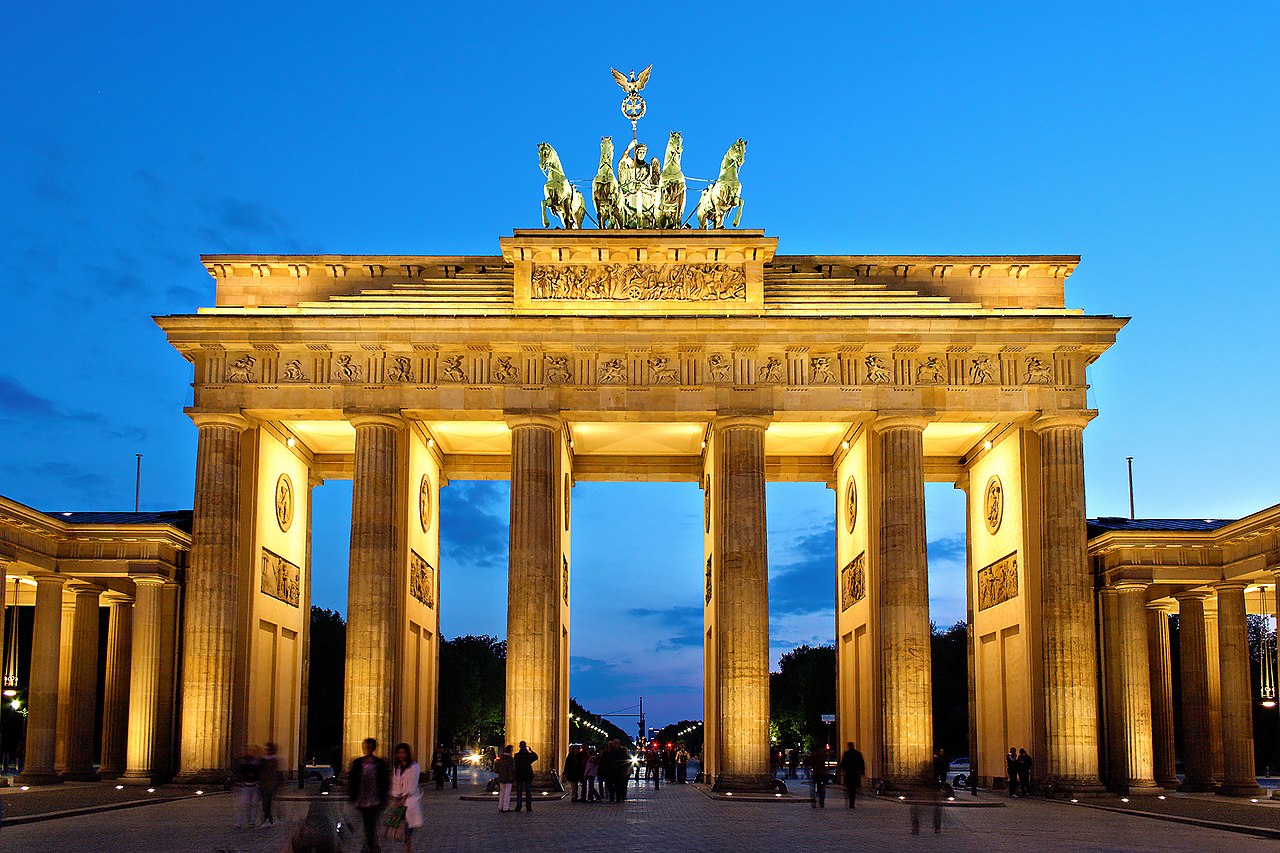
Brandenburger Tor Abends


Architectural Genesis and Symbolism
The Brandenburg Gate, a masterpiece of 18th-century neoclassical architecture, stands as Berlin's most iconic landmark. Commissioned by King Frederick William II of Prussia and designed by Carl Gotthard Langhans, its construction spanned from 1788 to 1791. The gate's design draws heavily from the Propylaea, the monumental gateway to the Acropolis in Athens, reflecting the era's fascination with classical antiquity and its association with democracy and civilization.
Originally conceived as a symbol of peace, it was named after the road leading to Brandenburg an der Havel, the historic capital of the Margraviate of Brandenburg. The addition of Johann Gottfried Schadow's Quadriga in 1793, a dynamic sculpture of the goddess of victory driving a chariot, further enhanced its symbolic resonance, initially representing Prussian triumph and later evolving to embody broader themes of peace and national identity.
Its imposing scale and elegant proportions have always commanded attention, making it a focal point for public life and historical commemoration.
A Stage for Germany's Tumultuous History
The Brandenburg Gate's physical location in Berlin's historic center has made it an unavoidable witness to Germany's dramatic and often tragic history. From its inauguration, it served as a backdrop for royal processions, military parades, and significant public gatherings. However, its role shifted dramatically in the 20th century.
Following World War II, Berlin was divided, and the gate found itself in the Soviet sector, directly on the border with the British sector. The construction of the Berlin Wall in 1961 rendered the gate inaccessible to both East and West Berliners, transforming it from a symbol of connection into a stark emblem of division and the Iron Curtain. For nearly three decades, it stood isolated and forlorn, a potent visual representation of the Cold War's geopolitical schism.
Its eventual reopening after the fall of the Wall in 1989, witnessed by hundreds of thousands, marked a profound moment of national and international celebration, symbolizing the end of an era and the dawn of reunification.
Geopolitical Significance and Urban Context
The Brandenburg Gate is situated in the heart of Berlin's Mitte district, a historically significant area that has undergone continuous transformation. Its placement at the nexus of Unter den Linden, a grand boulevard, and Ebertstraße, adjacent to Pariser Platz, underscores its monumental urban design. To its west, it opens onto the vast Tiergarten park, Berlin's green lung, and the Reichstag building, the seat of the German parliament, highlighting its proximity to centers of political power and public recreation.
This strategic positioning has cemented its role not just as a tourist attraction but as an integral part of Berlin's civic and political landscape. The gate's enduring presence, despite the city's radical changes, makes it a constant reference point, connecting contemporary Berlin to its imperial, war-torn, and reunited past. Its integration into the urban fabric ensures its continued relevance in shaping the city's identity.
Enduring Symbol of Peace and European Identity
Since German reunification in 1990, the Brandenburg Gate has transcended its national significance to become a powerful symbol of European unity and peace. It represents the overcoming of historical divisions and the aspiration for a continent free from conflict. The gate serves as a constant reminder of the fragility of peace and the importance of dialogue and cooperation.
It is a site where Germans and Europeans alike come to reflect on their shared history and to celebrate their common future. Its image is globally recognized, often used in media and political discourse to represent Germany and the broader concept of European integration. The gate's transformation from a symbol of division to one of unity is a testament to its enduring power and its capacity to adapt its meaning through historical events, making it a vital monument for understanding contemporary Europe.
Cultural Resonance and Modern Relevance
The Brandenburg Gate continues to resonate deeply within German culture and beyond. It is a focal point for national celebrations, such as New Year's Eve festivities, and a gathering place for political demonstrations and public discourse. Its image is ubiquitous, appearing on currency, in films, and in art, solidifying its status as a cultural icon.
The gate's historical narrative, marked by periods of grandeur, conflict, and reconciliation, provides a rich tapestry for educational and commemorative purposes. For younger generations, it serves as a tangible link to the past, offering lessons about the consequences of war and the value of peace and unity. Its continued prominence in public life ensures that the Brandenburg Gate remains a dynamic and relevant monument, inspiring reflection and dialogue about history, identity, and the future of Europe.
Go deeper
Frequently Asked Questions
What is the Brandenburg Gate?+
Who built the Brandenburg Gate?+
Why does the gate have a statue called the Quadriga?+
What happened to the gate during the Berlin Wall?+
Where is the Brandenburg Gate located in Berlin?+
Based on content from Wikipedia · Licensed under CC BY-SA 4.0