

Bodhi Tree
Images

Under the Bodhi tree, At Lord Buddha's enlightenment seat, The Vajrasana, (Sanskrit for 'diamond throne'), offerings under the new cover, flowers, khatas, buddhist flag, His Holiness Dagchen Sakya, monks, relatives, BodhGaya, H.P., India, 1993


The Genesis of Awakening
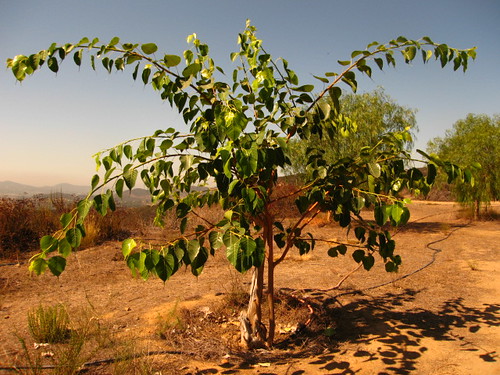
The Bodhi Tree, scientifically classified as Ficus religiosa, holds unparalleled significance in the spiritual landscape, primarily as the arboreal witness to Siddhartha Gautama's attainment of enlightenment. This pivotal event, occurring approximately 2,500 years ago in Bodh Gaya, India, marked the birth of Buddhism and fundamentally reshaped philosophical and religious thought across Asia and beyond. The Ficus religiosa, a species native to the Indian subcontinent and parts of Southeast Asia, is characterized by its large, distinctive leaves with elongated tips and its impressive, spreading canopy, creating an atmosphere conducive to deep meditative states.
Its natural habitat typically includes riverbanks and sacred groves, environments that foster its growth and contribute to its serene aura. The original Bodhi Tree is no longer standing, but its legacy is meticulously preserved through its descendants, making Bodh Gaya a paramount pilgrimage site for millions seeking spiritual connection.
Symbolism and Propagation
Beyond its historical role, the Bodhi Tree functions as a potent and multifaceted symbol within Buddhist traditions and wider culture. It represents not only enlightenment but also peace, wisdom, compassion, and the interconnectedness of life. The tree's unique biological characteristic of producing aerial roots that descend from branches and re-establish themselves in the ground is often interpreted metaphorically, symbolizing the continuous growth and propagation of spiritual understanding and the enduring nature of truth.
This symbolic resonance has driven its careful cultivation and propagation. The most famous living descendant, the Jaya Sri Maha Bodhi in Anuradhapura, Sri Lanka, was planted in 288 BCE from a cutting of the original Bodhi Tree, brought by Sanghamitta Theri. This remarkable continuity underscores the tree's profound cultural and religious importance, with many other Bodhi Trees worldwide tracing their lineage back to these ancient origins.
Botanical Characteristics and Ecological Role
From a botanical perspective, Ficus religiosa is a large, semi-epiphytic tree belonging to the Moraceae family, closely related to other fig species. Its leaves, often described as 'peepal' leaves, are ovate with a characteristic drip-tip, an adaptation that facilitates rapid runoff of water in tropical monsoonal climates, preventing fungal growth on the leaf surface. While it produces syconia, or figs, these are generally small and not a primary food source for humans, serving instead as a vital resource for various frugivorous animals, including birds, bats, and insects, thus playing a role in seed dispersal within its ecosystem.
The tree's longevity is exceptional; some specimens are estimated to be over 3,000 years old, contributing to its revered status and its role as a living historical artifact. Its resilience and adaptability allow it to thrive in diverse conditions within its native range.
The Bodhi Tree in Contemporary Society and Global Influence
The Bodhi Tree continues to exert a significant influence in contemporary society, transcending religious boundaries. Its image and symbolism are widely recognized, appearing in art, literature, and architectural designs globally. In modern times, Bodhi Trees are often found in Buddhist temples, monasteries, and meditation centers worldwide, serving as focal points for spiritual practice, mindfulness, and interfaith dialogue.
The act of tending to these sacred trees often involves community engagement, fostering a sense of shared responsibility and connection to nature. Furthermore, the tree's association with profound wisdom and inner peace makes it a relevant icon in discussions about mental well-being and contemplative practices in an increasingly fast-paced world. Its enduring presence serves as a constant reminder of the potential for profound insight and transformation that lies within quiet reflection.
Go deeper
Frequently Asked Questions
What is a Bodhi Tree?+
Where did Buddha become enlightened under the Bodhi Tree?+
Why is the Bodhi Tree special to Buddhists?+
How can I find a Bodhi Tree today?+
What makes the Bodhi Tree's leaves special?+
Based on content from Wikipedia · Licensed under CC BY-SA 4.0