

Biogeography: Where Do Animals and Plants Live?
Images

Molecular phylogeny and biogeography of ranoid frogs



The Architecture of Biodiversity Distribution
Biogeography is the scientific discipline dedicated to understanding the spatial patterns of biodiversity and the historical processes that have shaped them. It investigates why species and entire ecosystems are distributed across Earth's surface in the complex, non-random ways they are observed today. This field recognizes that biological communities exhibit regular variations along geographic gradients, such as latitude, elevation, isolation, and habitat area.
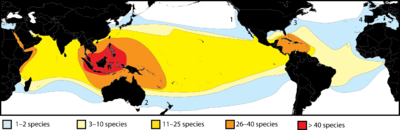
For instance, species richness generally declines from the tropics towards the poles, and distinct faunal and floral realms exist due to continental drift and evolutionary divergence. Biogeographers seek to explain these patterns by integrating data from various scientific domains, recognizing that life's distribution is a product of both contemporary ecological interactions and deep geological time.
Foundational Explorations and Evolutionary Insights
The conceptual foundations of modern biogeography were laid by pioneering naturalists and explorers. Alexander von Humboldt's meticulous observations in the late 18th and early 19th centuries, particularly his work on vegetation zones along altitudinal and latitudinal gradients, provided crucial empirical data. Francisco Jose de Caldas also contributed early insights into plant distribution.
Later, figures like Hewett Cottrell Watson and Alphonse de Candolle in the mid-19th century began to formulate theories about plant dispersal and adaptation. Alfred Russel Wallace, independently developing a theory of evolution by natural selection, made significant contributions through his extensive fieldwork in the Malay Archipelago, observing how geographic isolation led to unique species. These early investigations established biogeography as a critical field for understanding evolutionary processes and the history of life.
Ecological and Evolutionary Applications
Biogeography serves as a vital bridge between ecology and evolutionary biology, offering insights into both short-term ecological processes and long-term evolutionary history. Ecological biogeography examines the immediate factors influencing species distribution, such as dispersal limitations, competition, predation, and resource availability within specific habitats. It helps explain why a particular species thrives in one location but not another based on current environmental conditions.
Historical biogeography, conversely, reconstructs the past distribution of organisms and the geological and climatic events that caused them to spread, fragment, or become extinct. By studying fossil records and analyzing the evolutionary relationships of extant species, historical biogeographers can infer past continental configurations, climate shifts, and speciation events, providing a deep temporal context for current biodiversity patterns.
Modern Relevance and Integrative Research
In contemporary science, biogeography is an inherently integrative field, drawing upon and contributing to a wide array of disciplines. Modern research often combines detailed field observations and experimental ecology with sophisticated computational tools, phylogenetic analyses, and geological data. Scientists utilize geographic information systems (GIS) and molecular data to map species ranges with unprecedented accuracy and to infer historical dispersal routes.
The study is crucial for addressing pressing global challenges, including biodiversity loss, invasive species management, and predicting the impacts of climate change on ecosystems. By understanding the complex interplay of factors that govern species distribution, biogeography provides essential knowledge for conservation planning, resource management, and comprehending the dynamic nature of life on our planet.
See also
Based on content from Wikipedia · Licensed under CC BY-SA 4.0