

Ardipithecus
Images

Nut cracking Ardipithecus


The Afar Depression
The Afar Depression in Ethiopia has yielded some of the most significant fossil evidence for understanding early hominin evolution, and Ardipithecus is a prime example. This genus, comprising two recognized species-Ardipithecus kadabba (circa 5.6 million years ago) and Ardipithecus ramidus (circa 4.4 million years ago)-inhabited this region during the Late Miocene and Early Pliocene epochs. The paleoenvironment suggested by the fossil finds indicates a mosaic landscape, likely a woodland savanna with gallery forests, which played a critical role in shaping the adaptations of these early hominins.
The discovery and meticulous excavation of Ardipithecus fossils have fundamentally altered our perception of the earliest stages of human lineage divergence from the ape lineage, pushing back the known timeline and introducing novel interpretations of hominin traits.
Mosaic Locomotion
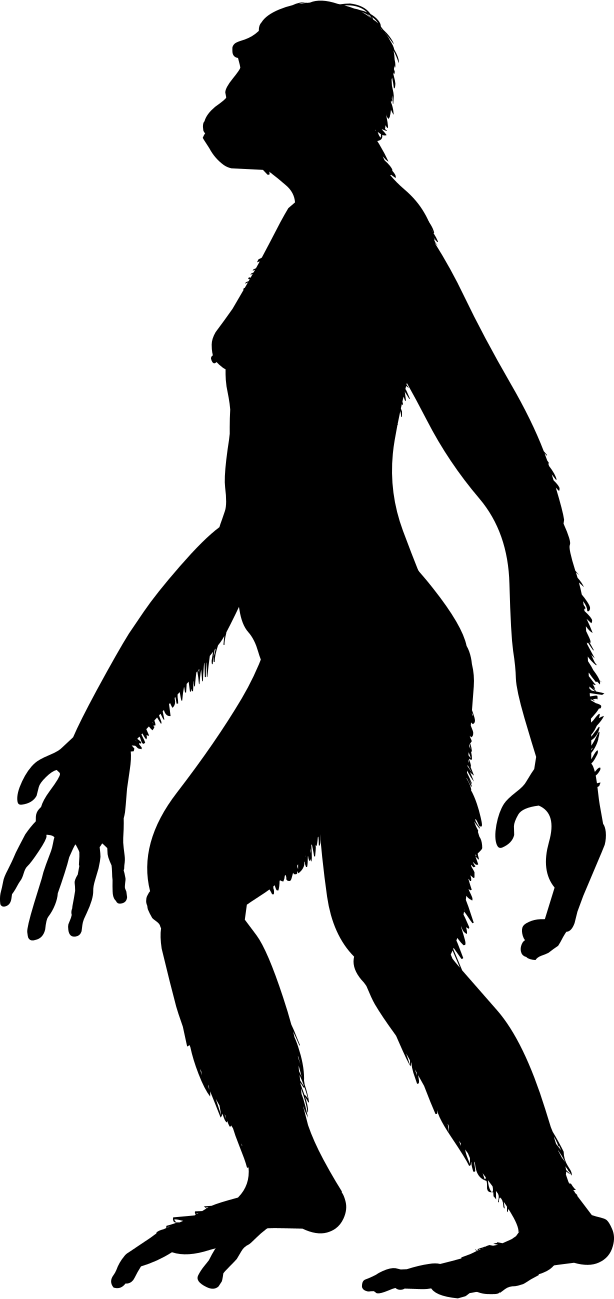
Ardipithecus is particularly renowned for its unique form of locomotion, which complicates the narrative of a straightforward progression towards obligate bipedalism. While possessing features indicative of bipedalism, such as a pelvis that suggests upright posture, Ardipithecus also retained traits associated with arboreal life. Its foot, for instance, appears to have had a more abducted hallux (a divergent big toe) and a less rigid structure than that of later hominins, potentially aiding in climbing.
This mosaic of adaptations suggests that Ardipithecus was not exclusively terrestrial; it likely engaged in both arboreal and terrestrial activities. This challenges the long-held view that early hominins abandoned trees entirely in favor of ground-dwelling bipedalism, presenting a more nuanced picture of transitional locomotion.
Social Dynamics
The social structure and behavioral ecology of Ardipithecus are subjects of ongoing research, with dental morphology providing crucial clues. Analysis of the canine teeth has been particularly revealing. Unlike many primates, including chimpanzees, Ardipithecus exhibits reduced canine size and a lack of significant canine sexual dimorphism. This dimorphism, where males have much larger canines than females, is often linked to inter-male competition and dominance hierarchies.
The reduction and equalization of canine size in Ardipithecus suggest a decrease in aggression and potentially a shift towards more cooperative social behaviors, drawing parallels with the social dynamics observed in bonobos. This interpretation implies that the path to human social evolution may not have been solely characterized by increased aggression.
Phylogenetic Placement
The phylogenetic position of Ardipithecus remains a pivotal point of discussion in paleoanthropology. Initially heralded as one of the earliest definitive human ancestors post-divergence from the chimpanzee lineage, its precise relationship to subsequent hominins is complex and debated. Some cladistic analyses propose that Ardipithecus ramidus is a sister taxon to Australopithecus, meaning Australopithecus is more closely related to A. ramidus than to A. kadabba.
This perspective implies that the genus Australopithecus, and by extension Homo sapiens, emerged from within the Ardipithecus lineage. If this is accurate, then Ardipithecus is not an extinct side branch but rather an ancestral component of the lineage that led to modern humans. This understanding is critical for reconstructing the branching patterns and evolutionary innovations that define our species' history.
Broader Implications for Human Origins Research
The study of Ardipithecus has profound implications for our understanding of human origins. It forces a re-evaluation of the selective pressures that drove hominin evolution, suggesting that factors beyond purely terrestrial bipedalism and inter-group conflict may have been paramount. The mosaic nature of its adaptations highlights the complexity of evolutionary transitions, demonstrating that ancestral traits can persist alongside new developments.
Furthermore, the ongoing debate surrounding its phylogenetic placement underscores the dynamic and often uncertain nature of reconstructing deep evolutionary history. Ardipithecus serves as a critical case study, illustrating how new fossil discoveries and analytical techniques continually refine, and sometimes revolutionize, our scientific understanding of where we came from.
Go deeper
Frequently Asked Questions
What is Ardipithecus?+
Where did scientists find Ardipithecus fossils?+
How did Ardipithecus move?+
Why are its teeth important?+
What does Ardipithecus tell us about human evolution?+
Based on content from Wikipedia · Licensed under CC BY-SA 4.0