

The Great Battles of Mysore!
Images

File:Anglo-Mysore War 4.png


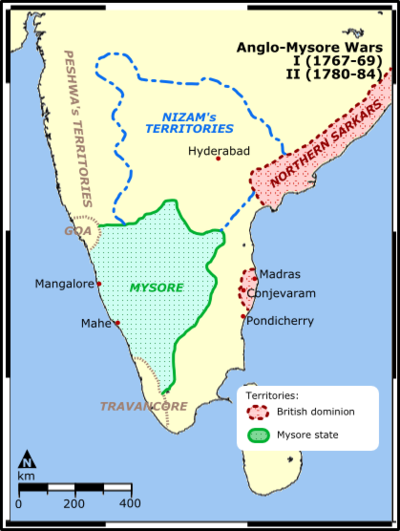
The Geopolitical Landscape
The Anglo-Mysore Wars were not isolated military engagements but rather the culmination of complex geopolitical forces at play in 18th-century India. The Kingdom of Mysore, particularly under Hyder Ali and his son Tipu Sultan, emerged as a formidable indigenous power capable of challenging both regional rivals like the Marathas and the Nizam of Hyderabad, and the increasingly assertive British East India Company.
Hyder Ali, a brilliant military strategist and administrator, modernized Mysore's army, incorporating European drill and tactics, and establishing a formidable artillery and rocket corps. His success in consolidating power and expanding Mysore's influence created a significant buffer state and a direct threat to British ambitions for pan-Indian dominance. The British, driven by economic imperatives and a burgeoning imperial vision, viewed Mysore's strength as an existential challenge to their own hegemonic aspirations.
The wars thus represented a critical struggle for control over the strategically and economically vital southern Indian territories, determining the future balance of power on the subcontinent.
Chronicle of Conflict
The four Anglo-Mysore Wars, spanning from 1767 to 1799, represent a dynamic period of military evolution and strategic adaptation. The First (1767-1769) and Second (1780-1784) Wars showcased Mysore's offensive capabilities. Hyder Ali's tactical brilliance led to significant victories, including the humiliating defeat of a British force under Sir Hector Munro at Polilur in 1780, demonstrating the effectiveness of Mysore's cavalry and artillery.
Tipu Sultan continued this resistance, employing innovative tactics and even utilizing rockets, which were a novel and terrifying weapon for the British. However, the Third Anglo-Mysore War (1790-1792) marked a turning point. The formation of a powerful tripartite alliance – the British, the Marathas, and the Nizam – against Tipu Sultan proved overwhelming.
The Treaty of Seringapatam, which concluded this war, imposed harsh terms, including territorial concessions and the payment of a large indemnity, significantly weakening Mysore. The Fourth Anglo-Mysore War (1799) was a swift and decisive campaign orchestrated by Governor-General Lord Wellesley. Employing superior numbers and resources, the British laid siege to and captured the impregnable fortress of Seringapatam, leading to the death of Tipu Sultan and the effective end of Mysore's independent power.
Architects of War
The Anglo-Mysore Wars were shaped by the strategic acumen and determination of key individuals. On the Mysore side, Hyder Ali laid the foundation for resistance with his astute political maneuvering and military reforms, transforming a principality into a major power. His son, Tipu Sultan, inherited this legacy and became a symbol of Indian resistance against colonial encroachment.
Known as the 'Tiger of Mysore,' Tipu was a visionary ruler who embraced modernity, implementing administrative reforms, promoting trade, and developing a sophisticated military, including a formidable rocket corps that inspired fear and awe. His unwavering commitment to sovereignty and his refusal to accept British paramountcy defined his reign. Countering them were prominent British figures.
Lord Cornwallis, a seasoned military commander, led significant campaigns during the Third War, while Lord Wellesley (later the Duke of Wellington's brother) masterminded the final, decisive victory in the Fourth War, employing a strategy of overwhelming force and diplomatic isolation of Mysore.
The Long Shadow
The conclusion of the Anglo-Mysore Wars in 1799 had profound and lasting consequences for the Indian subcontinent. The British East India Company's victory eliminated the last significant indigenous power in southern India capable of posing a serious military challenge. This success was instrumental in consolidating British dominance, paving the way for the eventual annexation of other Indian states through the Subsidiary Alliance system and direct conquest.
The fall of Mysore marked a critical juncture, accelerating the process of British imperial expansion and fundamentally altering the political landscape. For India, it signified the erosion of sovereignty and the beginning of a prolonged period of colonial rule. Conversely, the valor and tenacity displayed by Hyder Ali and Tipu Sultan cemented their place in history as iconic figures of resistance against foreign domination.
Their story continues to be studied for insights into military strategy, the complexities of colonial encounters, and the enduring spirit of defiance against overwhelming odds, resonating in contemporary discussions about national identity and historical memory.
See also
Frequently Asked Questions
What were the Anglo-Mysore Wars?+
Who was Hyder Ali and why was he important?+
How did Tipu Sultan use rockets in the wars?+
Why did the Third Anglo-Mysore War end with the Treaty of Seringapatam?+
What happened to Mysore after the Fourth Anglo-Mysore War?+
Based on content from Wikipedia · Licensed under CC BY-SA 4.0