

Ajiaco
Images

Ajiaco Colombian Bistro


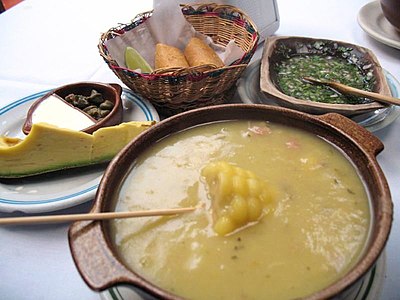

The Elusive Genesis and Pan-Latin American Presence of Ajiaco
Ajiaco stands as a testament to the dynamic nature of culinary traditions, a dish whose precise origins are a subject of ongoing scholarly inquiry, yet whose widespread presence is undeniable. While definitive historical documentation remains elusive, its deep roots are evident in the ingredients and preparation methods that echo centuries of cultural exchange in Latin America. The dish is particularly emblematic in Colombia, where it transcends mere sustenance to become a cultural touchstone.
In the capital, Bogotá, the preparation known as 'ajiaco santafereño' is a highly revered iteration, characterized by its meticulous assembly of tender chicken, a specific trio of potato varieties chosen for their textural and flavor contributions, and the distinctive herbaceous notes of Galinsoga parviflora, or guasca. This Colombian rendition is often considered the archetypal form, though variations abound. In Cuba, Ajiaco manifests as a robust stew, showcasing its adaptability to different culinary landscapes. Peru, with its vast gastronomic diversity, offers numerous regional Ajiacos, each reflecting local agricultural products and cooking techniques.
This geographical spread illustrates how a foundational dish can be reinterpreted, becoming a mirror of the distinct identities of the places it inhabits.
Ajiaco's Historical Trajectory and Socio-Cultural Significance
The historical trajectory of Ajiaco is intricately woven into the socio-cultural fabric of its host countries. While pinpointing an exact start date is challenging, the dish likely evolved from indigenous Andean culinary practices, augmented by ingredients and techniques introduced during the colonial era. The strategic use of multiple potato varieties is particularly noteworthy, given the potato's origin in the Andean highlands and its historical role as a primary food source for indigenous populations.
In Colombia, Ajiaco santafereño has ascended to the status of a national dish, frequently featured in significant social gatherings, family reunions, and festive occasions. Its preparation and consumption are often imbued with a sense of collective identity and heritage, serving as a powerful symbol of cultural continuity. The herb guasca, while perhaps obscure to international palates, is instrumental in defining Ajiaco’s unique sensory profile, imparting a subtle, almost medicinal aroma and a mild, peppery flavor that distinguishes it from other poultry-based soups.
Thus, Ajiaco is not merely a recipe but a vessel carrying historical narratives and communal memories.
The Gastronomic Science Behind Ajiaco's Appeal
The enduring appeal of Ajiaco lies in its sophisticated interplay of textures, flavors, and aromas, a result of thoughtful ingredient selection and preparation. The deliberate inclusion of three distinct potato types is fundamental to its characteristic consistency and mouthfeel. Certain varieties, such as the small, yellow papa criolla, are prized for their tendency to disintegrate during cooking, releasing starches that naturally thicken the broth into a creamy emulsion.
Complementary potato types, like the papa sabanera or pastusa, retain their structure, offering satisfying, tender chunks within the soup. This textural duality is a hallmark of authentic Ajiaco. The savory depth provided by the chicken forms the dish's foundation, while the guasca herb introduces a complex aromatic layer.
Botanical and chemical analyses of Galinsoga parviflora reveal volatile compounds that contribute its signature herbaceous, slightly pungent, and subtly bitter notes, which harmonize with the richness of the broth. The slow, patient simmering process is crucial, allowing these diverse elements to meld into a cohesive and deeply satisfying flavor profile, demonstrating how fundamental culinary techniques can elevate simple ingredients into a gastronomic masterpiece.
Ajiaco's Transnational Influence and Culinary Dialogue
Ajiaco's presence extends beyond its primary strongholds, acting as a culinary ambassador and fostering a dialogue between different food cultures. The Cuban iteration, often prepared as a more substantial stew, exemplifies how the core concept of a nourishing, flavorful dish can be adapted to suit local palates and available ingredients, potentially incorporating elements like yuca or plantains. Similarly, Peru’s array of regional Ajiacos underscores the dish’s remarkable capacity for assimilation, integrating indigenous ingredients and distinct culinary philosophies.
This transnational diffusion of Ajiaco serves as a compelling case study in foodways, illustrating how culinary ideas migrate, transform, and are localized. Studying Ajiaco also provides a valuable entry point for exploring broader themes in Latin American cuisine, such as the significance of staple crops like potatoes and corn, the evolution of stews and soups across the continent, and the impact of historical migrations on food traditions. It connects disparate culinary landscapes through a shared, albeit varied, gastronomic heritage.
Key Facts and Further Exploration
Ajiaco is a dish that invites deeper exploration into the culinary landscapes of its origin countries. Understanding its components, like the specific potato varieties and the unique herb guasca, offers insight into regional agriculture and traditional cooking methods. The scholarly debate surrounding its origins highlights the complexities of tracing food history and the influence of indigenous cultures.
Further research could involve investigating the specific chemical compounds in guasca that contribute to its flavor, or comparing the nutritional profiles of different Ajiaco preparations. Examining the socio-economic factors that have contributed to Ajiaco's status as a national dish in Colombia, or its role in Cuban and Peruvian culinary identity, provides a richer understanding of food's cultural significance. The study of Ajiaco is thus a gateway to appreciating the intricate connections between food, history, geography, and identity across Latin America.
See also
Based on content from Wikipedia · Licensed under CC BY-SA 4.0