

The Universe is Stretching!
Images

Accelerating expansion of the universe


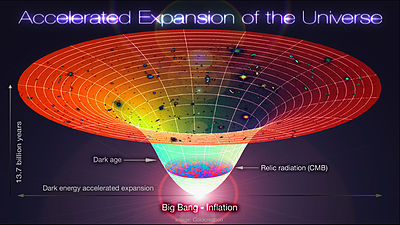


A Paradigm Shift
The prevailing cosmological model prior to the late 1990s assumed that the universe's expansion, initiated by the Big Bang, was decelerating due to the gravitational pull of matter. However, observations of distant Type Ia supernovae by two independent research teams-the Supernova Cosmology Project led by Saul Perlmutter and the High-Z Supernova Search Team led by Brian Schmidt and Adam Riess-provided compelling evidence to the contrary.
These supernovae, known for their consistent peak luminosity, served as crucial standard candles. By measuring their apparent brightness and redshift, astronomers could determine their distances and recession velocities. The data revealed that distant supernovae were fainter than predicted by a decelerating universe, indicating they were farther away.
This discrepancy strongly suggested that the expansion rate of the universe has been increasing over cosmic time, a finding that fundamentally altered our understanding of the cosmos and earned the Nobel Prize in Physics in 2011.
The Enigma of Dark Energy
The accelerating expansion necessitates the existence of a repulsive force counteracting gravity on cosmic scales. This hypothetical entity has been termed 'dark energy.' While its precise nature remains one of the greatest mysteries in physics, leading theories propose it could be a cosmological constant (Lambda, Λ), representing the energy density of empty space, or a dynamic field known as quintessence. Current observations suggest dark energy constitutes approximately 68% of the universe's total energy density, far outweighing dark matter (about 27%) and ordinary baryonic matter (about 5%).
Its equation of state parameter, w, which describes the ratio of its pressure to its energy density, is close to -1, consistent with a cosmological constant. This implies that dark energy's density remains constant even as the universe expands, leading to an ever-increasing repulsive force.
Cosmological Implications and Observational Probes
The discovery of accelerating expansion has profound implications for the ultimate fate of the universe. If dark energy is indeed a cosmological constant, the universe will likely continue to expand at an accelerating rate, leading to a scenario known as the 'Big Freeze' or 'Heat Death.' In this scenario, galaxies will recede beyond each other's observable horizon, stars will eventually exhaust their fuel, and the universe will become increasingly cold, dark, and dilute. Other theoretical possibilities, such as a 'Big Rip' (if dark energy's density increases over time) or a 'Big Crunch' (if dark energy weakens or reverses), are also explored.
Ongoing and future observational efforts, including large-scale galaxy surveys (e.g., the Dark Energy Survey, Euclid, Nancy Grace Roman Space Telescope) and studies of the cosmic microwave background, aim to precisely measure the properties of dark energy and refine our cosmological models.
Connecting to Fundamental Physics and Future Research
The existence of dark energy presents a significant challenge to fundamental physics, particularly in reconciling it with quantum field theory, which predicts a vacuum energy density vastly larger than observed. This discrepancy, known as the cosmological constant problem, suggests a deep gap in our understanding of gravity and quantum mechanics. Research into dark energy is at the forefront of modern cosmology and theoretical physics, driving efforts to develop new theoretical frameworks and more sensitive observational techniques.
Understanding dark energy is not just about the universe's expansion; it's about unraveling the fundamental constituents of reality and the forces that govern them, potentially leading to a more complete picture of the cosmos and its evolution.
See also
Frequently Asked Questions
What does it mean that the universe is stretching faster and faster?+
How did scientists discover that the universe is expanding faster?+
What is dark energy and why is it important?+
What could happen to the universe if dark energy keeps growing?+
Why do scientists still study dark energy?+
Based on content from Wikipedia · Licensed under CC BY-SA 4.0