

30 St Mary Axe
Images

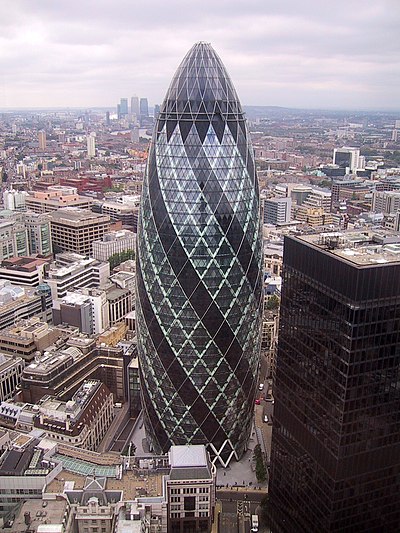
30 St Mary Axe The Gherkin From Leadenhall St Nov 2006


Contextualizing The Gherkin
Located at 30 St Mary Axe in the heart of London's historic financial district, this skyscraper, widely known as The Gherkin, represents a significant departure from traditional office building design. Its site, previously occupied by the Baltic Exchange, was redeveloped following a significant bombing in 1992, presenting an opportunity for bold architectural vision. The building's curvilinear form, designed by Foster + Partners, was a deliberate choice to maximize space and natural light while minimizing its environmental footprint.
Its placement within a dense urban environment necessitated a design that was not only functional for its occupants but also considerate of its impact on the surrounding cityscape and public realm. The Gherkin stands as a testament to the evolution of skyscraper design, moving beyond mere height to embrace form, function, and sustainability.
Engineering a Greener Skyscraper
The Gherkin's distinctive shape is intrinsically linked to its advanced sustainable design principles. Unlike conventional rectangular towers, its aerodynamic form allows wind to flow around it, reducing structural load and enabling the use of less material. The building's five-story lightwells act as natural ventilation shafts, drawing fresh air through the building and reducing reliance on mechanical cooling systems.
These lightwells also channel daylight deep into the floor plates, minimizing the need for artificial lighting and creating a more pleasant internal environment. The use of double-glazed, energy-efficient glass further contributes to thermal regulation. These integrated systems significantly reduce energy consumption, making The Gherkin a benchmark for eco-friendly high-rise construction and demonstrating that iconic architecture can also be environmentally responsible.
Beyond the Facade
Internally, 30 St Mary Axe is designed to foster a dynamic and collaborative working environment. The open-plan office spaces, bathed in natural light, are a stark contrast to the often-cramped and artificially lit offices of older buildings. The building's structure, with its central core and perimeter columns, creates column-free floor plates, offering maximum flexibility for office layouts.
At the apex of the building, the 'Top of the City' bar and restaurant provides breathtaking 360-degree views of London, serving as a public amenity and a draw for visitors. This integration of public space within a private office tower highlights a modern approach to urban development, where iconic structures can also offer accessible experiences and contribute to the city's cultural vibrancy.
Cultural Resonance and Architectural Legacy
Since its completion, The Gherkin has transcended its function as a mere office building to become a beloved symbol of contemporary London. Its unique silhouette has cemented its place in the city's visual identity, appearing in countless photographs, films, and artworks. The building's success has influenced subsequent skyscraper designs, encouraging architects and developers to prioritize innovative forms and sustainable practices.
It has sparked conversations about the role of architecture in shaping urban identity and the potential for buildings to be both functional and inspiring. The Gherkin stands as a powerful example of how bold design, coupled with a commitment to environmental responsibility, can create enduring architectural legacies that resonate with the public.
See also
Frequently Asked Questions
What is 30 St Mary Axe also called?+
Why does the Gherkin look like a pickle?+
How does the Gherkin help the environment?+
What can people see from the Top of the City bar?+
Where was the Gherkin built?+
Based on content from Wikipedia · Licensed under CC BY-SA 4.0