

2024 United Kingdom general election
Images

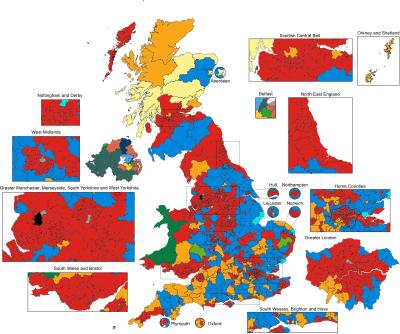
2024 United Kingdom general election map




The End of an Era
The 2024 United Kingdom general election, held on July 4th, marked a pivotal moment in British political history, fundamentally altering the parliamentary landscape. The election saw the Labour Party, under the leadership of Keir Starmer, achieve a decisive landslide victory, unseating the Conservative Party after 14 years in government. Labour secured an impressive 411 seats, representing a substantial majority and its most significant electoral success since 2001.
This outcome signaled a clear public desire for change and a rejection of the incumbent government's policies and performance. The scale of Labour's win, while celebrated, was also characterized by a historically low vote share for a majority government, raising questions about the proportionality of the UK's electoral system. This election was not merely a change of government; it represented a significant recalibration of the political center ground and a mandate for a new direction.
Conservative Catastrophe and the Rise of Smaller Parties
For the Conservative Party, the 2024 election was an unmitigated disaster, resulting in their worst-ever defeat. They lost a staggering 251 seats, plummeting to just 121, and saw prominent figures, including former Prime Minister Liz Truss and numerous Cabinet ministers, lose their constituencies. This electoral annihilation underscored deep dissatisfaction with the party's tenure, likely stemming from a combination of economic challenges, public service pressures, and a perceived lack of vision.
Simultaneously, the election witnessed a surge in support for smaller parties, collectively capturing 42.6% of the total vote. The Liberal Democrats, led by Ed Davey, experienced a remarkable resurgence, becoming the third-largest party with 72 seats, their best performance since 1923. Reform UK, under Nigel Farage, secured five seats and a notable 14.3% vote share, indicating a significant segment of the electorate seeking an alternative to the traditional two-party system.
The Green Party also achieved its best parliamentary result to date, winning four seats, demonstrating a growing appetite for environmental and progressive policies.
Devolutionary Dynamics and Shifting National Identities
The 2024 election also highlighted the evolving political dynamics within the devolved nations of the United Kingdom. In Scotland, the Scottish National Party (SNP) experienced a substantial decline, dropping from 48 to 9 seats and losing its status as the largest party in Scotland. This represented a significant blow to the SNP's dominance and raised questions about the future of the independence movement. Plaid Cymru, the Welsh nationalist party, achieved a stronger showing, winning four seats in Wales. Northern Ireland presented a particularly unique outcome, with Sinn Féin retaining its seven seats and becoming the first Irish nationalist party to win the most seats in the region.
This result further underscored the distinct political landscape of Northern Ireland and its ongoing debates about identity and future governance. The Democratic Unionist Party (DUP) also saw a reduction in its representation, falling from 8 to 5 seats.
Electoral Modernization and Evolving Campaign Narratives
The 2024 general election was conducted under several significant procedural changes. It was the first election held under the Dissolution and Calling of Parliament Act 2022, which altered the mechanisms for dissolving Parliament and calling an election. Furthermore, it was the inaugural election in Great Britain requiring voters to present photo identification, a measure intended to enhance electoral integrity but which drew criticism for potentially disenfranchising certain groups.
The election also utilized new constituency boundaries, redrawn following the 2023 review of Westminster constituencies, aiming to ensure more equal representation across the country. Campaign narratives largely focused on pressing domestic issues such as the economy, healthcare provision, housing affordability, and energy policy. Notably, the contentious issue of Brexit, which dominated previous elections, played a comparatively minor role in the 2024 campaign, suggesting a shift in public priorities and a desire to move beyond the immediate aftermath of the UK's departure from the European Union.
See also
Frequently Asked Questions
What happened in the 2024 UK general election?+
Who lost the most seats in the 2024 election?+
Which smaller parties gained votes in 2024?+
How did the election affect Scotland and the SNP?+
When was the 2024 UK general election held?+
Based on content from Wikipedia · Licensed under CC BY-SA 4.0