

Yazdegerd III
Images

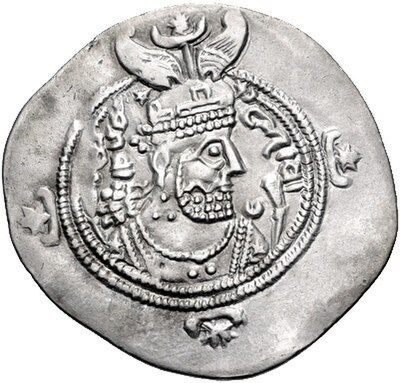
Coin of the Sasanian king Yazdegerd III, 651 mint




Ascension Amidst Anarchy
Yazdegerd III inherited the Sasanian throne in 632 AD, a period of profound internal crisis. Ascending at the remarkably young age of eight, he was thrust into a political landscape dominated by feuding aristocrats, powerful military commanders, and a fractured court. His father, Shahriyar, and grandfather, Khosrow II, had presided over periods of both immense power and devastating conflict, leaving the empire vulnerable.
Yazdegerd's reign was thus characterized by a severe lack of personal authority; he was a symbolic monarch, a 'King of Kings' in name only, while the reins of power were effectively held by competing factions engaged in internecine warfare. This internal paralysis crippled the empire's ability to respond to external threats, setting the stage for its eventual collapse. The Sasanian state, once a formidable rival to the Roman and Byzantine Empires, was internally weakened to the point of near-incoherence.
The Unstoppable Tide
The internal decay of the Sasanian Empire made it an irresistible target for its neighbors. From the east, the Göktürks, a Turkic confederation, had previously encroached upon Sasanian territories, and from the north, the Khazars posed a persistent threat. However, the most existential challenge came from the Arabian Peninsula with the rapid expansion of the Rashidun Caliphate.
The Sasanian military, weakened by infighting and a lack of unified command, proved incapable of repelling these invasions. Yazdegerd III spent the majority of his short reign in a desperate, and ultimately futile, attempt to raise an army and stem the tide of conquest. He was forced to flee from one provincial capital to another, a king in perpetual flight, a stark symbol of his empire's disintegration.
His nomadic existence highlighted the complete loss of central authority and territorial control.
The End of an Epoch
The final years of Yazdegerd III's life were marked by increasing desperation and isolation. Despite his efforts to rally resistance, the Sasanian Empire was systematically dismantled by the Rashidun forces. His quest for a stable base of operations and a loyal army proved fruitless.
In 651 AD, his tragic saga concluded not on a battlefield, but through assassination. He was killed by a miller near the city of Merv, an ignominious end for the last sovereign of a dynasty that had ruled Persia for over four centuries. His death extinguished the last major pre-Islamic Iranian empire, fundamentally altering the political and cultural landscape of the Middle East.
The Sasanian legacy, however, persisted in its vast contributions to art, architecture, literature, and administrative practices, which continued to influence the succeeding Islamic caliphates.
Historical Significance
Yazdegerd III's reign represents a critical turning point, marking the definitive end of Zoroastrian Persia as a dominant political entity and the beginning of Islamic rule in Iran. His failure to preserve the empire is often attributed to the deep-seated internal divisions that had plagued the Sasanian state for decades, exacerbated by the overwhelming military and ideological force of the early Islamic conquests. The fall of the Sasanian Empire had profound and lasting consequences, leading to the gradual Islamization and Arabization of Persia, though Iranian culture and language would demonstrate remarkable resilience.
Yazdegerd III is remembered not for his achievements, but as the final, tragic figurehead of a glorious era, his reign a poignant epilogue to over 400 years of Sasanian imperial power.
See also
Frequently Asked Questions
What age was Yazdegerd III when he became king?+
Why was Yazdegerd III's reign difficult?+
How did the Sasanian Empire fall?+
Where did Yazdegerd III die?+
What happened to Persia after Yazdegerd III died?+
Based on content from Wikipedia · Licensed under CC BY-SA 4.0