

Wien's Displacement Law
Images
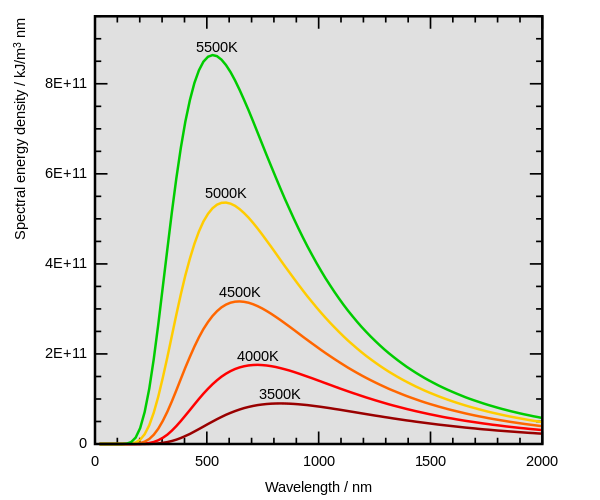
Wien's displacement law
The Genesis of Spectral Peak Understanding
Wien's Displacement Law, formulated by German physicist Wilhelm Wien in 1893, predates Max Planck's quantum theory of radiation but provides a crucial insight into the behavior of black-body radiation. It states that the wavelength at which the spectral radiance of a black body is maximal is inversely proportional to its absolute temperature. Mathematically, this is expressed as λ_peak = b/T, where λ_peak is the peak wavelength, T is the absolute temperature in Kelvin, and 'b' is Wien's displacement constant, approximately 2.898 x 10^-3 m·K.
This law describes the 'shift' in the black-body curve: as temperature increases, the entire spectrum of emitted radiation shifts towards shorter wavelengths, and the peak intensity moves to a higher frequency. This phenomenon is a direct consequence of the Planck radiation law, which quantifies the spectral radiance as a function of wavelength and temperature, but Wien's law elegantly captures the specific location of the spectral peak.
Astrophysical Thermometry and Stellar Evolution
The practical implications of Wien's Displacement Law are profound, particularly in astrophysics. By analyzing the spectrum of light emitted by stars, astronomers can determine their surface temperatures with remarkable accuracy. The color of a star is a direct indicator of its temperature: hotter stars emit more blue and ultraviolet light, appearing blue or white, while cooler stars emit more red and infrared light, appearing red or orange.
For instance, the Sun's surface temperature is around 5,778 K, and its peak emission is in the green-yellow part of the visible spectrum. More massive and hotter stars, like Rigel, can have surface temperatures exceeding 10,000 K and appear distinctly blue. Conversely, cooler red dwarf stars have temperatures below 3,500 K.
This spectral peak analysis is a cornerstone of stellar classification and understanding stellar evolution, allowing scientists to map the life cycles of stars from their birth in nebulae to their eventual demise.
Beyond Visible Light
While often illustrated with visible light colors, Wien's Displacement Law is fundamental to understanding thermal radiation across the entire electromagnetic spectrum. Objects at room temperature (around 293 K) emit peak radiation in the infrared range, which is why thermal imaging cameras can detect heat signatures. Even cooler objects, like the cosmic microwave background radiation (CMB), which has a temperature of about 2.7 K, have a peak emission in the microwave portion of the spectrum.
This law is also relevant in engineering, for example, in designing heating elements, incandescent light bulbs, and understanding heat transfer in various materials. The precise value of Wien's displacement constant, b, is determined experimentally and is crucial for accurate calculations in these applications, linking the macroscopic property of temperature to the microscopic behavior of emitted photons.
The Theoretical Underpinnings and Limitations
Wien's Displacement Law is derived from the more general Planck's Law, which describes the spectral radiance of a black body at a given temperature. Planck's Law, developed using quantum mechanics, successfully resolved the ultraviolet catastrophe that classical physics could not explain. Wien's law can be obtained by differentiating Planck's law with respect to wavelength and setting the derivative to zero to find the maximum.
It's important to note that Wien's law specifically describes the peak of the spectral radiance per unit wavelength. If one considers the peak spectral radiance per unit frequency or per proportional bandwidth, different proportionality constants are used, although the inverse relationship between temperature and peak wavelength remains. The concept of a perfect black body is an idealization; real objects approximate black-body behavior to varying degrees, but Wien's law provides an essential framework for understanding thermal emission.
See also
Frequently Asked Questions
What does Wien's Displacement Law say about hot objects and light colors?+
How can we use Wien's Law to find the temperature of a star?+
Why do we feel heat from a lamp even though we don't see it?+
What is the constant 'b' in Wien's Law and why is it important?+
Does Wien's Law work for all kinds of light, not just visible?+
Based on content from Wikipedia · Licensed under CC BY-SA 4.0