

Virtual Reality
Images

Exploring the Universe in Virtual Reality




Defining Immersion
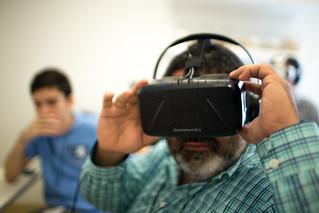
Virtual reality (VR) represents a frontier in digital interaction, offering a simulated experience that aims for complete sensory immersion. Unlike other forms of digital visualization, VR seeks to transport the user entirely into a computer-generated environment. This is primarily achieved through head-mounted displays (HMDs), which feature high-resolution screens positioned inches from the user's eyes.
These displays present stereoscopic images, with each eye receiving a slightly different perspective, thereby creating a convincing sense of depth and three-dimensionality. Crucially, VR systems incorporate sophisticated pose tracking, utilizing sensors like gyroscopes, accelerometers, and external tracking systems to monitor the user's head and body movements in real-time. As the user moves, the virtual environment updates instantaneously, maintaining visual continuity and preventing the disorientation or motion sickness that can plague less advanced systems.
This seamless integration of movement and visual feedback is what defines the immersive quality of VR, allowing users to not only observe but also navigate and interact within the virtual space.
Evolution of Virtual Worlds
The concept of virtual reality has roots stretching back to the mid-20th century, with early explorations in stereoscopic viewers and rudimentary simulation devices. However, these early iterations were largely confined to research labs and were far from the immersive experiences we know today. The term 'virtual reality' itself was coined in the 1980s, coinciding with significant advancements in computer graphics, processing power, and sensor technology.
The 1990s saw the emergence of early commercial VR systems, though they were often expensive, bulky, and offered limited fidelity, failing to capture widespread public interest. The true resurgence of VR began in the 2010s, driven by breakthroughs in mobile display technology, powerful mobile processors, and innovative tracking solutions. Companies like Oculus (now Meta), HTC, and Sony invested heavily, leading to the development of more accessible, higher-fidelity consumer headsets.
This period marked a significant shift, transforming VR from a niche technological curiosity into a viable platform for entertainment, education, and professional applications, setting the stage for its current trajectory.
The Transformative Potential
While virtual reality is widely recognized for its impact on the gaming and entertainment industries, its true significance lies in its transformative potential across a multitude of sectors. In education, VR provides unparalleled opportunities for experiential learning. Students can conduct virtual dissections, explore the surface of Mars, or witness historical events firsthand, fostering deeper engagement and understanding.
For professional training, VR offers a safe, repeatable, and cost-effective environment for skill development. Surgeons can practice complex procedures, pilots can simulate emergency scenarios, and engineers can train on intricate machinery without the risks or expenses associated with real-world training. Furthermore, VR is revolutionizing fields like therapy, where it's used to treat phobias, PTSD, and anxiety by exposing patients to controlled virtual environments.
In design and architecture, VR allows for immersive walkthroughs of buildings and products before they are constructed, enabling better visualization and client feedback. The collaborative potential is also immense, with virtual meeting spaces fostering a sense of presence and interaction that surpasses traditional video conferencing.
Under the Hood
The creation of a convincing virtual reality experience is a complex interplay of hardware and software. At its core, VR relies on specialized display technology integrated into a head-mounted display (HMD). These HMDs typically house two high-resolution screens, each dedicated to one eye, presenting slightly offset images to achieve stereoscopic vision.
The fidelity of these displays, measured in resolution and refresh rate, is critical for minimizing the 'screen door effect' and ensuring smooth motion. Complementing the visual component is advanced pose tracking. Inertial Measurement Units (IMUs) within the headset detect rotation and acceleration, while external sensors or inside-out tracking cameras monitor the user's position within a defined physical space.
This data is processed by powerful computing hardware-either a dedicated PC, a game console, or an integrated mobile processor-which renders the virtual environment in real-time. Auditory feedback, often delivered via integrated headphones, plays a crucial role in immersion, with spatial audio techniques creating soundscapes that correspond to the virtual environment. Increasingly, haptic feedback systems are being integrated, using vibrations or force feedback devices to simulate touch and physical interaction, further blurring the lines between the virtual and the real.
The VR Ecosystem
The applications of virtual reality are continually expanding, pushing the boundaries of what is possible. Beyond immersive gaming and cinematic experiences, VR is making significant inroads into professional domains. In healthcare, it's employed for surgical simulation, pain management, rehabilitation, and even mental health treatment, offering controlled exposure therapy for phobias and PTSD.
The education sector leverages VR for virtual field trips, complex scientific visualizations, and skills training, providing engaging and memorable learning experiences. Industries such as automotive and aerospace utilize VR for design prototyping, virtual assembly, and maintenance training, allowing for rapid iteration and risk-free practice. Furthermore, the development of social VR platforms is fostering new forms of remote collaboration and social interaction, creating persistent virtual spaces where users can connect and work together.
As hardware becomes more powerful, affordable, and comfortable, and as content creation tools become more sophisticated, VR is poised to become an even more integral part of our digital lives, influencing how we work, learn, socialize, and entertain ourselves.
Go deeper
Frequently Asked Questions
What is virtual reality?+
How does a VR headset make the world look 3D?+
Why do VR systems track my head and body?+
How can VR help students learn?+
Can VR help doctors or pilots practice?+
Based on content from Wikipedia · Licensed under CC BY-SA 4.0