

Tide: The Ocean's Big Breath!
Images
Tide
The Astrodynamics of Tidal Forces
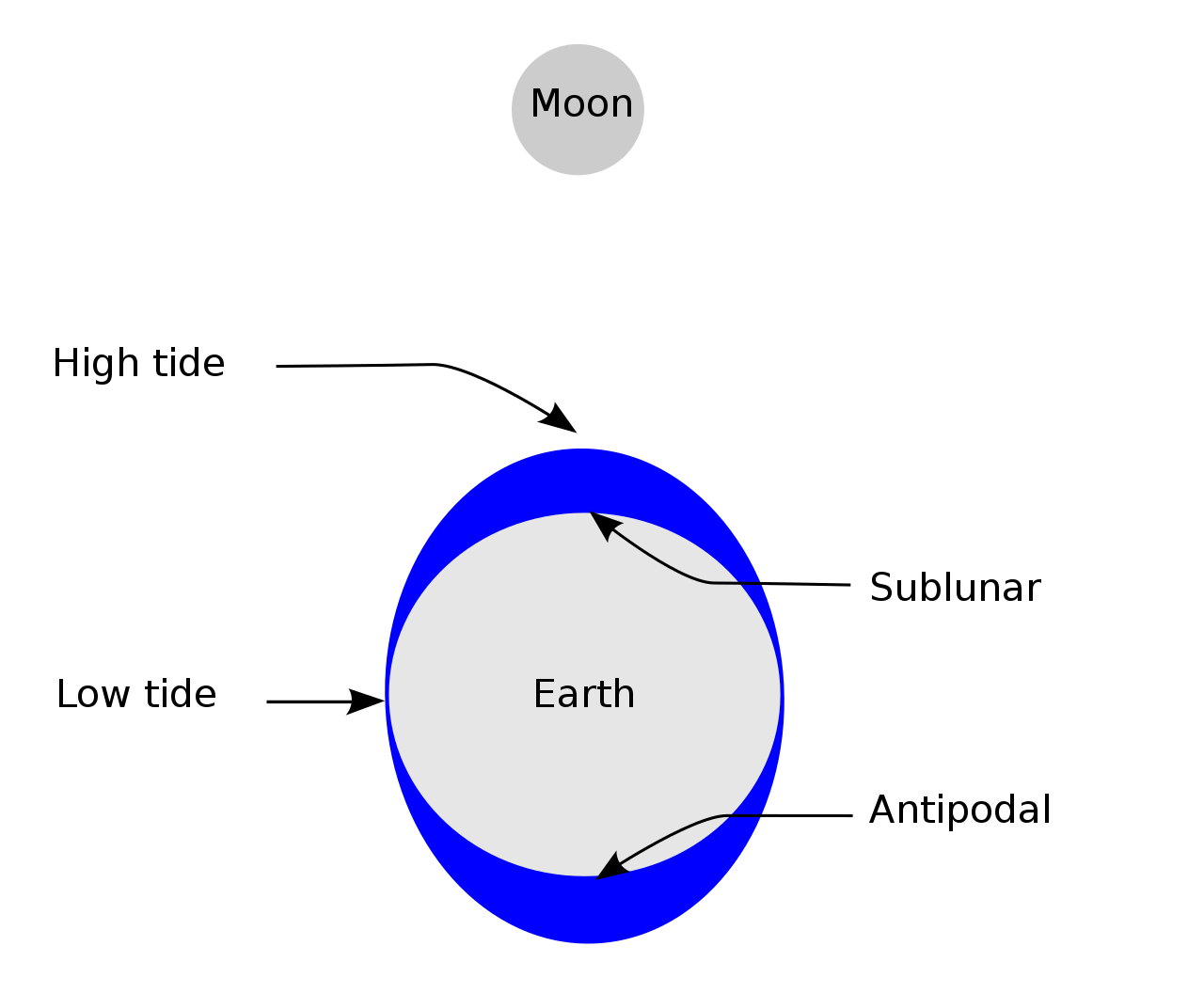
Tides are a direct consequence of differential gravitational forces exerted by celestial bodies, primarily the Moon and the Sun, on Earth's oceans. The Moon's gravitational pull is the dominant factor, creating a tidal bulge on the side of Earth facing it due to stronger attraction. Simultaneously, a secondary bulge forms on the opposite side.
This occurs because the Moon's gravity pulls the solid Earth more intensely than the water on the far side, effectively stretching the planet and leaving the water on the antipodal side lagging behind. The Sun also exerts a gravitational influence, but its effect is approximately 46% of the Moon's due to its vastly greater distance. When the Sun, Moon, and Earth are in alignment (syzygy), during new and full moons, their gravitational forces combine constructively, producing the highest tidal ranges known as spring tides.
Conversely, during the first and third quarter moons, the Sun and Moon are at right angles relative to Earth, and their gravitational forces partially counteract each other, resulting in the lowest tidal ranges, termed neap tides. Earth's rotation through these bulges means most locations experience two high tides and two low tides per lunar day (approximately 24 hours and 50 minutes).
Geomorphological Impacts and Coastal Dynamics
The relentless cycle of tides profoundly shapes coastal geomorphology and influences a myriad of ecological processes. The intertidal zone, a dynamic interface between terrestrial and marine environments, is characterized by unique adaptations of flora and fauna to survive periods of emersion and submersion, desiccation, and salinity fluctuations. Coastal landforms such as estuaries, salt marshes, mudflats, and mangrove forests are sculpted and maintained by tidal currents, which are responsible for sediment transport, deposition, and erosion.
Tidal bores, a phenomenon where the leading edge of an incoming tide forms a wave that travels up a river or narrow bay, can significantly alter local hydrology and sediment dynamics. Furthermore, tidal influences extend to groundwater levels in coastal aquifers and can impact the distribution and abundance of marine species, influencing feeding grounds, breeding sites, and migratory pathways. Understanding these complex interactions is vital for effective coastal zone management, including infrastructure development, conservation efforts, and disaster preparedness.
Ecological Significance and Biological Adaptations
The tidal rhythm is a fundamental environmental cue that governs the life cycles and behaviors of countless marine and coastal organisms. Species inhabiting the intertidal zone exhibit remarkable adaptations to cope with the extreme conditions. For instance, sessile organisms like barnacles and mussels possess opercula or strong byssal threads to seal themselves against desiccation and wave action.
Mobile invertebrates, such as crabs and snails, may seek refuge in crevices, burrow into sediment, or migrate with the tide. Many fish species utilize tidal flows for movement and foraging, entering estuaries and salt marshes at high tide to feed and retreating with the ebb. The availability of food resources is also directly linked to tidal cycles, with filter feeders relying on the influx of plankton-rich water.
Reproductive strategies, such as synchronized spawning events timed with specific tidal phases, are common, maximizing fertilization success and larval dispersal. The ecological health of coastal ecosystems is intrinsically tied to the regularity and magnitude of tidal cycles.
Tidal Energy
The predictable and consistent nature of tides makes them an attractive source of renewable energy. Tidal energy conversion technologies harness the kinetic energy of tidal currents or the potential energy of tidal range differences. Tidal stream generators, akin to underwater wind turbines, are deployed in areas with strong tidal flows, converting the energy of moving water into electricity.
Tidal barrages, constructed across estuaries, utilize the difference in water height between high and low tide to drive turbines. While barrages can have significant environmental impacts on estuarine ecosystems, tidal stream technology offers a less intrusive alternative. The predictability of tides, unlike intermittent solar or wind power, allows for more reliable energy generation.
Despite the high initial installation costs and potential localized environmental concerns, tidal energy represents a significant, albeit currently underutilized, component of the global renewable energy portfolio, offering a sustainable solution to meet growing energy demands.
Go deeper
Frequently Asked Questions
What causes the tide to rise and fall?+
Why is the Moon more important than the Sun for tides?+
What are spring tides and neap tides?+
How do tides affect animals that live on the shore?+
Why do we have two high tides and two low tides each day?+
Based on content from Wikipedia · Licensed under CC BY-SA 4.0