

The Voyage of the Beagle
Images

<div class='fn'> Illustrations of Fuegians from the voyage of the Beagle.</div>




Charting the Globe, Uncharting Minds
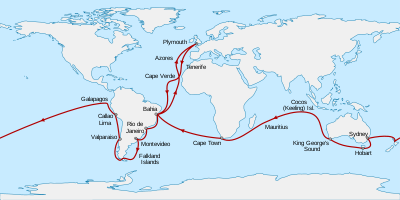
The second survey expedition of HMS Beagle, commencing in 1831, was a ambitious undertaking with a primary objective of charting South American coastlines. However, its true historical significance lies in the intellectual ferment it fostered, particularly within the mind of its young naturalist, Charles Darwin. The voyage, which stretched to nearly five years, far exceeding its initial two-year scope, provided Darwin with an unprecedented opportunity for extensive fieldwork.
He dedicated over three years to terrestrial exploration, amassing a vast and diverse collection of geological and biological specimens. This immersive experience allowed him to witness firsthand the geological processes shaping the Earth and the remarkable adaptations of life in varied environments, from the arid plains of Patagonia to the volcanic landscapes of the Galapagos. His detailed notes and collected samples formed the empirical bedrock upon which his later revolutionary theories would be constructed, challenging prevailing scientific orthodoxies of the time.
From Journal to Landmark Publication
Darwin's meticulous documentation of his experiences culminated in the publication of 'Journal and Remarks' in 1839, a volume within the larger 'Narrative of the Voyages of H.M. Ships Adventure and Beagle'. The book's immediate popularity led to its reissue as 'Darwin's Journal of Researches', a title that better reflected its content and Darwin's growing renown.
This work is a masterful blend of scientific rigor and engaging narrative. It presents detailed observations in biology, geology, and anthropology, demonstrating Darwin's exceptional powers of observation and analytical thought during a period of intense global exploration by Western powers. The chapters, organized geographically rather than chronologically for clarity, offer a comprehensive account of the expedition's scientific findings and Darwin's evolving understanding of the natural world, making it a seminal work in the history of science literature.
The Incubation of Natural Selection
Crucially, the voyage served as the crucible for Darwin's nascent ideas about the transmutation of species. His observations of geographical variation, most famously the distinct beak morphologies of finches on different Galapagos islands, began to erode his belief in the fixity of species. He noted how these variations appeared to be adaptations to specific ecological niches and food sources.
These insights, initially hinted at in his private notes and later subtly woven into the second edition of his book in 1845, were the first glimmers of his theory of evolution by natural selection. The Beagle's journey provided the critical empirical evidence that challenged the prevailing creationist views and set Darwin on the path to formulating one of the most profound scientific theories in history.
Enduring Impact and Modern Relevance
The Voyage of the Beagle and Darwin's subsequent publication represent a watershed moment in intellectual history. The book not only brought Darwin considerable fame and respect but also fundamentally altered humanity's understanding of life's origins and diversity. The theory of evolution by natural selection, born from the observations made during this epic journey, remains the cornerstone of modern biology, underpinning fields from genetics and medicine to ecology and conservation.
The Beagle's legacy extends beyond science; it embodies the spirit of exploration, the importance of empirical evidence, and the power of a single individual's curiosity to reshape our worldview. Its continued study highlights the ongoing relevance of Darwin's insights in addressing contemporary biological questions.
See also
Frequently Asked Questions
What was the main goal of the Beagle's second expedition?+
How long did the voyage last?+
What did Charles Darwin do on the ship?+
Why is the Beagle voyage important for science?+
What book did Darwin publish about his journey?+
Based on content from Wikipedia · Licensed under CC BY-SA 4.0