

Synchrotron Light Source
Images

Synchrotron light source


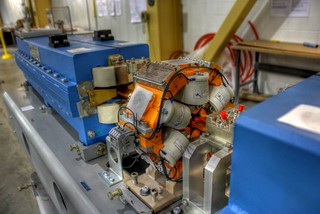

The Physics of Brilliance
A synchrotron light source is a highly specialized particle accelerator designed to produce coherent and intense beams of electromagnetic radiation across a broad spectrum, from infrared to hard X-rays. The fundamental principle relies on accelerating charged particles, typically electrons, to relativistic speeds (very close to the speed of light) within a storage ring. These high-energy electrons are then guided by precisely engineered magnetic fields.
When the electron beam passes through bending magnets or specialized insertion devices like wigglers and undulators, the particles undergo centripetal acceleration. According to classical electrodynamics, accelerating charges emit radiation. In this case, the relativistic nature of the electrons amplifies this emission, resulting in highly collimated, intense beams of photons known as synchrotron radiation.
The energy of the emitted photons and the properties of the beam (like its brightness and coherence) can be finely tuned by adjusting the electron beam energy and the magnetic field configurations of the insertion devices.
Evolution of a Scientific Powerhouse
The discovery of synchrotron radiation was an incidental observation in early synchrotrons, particle accelerators developed in the mid-20th century primarily for high-energy physics research. In the 1940s and 1950s, scientists working with these machines noticed an unintended, bright glow emanating from the electron beams as they were bent by magnets. Initially considered a nuisance that caused energy loss for the accelerating particles, its potential as a powerful scientific tool was soon recognized.
This led to the development of dedicated storage rings in the 1970s and 1980s, specifically engineered to optimize the production and delivery of synchrotron light. These facilities moved beyond simply harnessing a byproduct to creating controlled, tunable, and incredibly bright light sources, marking a significant paradigm shift in experimental science and enabling research that was previously impossible.
The Indispensable Role in Modern Research and Development
Synchrotron light sources are now indispensable tools across a vast array of scientific disciplines. Their unparalleled brightness and tunability allow researchers to probe matter at atomic and molecular scales with exquisite detail. In condensed matter physics and materials science, they are used for techniques like X-ray diffraction and spectroscopy to understand crystal structures, electronic properties, and phase transitions, driving innovation in semiconductors, superconductors, and advanced alloys.
In the life sciences, synchrotron X-rays are critical for determining the three-dimensional structures of proteins, enzymes, and viruses through X-ray crystallography and small-angle scattering, which is fundamental to drug discovery, understanding disease mechanisms, and developing new therapeutics. Medical imaging applications benefit from the high resolution and contrast achievable with synchrotron-based techniques, offering potential for earlier and more accurate diagnoses.
Practical Applications and Future Frontiers
Beyond fundamental research, synchrotron light sources play a crucial role in industrial innovation and technological advancement. Processes like photolithography, enabled by synchrotron radiation, are essential for manufacturing the micro- and nano-scale components found in modern microprocessors and integrated circuits, pushing the boundaries of computing power and miniaturization. The LIGA (Lithographie, Galvanoformung, Abformung) process, which uses synchrotron X-rays for high-resolution patterning, is vital for creating micro-mechanical devices and microfluidic systems.
Furthermore, synchrotron light is employed in environmental science for analyzing pollutants at trace levels and understanding complex geochemical processes. The ongoing development of new insertion devices, advanced detectors, and computational methods continues to expand the capabilities of these facilities, promising further breakthroughs in fields ranging from quantum computing to personalized medicine and sustainable energy solutions.
See also
Frequently Asked Questions
What is a synchrotron light source?+
How does a synchrotron make light?+
Why was synchrotron light discovered?+
What can scientists do with synchrotron light?+
Where is synchrotron light used today?+
Based on content from Wikipedia · Licensed under CC BY-SA 4.0