

Sunspots: Our Sun's Wobbly Bits!
Images

Merging Sunspots close up


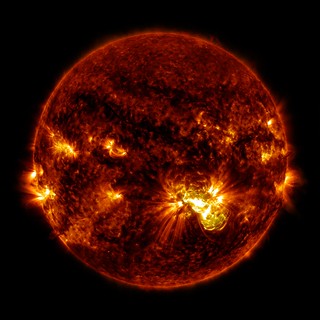
The Physics of Sunspots
Sunspots are transient features on the Sun's photosphere characterized by lower temperatures and reduced brightness compared to their surroundings. Their existence is a direct consequence of intense magnetic activity. Specifically, sunspots form in regions where strong magnetic flux tubes emerge from the Sun's interior, penetrating the photosphere.
These concentrated magnetic fields exert immense pressure, inhibiting the normal convective transport of heat from the Sun's radiative zone to the surface. This suppression of convection leads to a localized decrease in surface temperature, typically by 1,500-2,500 degrees Celsius below the Sun's average photospheric temperature of about 5,778 Kelvin (5,505 °C or 9,941 °F). While appearing dark relative to the photosphere, sunspots are still incredibly luminous, radiating intensely at their lower temperatures.
They often appear in groups, typically with a leading spot and a trailing spot, exhibiting opposite magnetic polarities, indicative of the bipolar nature of the underlying magnetic field.
Formation and Evolution
The emergence of sunspots is a dynamic process driven by the Sun's differential rotation and the resulting magnetic field generation within the solar dynamo. As magnetic field lines are stretched, twisted, and amplified, they can rise to the surface. When a strong enough magnetic flux emerges, it can create a sunspot.
Upon formation, sunspots can expand and contract, and their movement across the solar disk is influenced by solar rotation and their own internal dynamics. Individual sunspots may last from a few days to a couple of weeks, while complex sunspot groups, often containing multiple spots with intricate magnetic configurations, can persist for months. The decay of a sunspot occurs when the magnetic field lines become less concentrated or when convection is gradually restored, allowing heat to replenish the region.
Sunspots as Engines of Solar Activity and Space Weather
Sunspots are not merely passive features; they are the primary source of energetic phenomena that constitute space weather. The complex and often unstable magnetic field configurations associated with sunspot groups are the breeding grounds for solar flares and coronal mass ejections (CMEs). Magnetic reconnection, a process where tangled magnetic field lines suddenly snap and reconfigure, releases vast amounts of energy, driving these explosive events.
Solar flares emit high-energy electromagnetic radiation across the spectrum, including X-rays and gamma rays, while CMEs eject massive quantities of plasma and embedded magnetic fields into interplanetary space. These events can have significant impacts on Earth, including geomagnetic storms that can disrupt satellite operations, communication systems, navigation, and power grids, and pose radiation hazards to astronauts and high-altitude aircraft.
The Solar Cycle
The number of sunspots observed on the Sun fluctuates in a roughly 11-year cycle, known as the solar cycle. This cycle is a fundamental characteristic of solar activity and is driven by the complex processes within the Sun's interior. During solar minimum, the Sun exhibits very few sunspots and relatively low magnetic activity.
As the cycle progresses towards solar maximum, the number of sunspots increases dramatically, and the frequency and intensity of solar flares and CMEs rise significantly. The polarity of the Sun's global magnetic field also reverses approximately every 11 years, completing a full magnetic cycle of about 22 years. Monitoring sunspot numbers and their distribution provides crucial data for understanding the Sun's behavior and forecasting space weather events, enabling mitigation strategies for technological and societal impacts.
Beyond Our Sun
The phenomenon of sunspots is not unique to our Sun. Observations of other stars have revealed similar dark, cooler regions, commonly referred to as starspots. These starspots are detected indirectly through variations in a star's brightness as it rotates, or through spectroscopic analysis.
The size, number, and distribution of starspots can vary significantly between different stars and even for the same star over time. Studying starspots allows astronomers to infer magnetic activity levels on other stars, providing insights into stellar dynamos, stellar evolution, and the potential for exoplanet habitability. The comparative study of sunspots and starspots helps us understand the universal principles governing stellar magnetic activity.
Go deeper
Based on content from Wikipedia · Licensed under CC BY-SA 4.0