

Sun and Planet Gears: Spinning Wonders!
Images

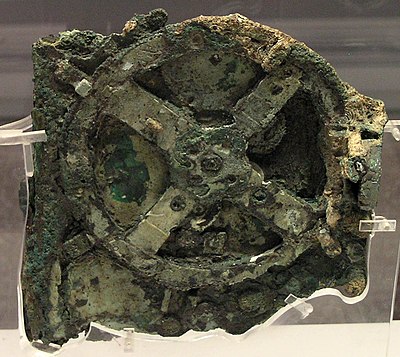
Antikythera Fragment A (Front)




Mechanical Principles and Kinematic Analysis
The sun and planet gear is a type of epicyclic gear train, specifically designed to convert reciprocating linear motion into continuous rotary motion. Its fundamental operation relies on the kinematic relationship between a central 'sun' gear and orbiting 'planet' gears. In this configuration, the sun gear is typically fixed or driven by a reciprocating input.
The planet gears are mounted on a carrier, which is also driven, often by the same reciprocating input or a related mechanism. Crucially, the planet gears mesh with the sun gear and simultaneously orbit around it. This dual action-orbiting and rotating on their own axes-results in a net rotary output at the carrier or a shaft connected to it.
The gear ratio is determined by the number of teeth on the sun and planet gears, as well as the carrier's motion. This system effectively translates the oscillatory movement of a beam engine, for instance, into the rotational power required for flywheels and drive shafts, a critical step in mechanization.
Historical Context and Industrial Impact
The invention of the sun and planet gear by William Murdoch and its subsequent patenting by James Watt in 1781 marked a significant advancement during the nascent stages of the Industrial Revolution. Prior to this, steam engines primarily produced reciprocating motion, which was difficult to adapt for continuous rotary tasks like powering textile machinery or mills. The crank mechanism, patented by James Pickard, was one solution, but Watt's company sought alternative methods.
The sun and planet gear provided a viable and effective alternative, allowing for the development of rotative beam engines. These engines were instrumental in driving the machinery that fueled the rapid industrial expansion of the era. Its adoption facilitated the transition from manual labor to machine-driven production, fundamentally altering economic and social structures by enabling greater efficiency and scale in manufacturing.
Innovation, Patents, and Engineering Strategy
The development and patenting of the sun and planet gear offer a fascinating glimpse into the strategic thinking of engineers and industrialists in the late 18th century. William Murdoch, a brilliant inventor in his own right, devised the mechanism. However, James Watt, a senior figure at Boulton and Watt, secured the patent.
This move was partly motivated by the need to circumvent James Pickard's existing patent on the crank, a common practice in the competitive landscape of early industrial innovation. By developing and patenting an alternative method for achieving rotary motion, Boulton and Watt could offer their steam engines with a complete system for power transmission, enhancing their marketability and profitability. This episode underscores the interplay between technical ingenuity, intellectual property law, and commercial strategy in driving technological progress.
Legacy and Evolution of Rotary Motion Conversion
While the sun and planet gear was a groundbreaking solution for its time, particularly in early rotative beam engines, its direct application has largely been superseded by more efficient and compact mechanisms in modern engineering. However, its conceptual importance cannot be overstated. It represents a foundational understanding of epicyclic gearing and the conversion of linear to rotary motion, principles that remain central to countless mechanical systems today.
Modern applications of epicyclic gear trains, such as those found in automatic transmissions, wind turbines, and robotics, build upon the fundamental kinematic principles first explored and implemented by early pioneers like Murdoch and Watt. The sun and planet gear serves as a historical touchstone, illustrating the evolutionary path of mechanical power transmission and the enduring quest for efficient motion conversion.
See also
Frequently Asked Questions
What is a sun and planet gear?+
How does the sun and planet gear turn up-and-down motion into spinning motion?+
Why was the sun and planet gear important during the Industrial Revolution?+
Who invented and patented the sun and planet gear?+
What happens to the planet gears in the system?+
Based on content from Wikipedia · Licensed under CC BY-SA 4.0