

San Fernando Valley
Images

WPA Land use survey map for the City of Los Angeles, book 3 (San Fernando Valley from Canoga Park District to Van Nuys District), sheet 28 (450)


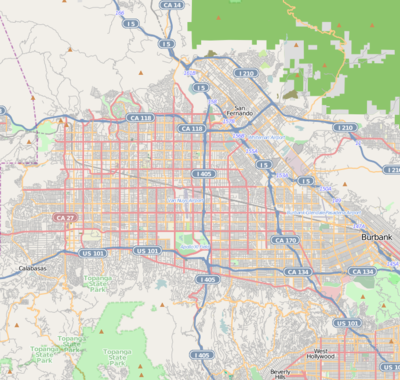


Geomorphology and Climate of the Valley
The San Fernando Valley is a distinct geographical basin within Los Angeles County, California, situated north of the larger Los Angeles Basin. Its geological formation is characterized by alluvial plains, shaped by ancient river systems and tectonic activity, creating a relatively flat topography ideal for extensive development. Bounded by the Santa Susana Mountains to the north and west, the Verdugo Mountains to the east, and the Santa Monica Mountains to the south, the Valley acts as a natural amphitheater.
This topography influences its climate, which is Mediterranean, featuring hot, dry summers and mild, wetter winters. The surrounding mountains can also create a 'heat island' effect, making the Valley warmer than coastal areas. Its substantial area, approximately 260 square miles, supports a dense urban environment and a significant population, making it a crucial component of Southern California's geography.
Historical Trajectory
The San Fernando Valley holds a rich history stretching back millennia, initially inhabited by the Tongva and Chumash peoples. Spanish colonization in the late 18th century led to the establishment of the San Fernando Rey de España Mission, marking the beginning of European influence and large-scale ranching. For much of the 19th century, the Valley remained largely agricultural.
The pivotal moment in its transformation was the 1913 completion of the Los Angeles Aqueduct, which brought much-needed water, enabling massive growth. Post-World War II, the Valley experienced explosive suburban development, becoming a symbol of the American Dream with its tract housing and car-centric lifestyle. This era saw the rise of major industries, most notably the film studios, which found the Valley's open spaces and favorable climate perfect for expansion, solidifying its identity as an entertainment capital.
Demographic Tapestry and Cultural Dynamics
The San Fernando Valley is a demographic mosaic, home to over 1.7 million residents, making it one of the most populous areas in Los Angeles County. Its population is remarkably diverse, reflecting a significant influx of various ethnic and racial groups over the decades, including large Hispanic/Latino, White, Asian, and Black communities. This diversity is not merely statistical; it translates into a rich cultural landscape, evident in the array of cuisines, festivals, and community organizations.
The Valley's cultural identity is also deeply intertwined with its role in the entertainment industry, influencing fashion, music, and popular culture globally. Despite its urban nature, many communities within the Valley retain a distinct suburban feel, fostering a unique blend of urban energy and neighborhood cohesion.
Economic Engine
Economically, the San Fernando Valley is a powerhouse, with its identity intrinsically linked to the global entertainment industry. It hosts major film and television studios, including Warner Bros. Studios and Universal Studios Hollywood, which are not only production centers but also significant tourist attractions and employers.
These studios represent a vast ecosystem of creative and technical jobs, from actors and directors to set designers and post-production specialists. Beyond entertainment, the Valley boasts a diversified economy with significant sectors in healthcare, technology, aerospace, and retail. Its strategic location and infrastructure support a wide range of businesses, contributing substantially to the economic vitality of Los Angeles County and the state of California.
The presence of major educational institutions also fuels innovation and workforce development.
Governance and Civic Structure
The governance of the San Fernando Valley is complex, reflecting its status as a large, urbanized region comprising multiple incorporated cities and unincorporated areas within Los Angeles County. The City of Los Angeles itself governs the largest portion of the Valley, with its residents electing city council members and a mayor who oversee municipal services. Additionally, independent cities like Burbank, Calabasas, Glendale, Hidden Hills, and San Fernando operate under their own city governments, managing local affairs, public safety, and zoning.
Unincorporated areas fall under the direct jurisdiction of the Los Angeles County Board of Supervisors. This multi-layered governance structure means that residents interact with different levels of government for various services, from local parks and police to county-wide initiatives and state representation. The political landscape is dynamic, with local issues often taking center stage in civic discourse.
See also
Based on content from Wikipedia · Licensed under CC BY-SA 4.0