

Rubik's Cube
Images
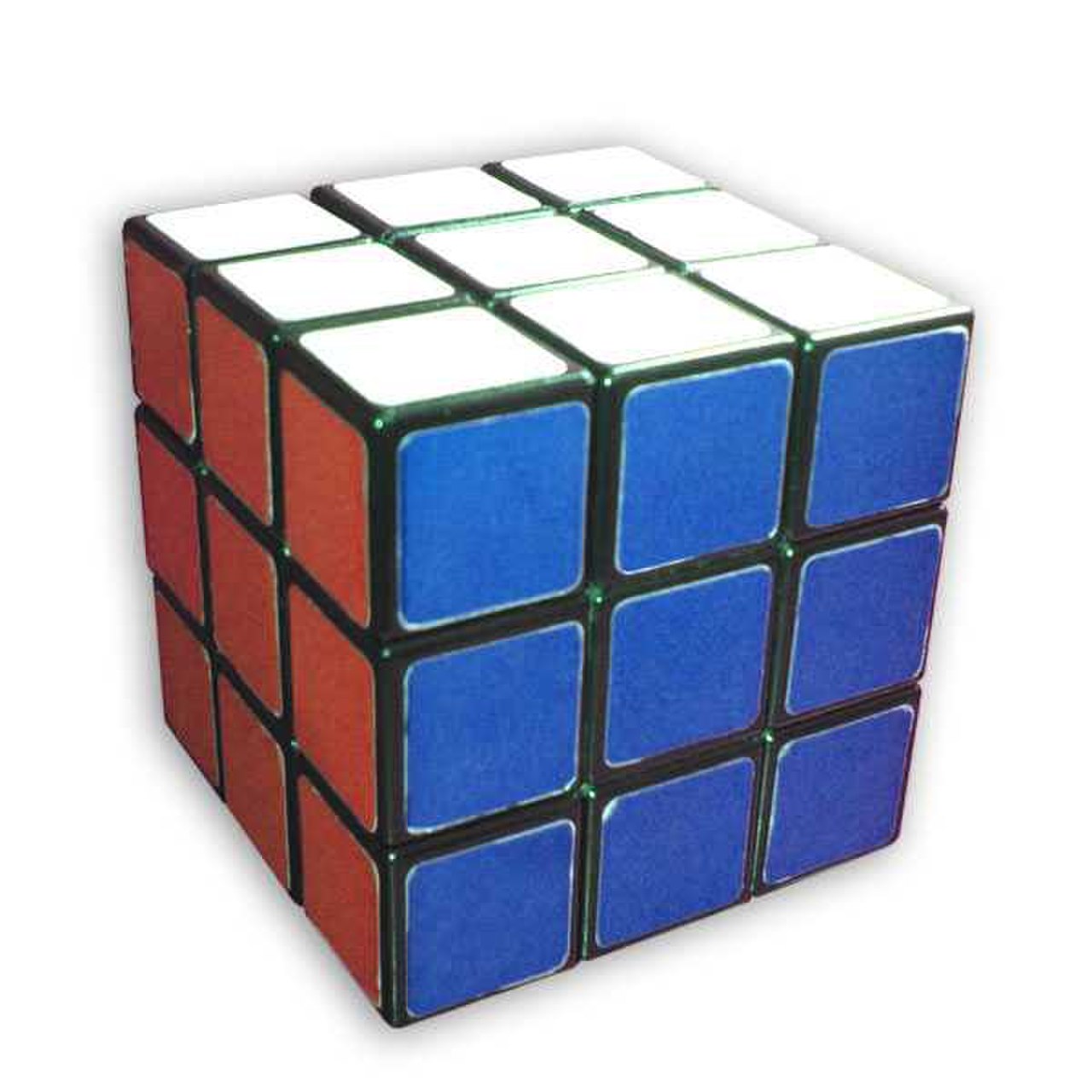
Rubik's Cube
The Genesis of a Geometric Marvel
The Rubik's Cube emerged in 1974 from the mind of Ernő Rubik, a Hungarian architect and professor of interior design. His initial motivation was pedagogical: to create a physical model that could help students grasp abstract concepts of three-dimensional geometry and spatial relationships. He sought to design a structure where individual parts could move independently without the whole object disintegrating.
The result was a cube composed of 26 smaller cubes (or cubelets), with a unique internal mechanism allowing for rotation along three axes. The center pieces are fixed to a core, dictating the color of each face, while the corner and edge pieces are free to permute. Rubik himself famously took over a month to solve his own creation, a testament to its inherent complexity.
Initially marketed in Hungary as the 'Magic Cube' (Bűvös Kocka), its international debut in 1980 under the name Rubik's Cube, facilitated by Ideal Toy Corp., ignited a global craze, selling hundreds of millions of units and becoming one of the most iconic toys ever produced.
Mathematical Underpinnings and Algorithmic Solutions
The Rubik's Cube is a profound object of study in group theory, a branch of abstract algebra. The set of all possible states of the cube forms a mathematical group, where the operations are the rotations of the faces. The total number of permutations for a 3x3x3 cube is 43,252,003,274,489,856,000, often approximated as 43 quintillion.
This astronomical number underscores the challenge of solving the cube randomly. Consequently, efficient solutions rely on algorithms-sequences of moves designed to achieve specific transformations. The concept of 'God's Number' refers to the maximum number of moves required to solve any configuration of the cube, which has been proven to be 20 (in the half-turn metric).
The development of sophisticated algorithms by mathematicians and enthusiasts has led to the rise of speedcubing, where competitors execute these algorithms at incredible speeds, often under five seconds.
Cultural Resonance and Enduring Legacy
The Rubik's Cube transcended its status as a mere puzzle to become a cultural icon of the 1980s and beyond. Its colorful, geometric design became instantly recognizable, appearing in art, film, and fashion. It symbolized intelligence, problem-solving, and the era's fascination with logic and technology.
The cube's impact extends into educational fields, where it's used to teach principles of mathematics, computer science, and engineering. The competitive aspect, formalized through organizations like the World Cube Association (WCA), fosters a global community united by a shared passion. Beyond the standard 3x3x3, the proliferation of larger cubes (4x4x4 to 17x17x17), shape-shifting puzzles (like the Pyraminx and Megaminx), and even electronic versions demonstrates the enduring appeal and adaptability of Rubik's original concept.
The Mechanics of Ingenuity
The genius of the Rubik's Cube lies in its deceptively simple yet robust internal mechanism. The core structure, typically a three-axis 'spider' or similar assembly, allows for smooth rotation of the six center pieces. These centers are fixed relative to each other, defining the cube's orientation.
The 20 movable pieces (8 corners and 12 edges) interlock with the center pieces and with each other, enabling their complex permutations without falling out. This elegant design is what allows for the vast number of possible states. The evolution of the cube has seen numerous variations, including the 2x2x2 'Pocket Cube,' the 'Revenge Cube' (4x4x4), and the 'Professor's Cube' (5x5x5), each introducing new layers of complexity and requiring modified solving strategies.
These variations highlight the modularity and potential for expansion inherent in Rubik's original design, ensuring its continued relevance in the world of puzzles.
See also
Frequently Asked Questions
What is a Rubik's Cube?+
How many different ways can a Rubik's Cube be scrambled?+
Why is solving a Rubik's Cube hard?+
How fast can people solve a Rubik's Cube?+
Where can I see a Rubik's Cube used outside of toys?+
Based on content from Wikipedia · Licensed under CC BY-SA 4.0