

Renfrewshire (historic)
Images

Scottish Enterprise Building
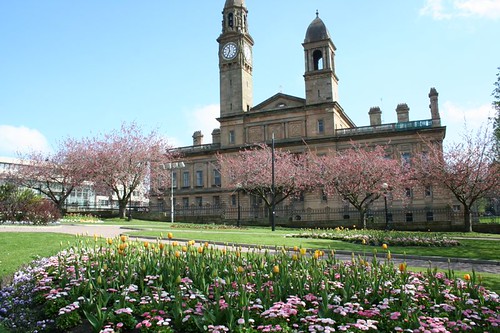


Geographical Nexus
Renfrewshire's historical geography is defined by its strategic location in the west central Lowlands of Scotland. Its northern boundary along the Firth of Clyde was not merely a physical demarcation but a vital artery for trade, communication, and defense, connecting it to the Atlantic and beyond. This maritime access profoundly influenced its development, particularly its later industrial prowess in shipbuilding.
Bordering established regions like Lanarkshire and the burgeoning city of Glasgow to the east, and Ayrshire to the south and west, Renfrewshire occupied a central position within Scotland's most populated and economically active corridor. The landscape itself, characterized by fertile river valleys and undulating terrain, was historically conducive to agriculture but possessed the natural resources and topography that would later support industrial expansion. The region's climate, typical of western Scotland, is maritime, with mild temperatures and significant rainfall, which historically powered watermills and sustained the agricultural base before the advent of steam power.
The presence of rivers like the Gryffe and White Cart were crucial for early settlements and later industrial processes, serving as power sources and transport routes.
From Feudal Grants to Shire Formation
The historical roots of Renfrewshire delve deep into Scotland's medieval past. Its administrative origins can be traced to the feudal lands of Strathgryfe, a territory bestowed upon Walter FitzAlan, the first High Steward of Scotland, in the 12th century. FitzAlan's lineage was instrumental in the foundation of the Scottish monarchy, making his landholdings strategically important.
Over centuries, these lands coalesced and were formally constituted as a 'shire'-an administrative and judicial district-in the early 15th century. Prior to this formalization, the territory was often administered as part of the larger shire of Lanarkshire. The choice of Renfrew, a royal burgh with a long history, as the county town underscored its administrative and symbolic importance.
This process of shire formation was a key element in the centralization of royal power and the development of a more structured system of governance and law enforcement across Scotland, laying the groundwork for Renfrewshire's distinct identity.
The Crucible of Industry
Renfrewshire stands as a prime example of Scotland's dramatic industrialization during the 18th and 19th centuries. Building upon a pre-existing tradition of textile production, the county became a powerhouse in the manufacturing of cottons, calicos, and silks. This weaving heritage, passed down through generations, provided the skilled workforce and established infrastructure for large-scale factory production. The advent of the Industrial Revolution saw the rise of new, dominant industries.
Shipbuilding on the River Clyde became world-renowned, with Renfrewshire's yards contributing significantly to the global fleet. Beyond textiles and shipbuilding, the region developed diverse manufacturing capabilities, including distilleries, printworks, and engineering firms. Paisley emerged as the undisputed economic and demographic heart of the county, evolving into a major urban center with a population and commercial activity that far outstripped other towns.
This industrial boom fundamentally reshaped the landscape, society, and economy of Renfrewshire.
Administrative Evolution
The administrative framework of Renfrewshire has undergone significant transformations, reflecting broader changes in Scottish local government. The establishment of Renfrewshire County Council in 1890 marked a period of centralized local administration, with Paisley serving as its base. However, the relentless expansion of Glasgow presented a continuous challenge to Renfrewshire's boundaries.
As the city grew, it incrementally absorbed adjacent territories, such as Pollokshaws (1912) and Nitshill (1926), integrating them into its urban fabric. This process highlights the dynamic interplay between urban growth and historical administrative divisions. The pivotal reform of 1975 abolished the traditional county structure, replacing it with the larger Strathclyde region and three subordinate district councils.
Further restructuring in 1996 led to the current configuration, where the historic Renfrewshire area is now governed by three distinct modern council areas: Renfrewshire, East Renfrewshire, and Inverclyde. This evolution from a single county council to multiple modern authorities demonstrates a continuous adaptation of governance models to contemporary needs and regional dynamics.
Cultural Threads and Societal Fabric
The cultural identity of Renfrewshire is deeply intertwined with its history of settlement, industry, and community. While the primary language spoken is English, the Scots language and its dialects have historically played a significant role in the region's linguistic landscape, influencing local expressions and traditions. The legacy of the Industrial Revolution profoundly shaped daily life, drawing populations to the burgeoning towns and fostering a strong working-class culture centered around the mills and shipyards.
Paisley, in particular, developed a distinct identity as a major industrial hub. While the source material doesn't detail specific cultural traditions or notable individuals beyond its historical administrative and economic roles, it's evident that Renfrewshire fostered a resilient and industrious population. The weaving heritage, for instance, implies a culture that valued craftsmanship and passed down skills through generations.
The eventual incorporation of parts of Renfrewshire into Glasgow also reflects a cultural assimilation, where distinct local identities gradually merged with the broader urban character of the expanding city.
See also
Frequently Asked Questions
What is Renfrewshire and where is it in Scotland?+
Why was the Firth of Clyde important to Renfrewshire?+
How did Renfrewshire become a shire?+
What industries made Renfrewshire famous during the Industrial Revolution?+
Where was the main town in Renfrewshire and why was it important?+
Based on content from Wikipedia · Licensed under CC BY-SA 4.0