

Ray Lewis
Images

Ray Lewis 2015 (cropped)
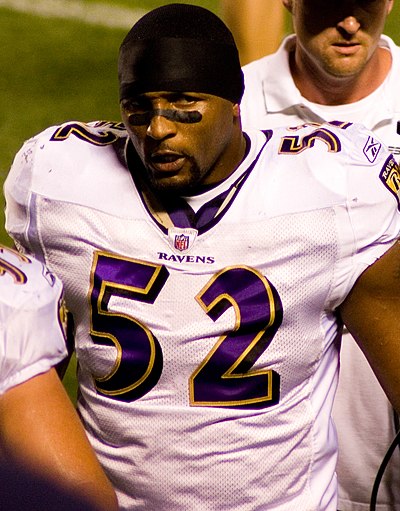


The Genesis of a Defensive Maestro
Raymond Anthony Lewis Jr., born May 15, 1975, emerged as a football prodigy long before gracing the NFL. His collegiate career at the University of Miami was a prelude to his professional greatness, where he garnered All-America honors and established himself as a formidable presence. This collegiate success paved the way for his selection by the Baltimore Ravens in the first round of the 1996 NFL Draft.
From the outset, Lewis was not merely a player but a leader. He immediately assumed a pivotal role on the Ravens' defense, leading the team in tackles as a rookie. This marked the beginning of an unparalleled tenure, as he would go on to lead the Ravens in tackles an astounding 14 times over his 17-year career.
Remarkably, Lewis was the final active player from the Ravens' inaugural season, a testament to his enduring impact and commitment to the franchise. His integration into the team was swift and transformative, setting the stage for a legacy built on defensive prowess and unwavering leadership.
Championship Pedigree
Lewis's career is intrinsically linked to the Baltimore Ravens' most successful periods, highlighted by two Super Bowl victories. His leadership was instrumental in the Ravens' dominant performance in Super Bowl XXXV. In the 2000 season, he anchored a defense that set historic benchmarks, allowing a mere 165 points and 970 rushing yards over a 16-game schedule – records that underscored their suffocating efficiency.
Lewis's individual brilliance in that championship game earned him the Super Bowl MVP award, a distinction that placed him in elite company as only the second linebacker to achieve this feat and the first to do so on a winning Super Bowl team. His final NFL game mirrored this championship success, as he returned from a significant triceps tear to help lead the Ravens to victory in Super Bowl XLVII, providing a storybook ending to an illustrious career. These triumphs were not just wins; they were the culmination of his defensive philosophy and leadership.
Statistical Supremacy and Individual Accolades
Beyond team success, Ray Lewis amassed individual accolades that solidify his place among the NFL's all-time greats. He was honored as the NFL Defensive Player of the Year twice, in 2000 and 2003, a rare achievement that speaks to his sustained dominance. His career statistics are staggering: 2,059 combined tackles and 1,568 solo tackles, both NFL records that highlight his relentless playmaking ability.
Lewis's consistent excellence was further recognized through 13 Pro Bowl selections and 10 First-Team All-Pro selections, underscoring his status as one of the league's premier defensive players for over a decade. His ability to perform at an elite level across three distinct decades (1990s, 2000s, and 2010s) is a testament to his adaptability, physical conditioning, and enduring football IQ, a rarity in professional sports.
The Enduring Legacy of an NFL Icon
Ray Lewis is widely considered the greatest middle linebacker in NFL history, a player whose influence transcended the game. His leadership style, characterized by intense passion and motivational prowess, inspired teammates and galvanized fan bases. His iconic pre-game rituals, including the famous 'squirrel dance,' became synonymous with his electrifying presence.
The pinnacle of his recognition came on February 3, 2018, when he was inducted into the Pro Football Hall of Fame in his first year of eligibility, a testament to his profound impact. Lewis is not only celebrated as the greatest Baltimore Raven of all time but also as one of the most dominant defensive players the NFL has ever witnessed. His legacy is a powerful narrative of dedication, resilience, and unparalleled athletic achievement that continues to inspire future generations of athletes.
See also
Frequently Asked Questions
Who is Ray Lewis?+
Why did Ray Lewis win the Super Bowl MVP?+
How many times did Ray Lewis lead the Ravens in tackles?+
What is the squirrel dance?+
Did Ray Lewis win any championships?+
Based on content from Wikipedia · Licensed under CC BY-SA 4.0