

Quantum Field Theory: The Secret Language of the Universe!
Images

Quantum field theory


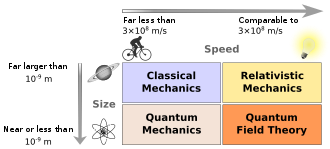


The Foundational Framework of Modern Physics
Quantum Field Theory (QFT) represents the pinnacle of our current understanding of the fundamental constituents of the universe and their interactions. It is not merely a theory of particles but a theory of fields that permeate all of spacetime. In QFT, particles are not fundamental entities in themselves but rather localized excitations or quanta of these underlying fields.
For instance, an electron is an excitation of the electron field, a photon is an excitation of the electromagnetic field, and so on. This perspective elegantly resolves paradoxes that arise when trying to reconcile quantum mechanics with Einstein's special relativity, particularly concerning particle creation and annihilation, which are commonplace in high-energy interactions. QFT provides a consistent mathematical language to describe phenomena from the smallest subatomic scales to the vastness of the cosmos, forming the bedrock of the Standard Model of particle physics.
A Tapestry Woven from Quantum Threads and Relativistic Insights
The genesis of QFT is a story of intellectual perseverance spanning several decades. Early quantum mechanics, developed in the early 20th century by pioneers like Planck, Bohr, and Heisenberg, described the probabilistic nature of microscopic systems but struggled with relativistic speeds. Einstein's theory of special relativity, meanwhile, revolutionized our understanding of space, time, and energy but was initially separate from quantum principles.
The crucial step was realizing that relativistic quantum mechanics required a framework where particles could be created and destroyed, a concept naturally accommodated by fields. Dirac's relativistic equation for the electron in the late 1920s was a significant precursor. The subsequent development of Quantum Electrodynamics (QED) in the 1940s and 1950s by Feynman, Schwinger, and Tomonaga, which precisely describes the interaction of light and matter, marked a major triumph.
This success paved the way for the development of Quantum Chromodynamics (QCD) and the electroweak theory, culminating in the comprehensive Standard Model.
The Engine of Discovery and Technological Advancement
The profound implications of QFT extend far beyond theoretical physics, serving as the indispensable engine for both fundamental discovery and technological innovation. The Standard Model, a direct application of QFT, has been extraordinarily successful in predicting the existence and properties of elementary particles, validated by decades of experiments at particle accelerators like the Large Hadron Collider (LHC). The discovery of the Higgs boson in 2012, a key prediction of the Standard Model, was a monumental confirmation of QFT.
On the technological front, QFT is foundational to technologies such as lasers, transistors, and magnetic resonance imaging (MRI). Understanding particle interactions at a quantum field level allows for the precise design of materials and devices that underpin modern electronics, telecommunications, and medical diagnostics. Furthermore, QFT provides the conceptual tools for exploring frontiers like quantum computing and the search for a unified theory of everything.
Fields as the Primordial Substance
At its heart, QFT posits that the universe is fundamentally composed of fields, not particles. These fields are not static entities but dynamic systems that can possess energy and momentum. Interactions between particles are understood as interactions between their corresponding fields.
For example, an electron interacting with a photon is described as the electron field interacting with the electromagnetic field, resulting in the emission or absorption of a photon. The mathematical formalism of QFT, often involving Feynman diagrams, visually represents these complex interactions as exchanges of virtual particles, which are temporary fluctuations in fields. This field-centric view allows for a consistent description of phenomena such as particle decay, scattering, and the generation of forces, providing a unified and powerful lens through which to view the fundamental workings of the cosmos.
Go deeper
Frequently Asked Questions
What is Quantum Field Theory?+
How do particles like electrons come from fields?+
Why does QFT help us make things like lasers?+
What is the Higgs boson and why was it important?+
How did scientists discover that particles can be created and destroyed?+
Based on content from Wikipedia · Licensed under CC BY-SA 4.0